
Pulp Fiction, 1949 · page 76 of 132
A. Merritt's Fantasy Magazine, December 1949 — page 76: what you’re looking at
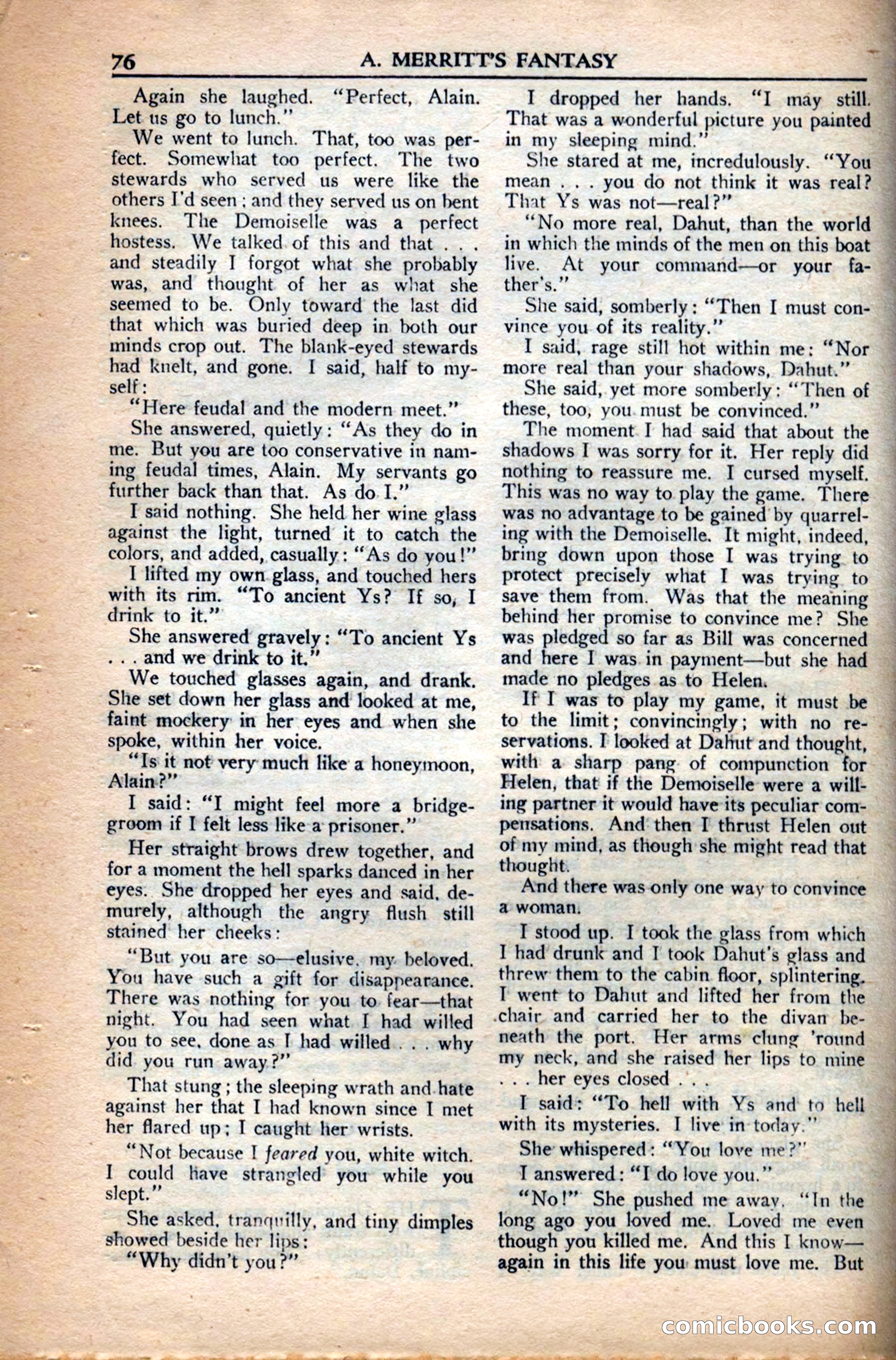
A restored page from Pulp Fiction, 1949. Page through the whole issue in the reader above.
📄 Transcribed text from this page (OCR, searchable)
Machine-transcribed from the original scan — historical spelling and the odd misread are preserved.
16 A. MERRITT’S FANTASY Again she laughed. “Perfect, Alain. Let us go to lunch.” We went to lunch. That, too was per- fect. Somewhat too perfect. The two stewards who served us were like the others I'd seen ; and they served us on bent knees. The Demoiselle was a_ perfect hostess. We talked. of this and that .. . and steadily I forgot what she probably was, and thought of her as what she seemed to be. Only toward the last did that which was buried deep in. both our minds crop out. The blank-eyed stewards had knelt, and gone. I said, half to my- self : “Here feudal and the modern meet.” She answered, quietly: “As they do in me. But you are too conservative in nam- ing feudal times, Alain. My servants go further back than that. As do. I.” I said nothing. She held her wine glass against the light, turned it to catch the colors, and added, casually: “As do you!” I lifted my own. glass, and touched hers with its rim. “To ancient Ys? If so, I drink to it.” She answered gravely: “To ancient Ys ... and we drink to it.” We touched glasses again, and drank. She set down her glass and looked at me, faint mockery in her eyes and when she spoke, within her voice. “Is it not very much like a honeymoon, Alain?” I said: “I might feel more a bridge- groom if I felt less like a prisoner.” Her straight brows drew together, and for a moment the hell sparks danced in her eyes. She dropped her eyes and said, de- murely, although the angry flush still stained her cheeks: “But you are so—elusive. my. beloved. You have such a gift for disappearance. There was nothing for you to. fear—that night. You had seen what I had willed you to see, done as [| had willed... . why did you run away.?” That stung ; the sleeping wrath and-hate against her that I had known since I met her flared up; I caught her: wrists. “Not because I feared you, white witch. I could have strangled’ you while you slept.” She asked, tranquilly, and tiny dimples showed beside her lips: “Why didn’t you?” I dropped her hands. “I may. still. q That was a wonderful picture you painted — in my sleeping mind.” She stared at me, incredulously. “You 4 ... you do not think it was real? — mean That Ys was not—real ?” ‘No more real, Dahut, than the world — in which the minds of the men on this boat — At your command—or your fa-— live, ther’s.’”’ She said, somberly; ‘Then I must con- — vince you of its reality.” I said, rage still hot within me; “Nor more real than your shadows, Dahut.” She said, yet more somberly; “Then of these, too; you. must be convinced.” The moment. I had said that about the shadows I was sorry for it. Her reply did nothing to reassure me. I cursed myself, This was no way to play the game. There was no advantage to be gained by quarrel- ing with the Demoiselle. It might, indeed, bring down upon those I was trying to protect precisely what I was trying to save them from. Was that the meaning behind her promise to convince me? She was pledged so far as Bill was concerned and here I was.in payment—but she had made no pledges as to Helen, If IT was to play my game, it must be — to the limit; convincingly; with no re- — servations. I looked at Dalut and thought, with a sharp pang of compunction for — Helen, that if the Demoiselle were a will- ing partner it would have‘its peculiar com-— pensations. And’ then T thrust Helen out of my mind, as though she might read that thought. And there was-only one way to convince a woman. I stood up. I took the glass from which 1 had drunk and TI took Dahut's glass and threw them to the cabin floor, splintering. IT went to Dahut and lifted her from the chair and carried her to the divan be- neath the port. Her arms clung ‘round — my neck, and she raised her lips to mine — ... her eyes closed .’. . I said: “To hell with Ys and to hell with its mysteries. I live in today.”’ She whispered: “You love me?” T answered: “TI do love you.” “No!” She pushed me away, “In the ~ long ago you loved me. Loved me even — though you killed me. And this I know— _ again in this life you must love me. But — dies £ Pd ele Pyare a x ood a ee eee eg Sl Le pvt ew iP oar. 4 as igh