
Pulp Fiction, 1949 · page 85 of 132
A. Merritt's Fantasy Magazine, December 1949 — page 85: what you’re looking at
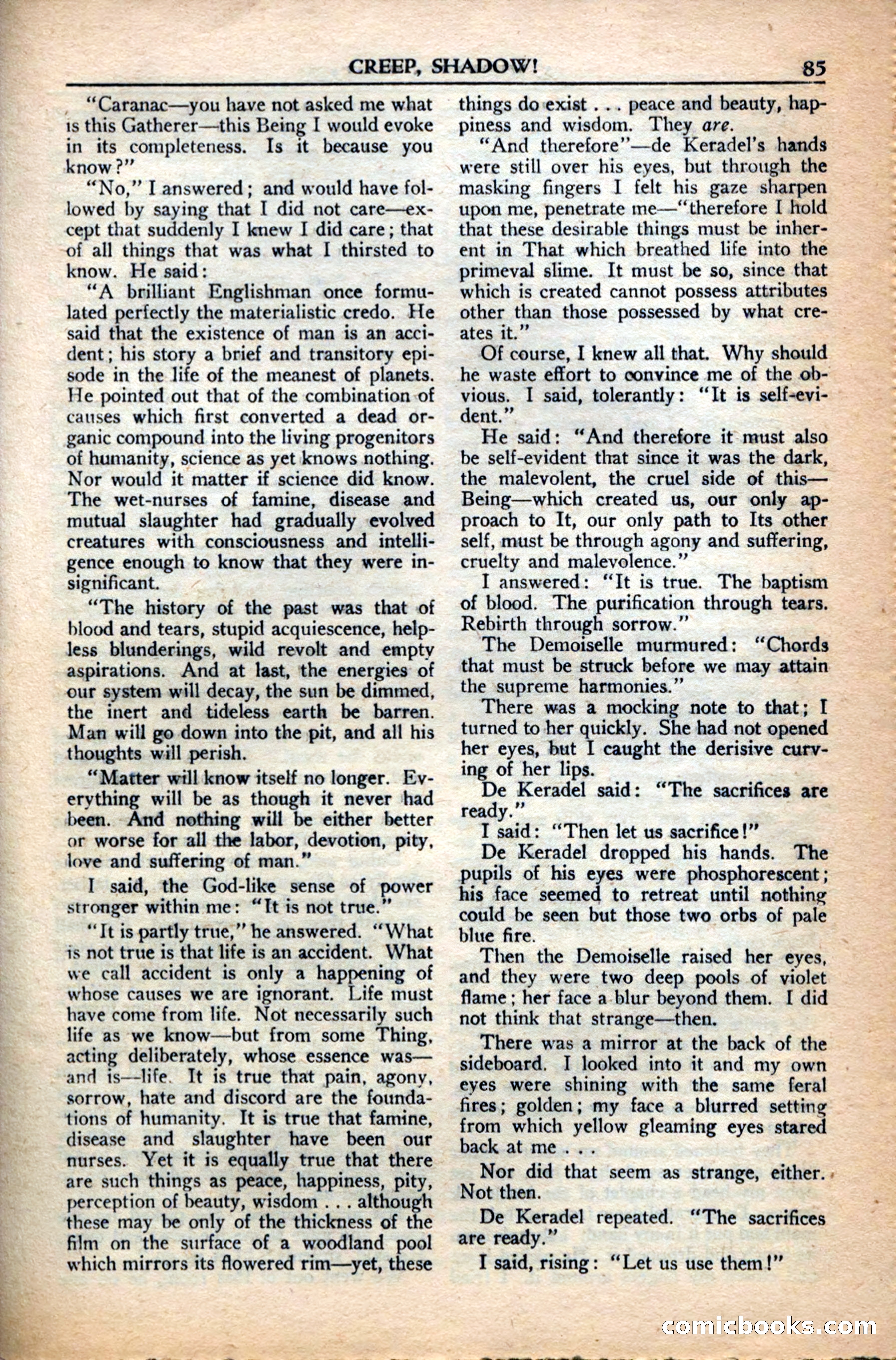
A restored page from Pulp Fiction, 1949. Page through the whole issue in the reader above.
📄 Transcribed text from this page (OCR, searchable)
Machine-transcribed from the original scan — historical spelling and the odd misread are preserved.
CREEP, SHADOW! 85 _ “Caranac—you have not asked me what is this Gatherer—this Being I would evoke in its completeness. Is it because you know ?” “No,” I answered; and would have fol- lowed by saying that I did not care—ex- cept that suddenly I knew I did care; that of all things that was what I thirsted to know. He said: “A brilliant Englishman once formu- lated perfectly the materialistic credo. He said that the existence of man is an acci- dent; his story a brief and transitory epi- sode in the life of the meanest of planets. He pointed out that of the combination of causes which first converted a dead or- ganic compound into the living progenitors of humanity, science as yet knows nothing. Nor would it matter if science did know. The wet-nurses of famine, disease and mutual slaughter had gradually evolved creatures with consciousness and intelli- gence enough to know that they were in- significant. “The history of the past was that of blood and tears, stupid acquiescence, help- less blunderings, wild revolt and empty aspirations. And at last, the energies of our system will decay, the sun be dimmed, the inert and tideless earth be barren. Man will go down into the pit, and all his thoughts will perish. “Matter will know itself no longer. Ev- erything will be as though it never had been. And nothing will be either better or worse for all the labor, devotion, pity, love and suffering of man.” I said, the God-like sense of power stronger within me: “It is not true.” “Tt is partly true,”’ he answered. “What is not true is that life is an accident. What we call accident is only a happening of whose causes we are ignorant. Life must have come from life. Not necessarily such life as we know—but from some Thing, acting deliberately, whose essence was— and is—-life. It is true that pain, agony, sorrow, hate and discord are the founda- tions of humanity. It is true that famine, disease and slaughter have been our nurses. Yet it is equally true that there are such things as peace, happiness, pity, perception of beauty, wisdom . . . althou these may be only of the thickness of the film on the surface of a woodland pool which mirrors its flowered rim—yet, these things dovexist . .. peace and beauty, hap- piness and wisdom. They are. “And therefore’—de Keradel’s hands were still over his eyes, but through the masking fingers I felt his gaze sharpen — upon me, penetrate me—“therefore I hold that these desirable things must be inher- ent in That which breathed life into the primeval slime. It must be so, since that which is created cannot possess attributes other than those possessed by what cre- ates it.” Of course, I knew all that. Why should he waste effort to convince me of the ob- vious. I said, tolerantly: “It is self-evi- dent.” He said: “And therefore it must also be self-evident that since it was the dark, the malevolent, the cruel side of this— Being—which created us, our only ap- proach to It, our only path to Its other self, must be through agony and suffering, cruelty and malevolence.” I answered: “It is true. The baptism of blood. The purification through tears. Rebirth through sorrow.”’ The Demoiselle murmured: ‘Chords that must be struck before we may attain the supreme harmonies.”’ There was a mocking note to that; I — turned to her quickly. She had not opened her eyes, but I caught the derisive curv- ing of her lips. De Keradel said: ready.” T said: “Then let us sacrifice!” De Keradel dropped his hands. The pupils of his eyes were phosphorescent ; his face sshined to retreat until nothing could be seen but those two orbs of pale blue fire. | Then the Demoiselle raised her eyes, and they were two deep pools of violet flame ; her face a blur beyond them. I did not think that strange—then. There was a mirror at the back of the sideboard. I looked into it and my own eyes were shining with the same feral fires; golden; my face a blurred setting from which yellow gleaming eyes stared back at me... “The sacrifices are Nor did that seem as strange, either. Not then. De Keradel repeated. “The sacrifices are ready.” . I said, rising: “Let us use them!” im OMIGhbooks: co eee, tee tee ae —— See —s > —_, . oe Ae