
Pulp Fiction, 1949 · page 99 of 132
A. Merritt's Fantasy Magazine, December 1949 — page 99: what you’re looking at
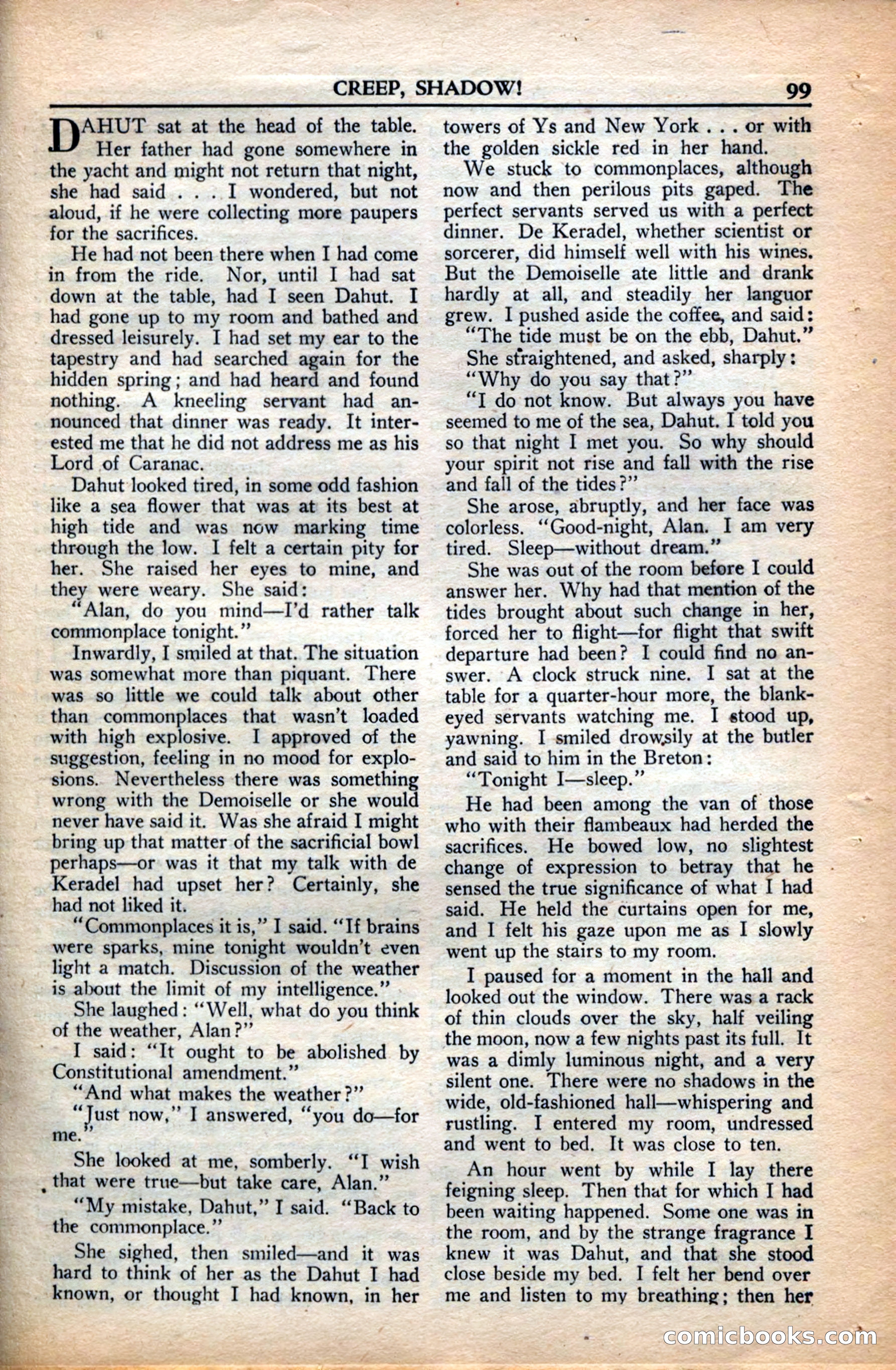
A restored page from Pulp Fiction, 1949. Page through the whole issue in the reader above.
📄 Transcribed text from this page (OCR, searchable)
Machine-transcribed from the original scan — historical spelling and the odd misread are preserved.
ge #0 ‘ > rf ce) AB ser ts ¥ / “ CREEP, SHADOW! 99 AHUT sat at the head of the table. Her father had gone somewhere in the yacht and might not return that night, she had said . . . I wondered, but not aloud, if he were collecting more paupers for the sacrifices. He had not been there when I had come in from the ride. Nor, until I had sat down at the table, had I seen Dahut. I had gone up to my room and bathed and dressed leisurely. I had set my ear to the tapestry and had searched again for the hidden spring; and had heard and found nothing. A kneeling servant had an- nounced that dinner was ready. It inter- ested me that he did not address me as his Lord of Caranac. Dahut looked tired, in some odd fashion like a sea flower that was at its best at high tide and was now marking time through the low. I felt a certain pity for her. She raised her eyes to mine, and they were weary. She said: “Alan, do you mind—lI’d rather talk commonplace tonight.” Inwardly, I smiled at that. The situation was somewhat more than piquant. There was so little we could talk about other than commonplaces that wasn’t loaded with high explosive. I approved of the suggestion, feeling in no mood for explo- sions.. Nevertheless there was something wrong with the Demoiselle or she would never have said it. Was she afraid I might bring up that matter of the sacrificial bowl perhaps—or was it that my talk with de Keradel had upset her? Certainly, she had not liked it. | “Commonplaces it is,” I said. “If brains were sparks, mine tonight wouldn’t even light a match. Discussion of the weather is about the limit of my intelligence.” She laughed: “Well, what do you think of the weather, Alan?” : I said: “It ought to be abolished by Constitutional amendment.” “And what makes the weather ?” “Just now,’ I answered, “you do—for me. She looked at me, somberly. “I wish , that were true—but take care, Alan.” “My mistake, Dahut,” I said. “Back to the commonplace.”’ She sighed, then smiled—and it was hard to think of her as the Dahut I had _. known, or thought I had known, in her s ——s | 2 eEeEEE————E—————=——x“ <-— towers of Ys and New York... or with the golden sickle red in her hand. We stuck to commonplaces, although now and then perilous pits gaped. The perfect servants served us with a perfect dinner. De Keradel, whether scientist or sorcerer, did himself well with his wines, But the Demoiselle ate little and drank hardly at all, and steadily her languor grew. I pushed aside the coffee, and said: “The tide must be on the ebb, Dahut.” She straightened, and asked, sharply: “Why do you say that?” “T do not know. But always you have seemed to me of the sea, Dahut. I told you so that night I met you. So why should your spirit not rise and fall with the rise and fall of the tides ?”’ She arose, abruptly, and her face was colorless. “‘Good-night, Alan. I am very tired. Sleep—without dream.” She was out of the room before I could answer her. Why had that mention of the tides brought about such change in her, forced her to flight—for flight that swift departure had been? I could find no an- swer. A clock struck nine. I sat at the table for a quarter-hour more, the blank- eyed servants watching me. I stood up, yawning. I smiled drowsily at the butler and said to him in the Breton: “Tonight I—sleep.”’ He had been among the van of those who with their flambeaux had herded the sacrifices. He bowed low, no slightest change of expression to betray that he . sensed the true significance of what I had said. He held the curtains open for me, and I felt his gaze upon me as I slowly went up the stairs to my room. I paused for a moment in the hall and looked out the window. There was a rack of thin clouds over the sky, half veiling the moon, now a few nights past its full. It was a dimly luminous night, and a very silent one. There were no shadows in the wide, old-fashioned hall—whispering and rustling. I entered my room, undressed and went to bed. It was close to ten. An hour went by while I lay there feigning sleep. Then that for which I had been waiting happened. Some one was in the room, and by the strange fragrance I knew it was Dahut, and that she stood close beside my bed. I felt her bend over me and listen to my breathing; then her comicbooks com ——— a “. —— 3 — © 4 a - “ > ot