
Pulp Fiction, 1950 · page 91 of 134
A. Merritt's Fantasy Magazine, February 1950 — page 91: what you’re looking at
A restored page from Pulp Fiction, 1950. Page through the whole issue in the reader above.
📄 Transcribed text from this page (OCR, searchable)
Machine-transcribed from the original scan — historical spelling and the odd misread are preserved.
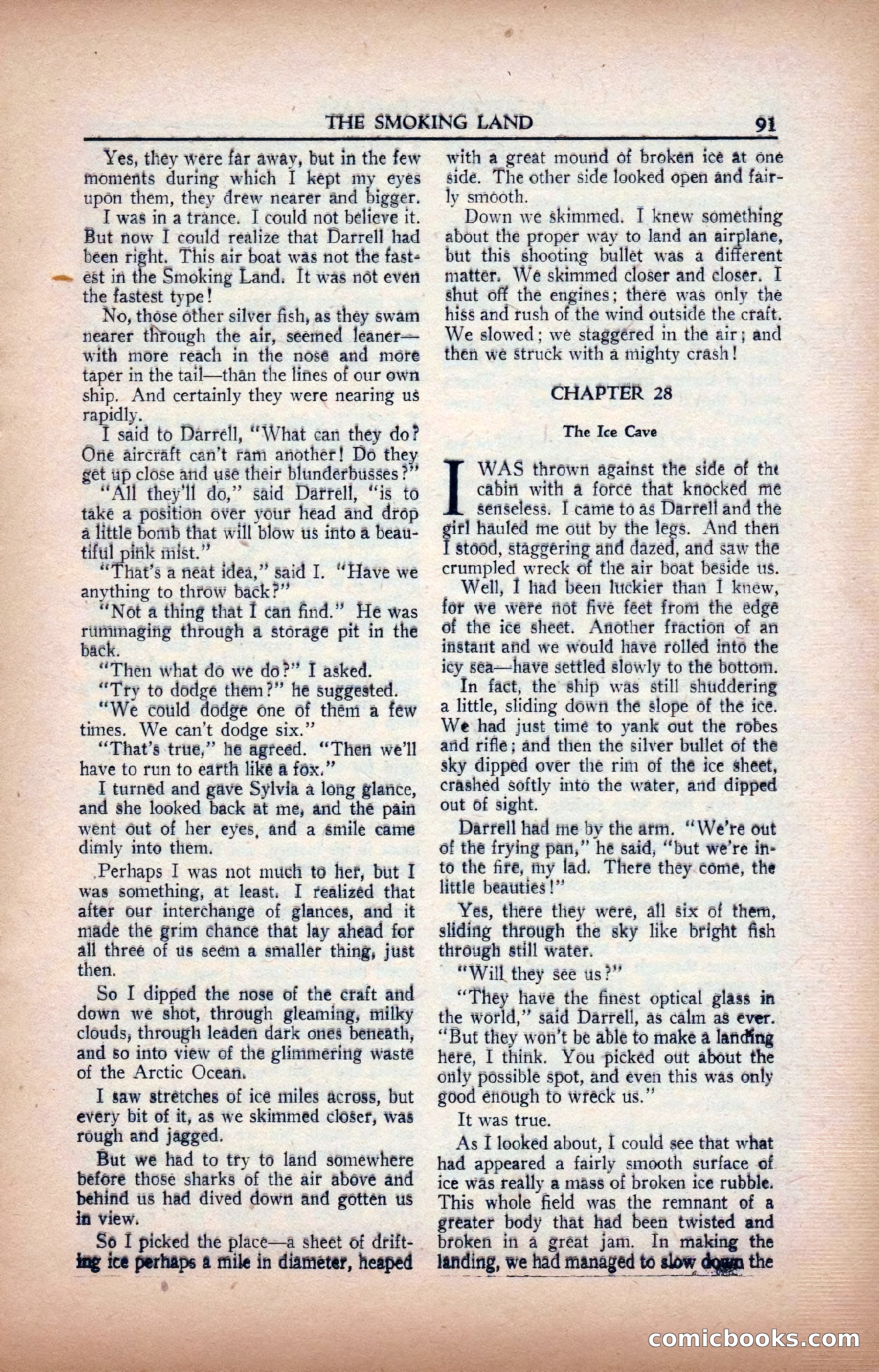
THE SMOKING LAND _ 94 Yes, they were far away, but in the few moments during which I kept my eyes upon them, they drew nearer and bigger. I was in a trance. I could not believe it. But now I could realize that Darrell had been right. This air boat was not the fast- est in the Smoking Land. It was nét even the fastest type! No, those other silver fish, as they swam nearer through the air, seerned leaner— with more reach in the nose and more taper in the tail—than the lines of our own ship. And certainly they were nearing us rapidly. : I said to Darrell, “What can they do? One aircraft can’t ram another! Do they get up close atid use their blinderbusses ?” “All they'll do,” said Darrell, “is to take a position over your head and drop a little bomb that will blow ws into a beau- tiftil pink mist.” “That’s a neat idea,” said I. “Have we anything to throw back?” — “Not a thing that I can find.” He was oi lat thtough a storage pit in the back. “Then what do we do?” I asked. “Try to dodge them?” he suggested. “We could dodge one of them a few times. We can’t dodge six.” _ “That’s trie,” he agreed. “Then we'll have to run to earth liké a f6x.”’ I turned and gave Sylvia a lofig glatice, and she looked back at me, ard thé pain went Out of her eyes, and a émile came dimly into them. Perhaps I was not much to lef, but I was something, at least. I realizéd that after our interchange of glances, and it made the grim chance that lay ahead for all threé of us seém a smaller thing, just then, So I dipped the nose of the craft and down we shot, through gleaming, milky clouds, through leaden dark ones befieath, and s0 into view of the glimmering waste of the Arctic Oceati, I saw strétches of ice miles across, but every bit of it, as we skimmed cloSef, was rough and jagged. But we had to tty to land somewhere before those sharks of the air above and behind us had dived dowri and gotten us in view. So I picked the place—a sheet of drift- ing ice perhaps 4 mile in diameter, heaped ‘ : * with a great mound of broken icé at one side. The other side looked open and fair- ly smooth. : Down we skimmed, I knew something about the proper way to land an airplane, but this shooting bullet was a different mattér. We skimmed closer and closer. I shut off the engines; there was only the hiss and tush of the wind outside the craft. We slowed; we staggéred in the air; and then we struck with a mighty crash! CHAPTER 28 The Ice Cave WAS thrown against the side of the cabin with a force that knocked me senseless. | came to as Dartell and the a hauled me otit by the legs. And then stood, staggering afd dazed, and saw the crumpled wreck of thé air boat beside us. Well, I had been luckier than I knew, for we wefe fiot five feet from the edge of the ice sheet. Another fraction of an instant and we would have rolled into the icy sea—have settled slowly to the bottom. In fact, the ship was still shuddering a little, sliding down thé slope of the ice. We had just time to yank out the robes afid rifle; and then the silver bullet of the sky dipped over the rim of thé ice sheet, crashed softly into the water, and dipped out of sight. Darfell had me by the atm. “We're out of the frying pan,” he said, “but we’re in- to the fite, my lad. There they come, the little beauties!” Yes, there they were, all six of them, sliding through the sky like bright fish through still water. ~ “Will they see us?” “They have the finest optical glass in the world,” said Darrell, as calm as ever. “But they won’t be able to make a lafiding here, I think. You pickéd otit about the only possible spot, and even this was only good efough to wreck us.” It was true. As I looked about, I could see that what had appeared a fairly smooth surface of ice was really a mass of broken ice rubble. This whole field was the remnant of a gfeater body that had been twisted and broken in a great jam. In making the landing, we had managed to slow dqgin the