
Pulp Fiction, 1950 · page 110 of 133
A. Merritt's Fantasy Magazine, February 1950 — page 110: what you’re looking at
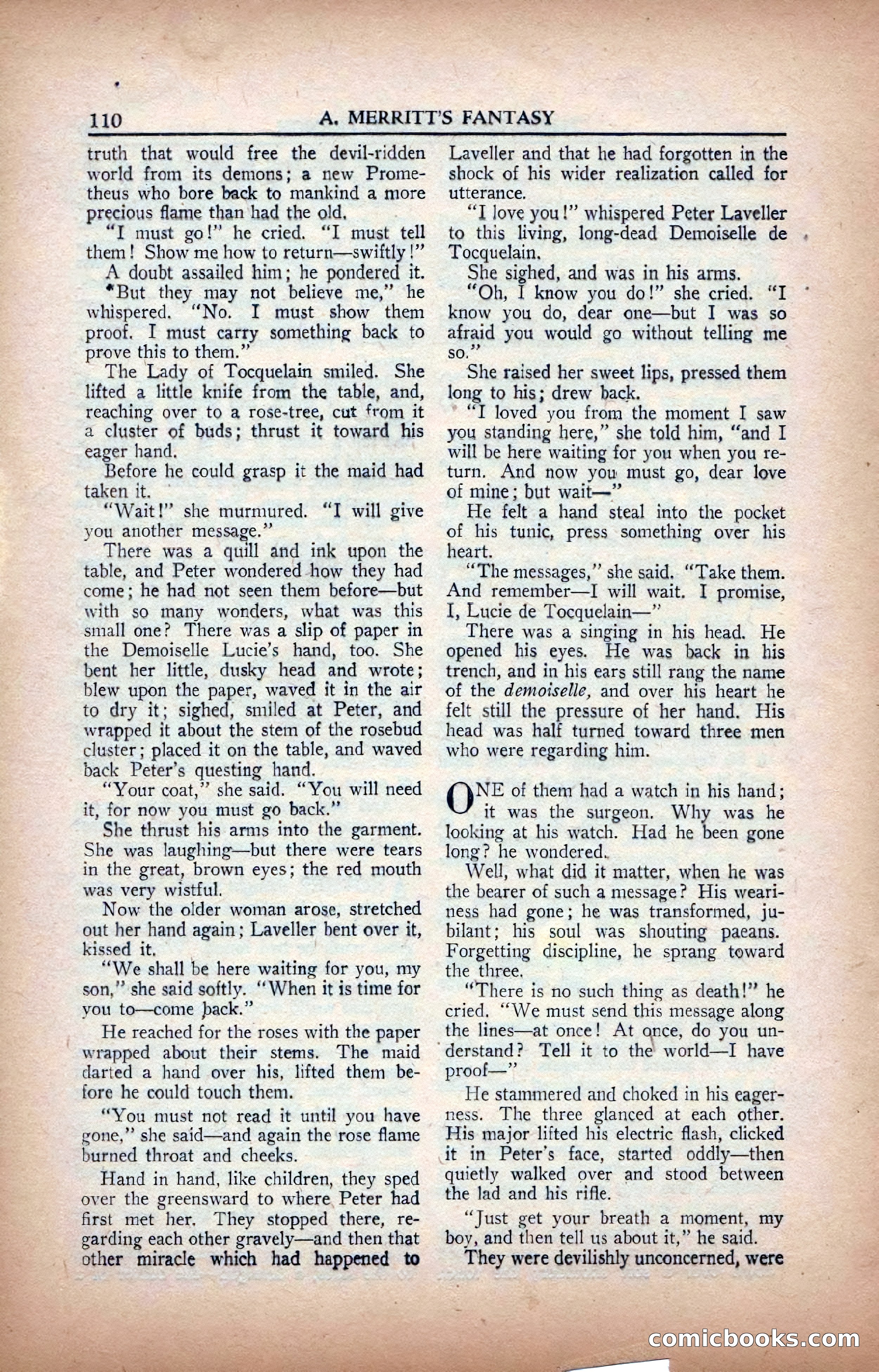
A restored page from Pulp Fiction, 1950. Page through the whole issue in the reader above.
📄 Transcribed text from this page (OCR, searchable)
Machine-transcribed from the original scan — historical spelling and the odd misread are preserved.
110 A. MERRITT’S FANTASY truth that would free the devil-ridden world from its demons; a new Prome- theus who bore back to mankind a more precious flame than had the old, “YT must go!” he cried. “I must tell them! Show me how to return—swiftly |” A doubt assailed him; he pondered it. “But they may not believe me,” he whispered. “No. I must show them proof. I must carry something back to prove this to them.” The Lady of Tocquelain smiled. She lifted a little knife from the table, and, reaching over to a rose-tree, cut from it a cluster of buds; thrust it toward his eager hand. Before he could grasp it the maid had taken it, — “Wait!” she murmured. “I will give you another message.” There was a quill and ink upon the table, and Peter wondered how they had come; he had not seen them before—but with so many wonders, what was this small one? There was a slip of paper in the Demoiselle Lucie’s hand, too. She bent her little, dusky head and wrote; blew upon the paper, waved it in the air to dry it; sighed, smiled at Peter, and wrapped it about the stem of the rosebud cluster; placed it on the table, and waved back Peter’s questing hand. “Your coat,’ she said. “You will need it, for now you must go back.” She thrust his arms into the garment. She was laughing—but there were tears in the great, brown eyes; the red mouth was very wistful. Now the older woman arose, stretched out her hand again; Laveller bent over it, kissed it, “We shall be here waiting for you, my son,” she said softly. ‘When it is time for you to—come pack.” He reached for the roses with the paper wrapped about their stems. The maid darted a hand over his, lifted them be- fore he could touch them. “You must not read it until you have gone,” she said—and again the rose flame burned throat and cheeks. Hand in hand, like children, they sped over the greensward to where Peter had first met her, They stopped there, re- garding each other gravely—and then that _. other miracle which had happened to Laveller and that he had forgotten in the shock of his wider realization called for utterance, “T love you!” whispered Peter Laveller to this living, long-dead Demoiselle de Tocquelain, She sighed, and was in his arms. “Oh, I know you do!” she cried. “I know you do, dear one—but I was so afraid you would go without telling me 50." She raised her sweet lips, pressed them long to his; drew back. * “T loved you from the moment I saw you standing here,” she told him, “and I will be here waiting for you when you re- turn. And now you must go, dear love of mine; but wait—” He felt a hand steal into the pocket of his tunic, press something over his heart. ‘The messages,” she said, “Take them. And remember—I will wait. I promise, I, Lucie de Tocquelain—”’ There was a singing in his head. He opened his eyes. He was back in his trench, and in his ears still rang the name of the demotselle, and over his heart he felt still the pressure of her hand. His head was half turned toward three men who were regarding him. NE of them had a watch in his hand; it was the surgeon. Why was he looking at his watch. Had he been gone long? he wondered. Well, what did it matter, when he was the bearer of such a message? His weari- ness had gone; he was transformed, ju- bilant; his soul was shouting paeans. Forgetting discipline, he sprang toward the three, ~ “There is no such thing as death!” he cried. ‘“We must send this message along the lines—at once! At ance, do you un- ‘derstand? Tell it to the world—I have proof—” He stammered and choked in his eager- ness. The three glanced at each other. His major lifted his electric flash, clicked it in Peter’s face, started oddly—then quietly walked over and stood between the lad and his rifle. “Just get your breath a moment, my boy, and then tell us about it,” he said. They were devilishly unconcerned, were