
Pulp Fiction, 1950 · page 113 of 133
A. Merritt's Fantasy Magazine, February 1950 — page 113: what you’re looking at
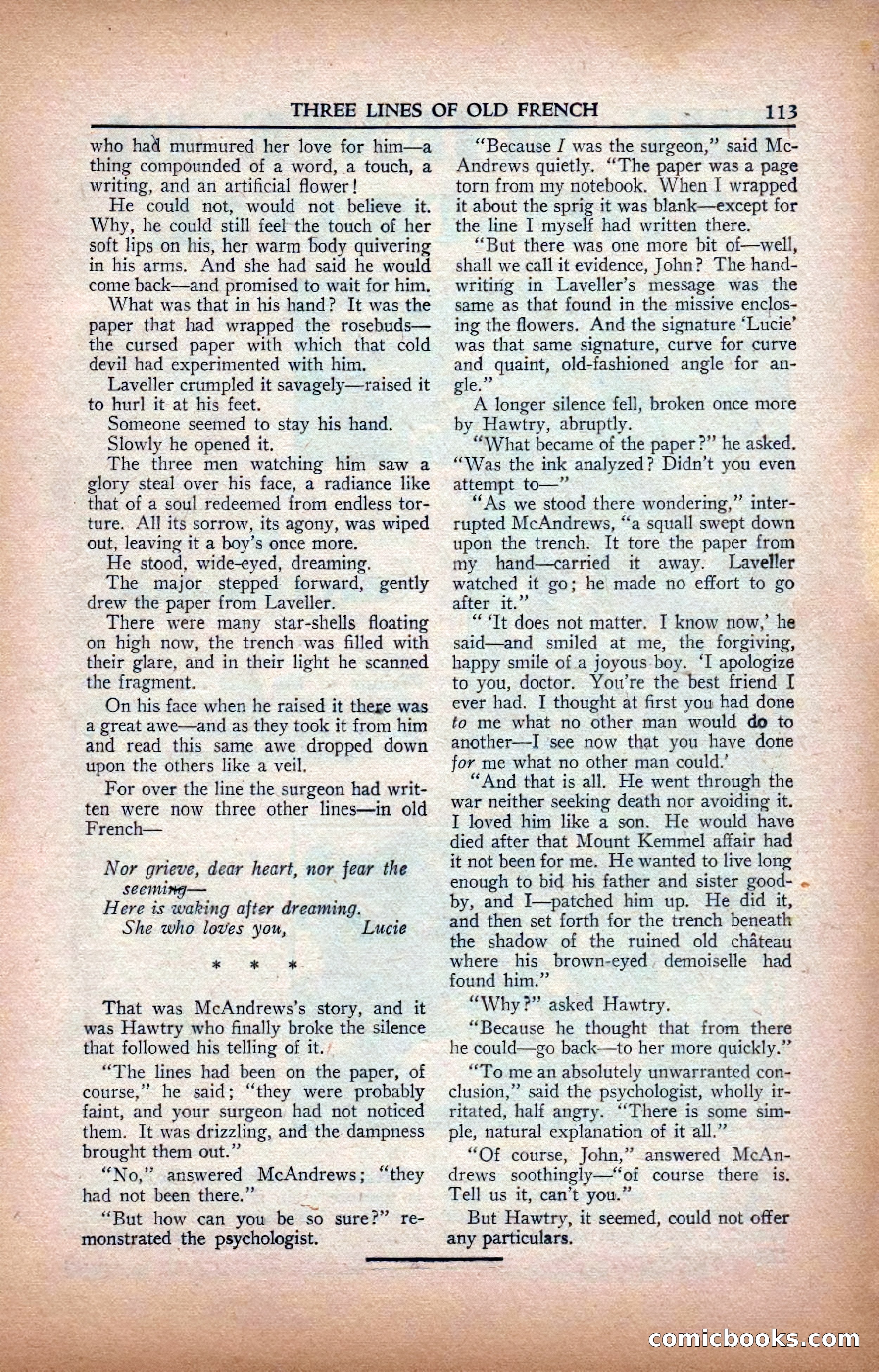
A restored page from Pulp Fiction, 1950. Page through the whole issue in the reader above.
📄 Transcribed text from this page (OCR, searchable)
Machine-transcribed from the original scan — historical spelling and the odd misread are preserved.
THREE LINES OF OLD FRENCH : 113 who had murmured her love for him—a thing compounded of a word, a touch, a writing, and an artificial flower! He could not, would not believe it. Why, he could still feet the touch of her soft lips on his, her warm body quivering in his arms. And she had said he would come back—and promised to wait for him. What was that in his hand? It was the paper that had wrapped the rosebuds— the cursed paper with which that cold devil had experimented with him. Laveller crumpled it savagely—raised it to hurl it at his feet. Someone seemed to stay his hand. Slowly he opened it. The three men watching him saw a glory steal over his face, a radiance like - that of a soul redeemed from endless tor- ture. All its sorrow, its agony, was wiped out, leaving it a boy’s once more. He stood, wide-eyed, dreaming. The major stepped forward, gently drew the paper from Laveller. There were many star-shells floating on high now, the trench was filled with their glare, and in their light he scanned the fragment. On his face when he raised it there was a great awe—and as they took it from him and read this same awe dropped down upon the others like a veil, For over the line the surgeon had writ- ten were now three other lines—in old French— Nor grieve, dear heart, nor fear the seeming— Here is waking after dreaming. She who loves you, Lucie * * > - That was McAndrews’s story, and it was Hawtry who finally broke the silence that followed his telling of it.’ “The lines had been on the paper, of course,” he said; “they were probably faint, and your surgeon had not noticed them. It was drizzling, and the dampness brought them out.” “No,” answered McAndrews; “they had not been there.” F “But how can you be so sure?” re- monstrated the psychologist. “Because I was the surgeon,” said Mc- Andrews quietly, “The paper was a page torn from my notebook. When | wrapped it about the sprig it was blank—except for the line I myself had written there. © “But there was one more bit of—vwell, shall we call it evidence, John? The hand- writing in Laveller’s message was the same as that found in the missive enclos- ing the flowers. And the signature ‘Lucie’ was that same signature, curve for curve and quaint, old-fashioned angle for an- le.” A longer silence fell, broken once more by Hawtry, abruptly. “What became of the paper?” he asked. “Was the ink analyzed? Didn’t you even attempt to—” ‘As we stood there wondering,” inter- rupted McAndrews, “‘a squall swept down upon the trench. It tore the paper from my hand—carried it away. Laveller watched it go; he made no effort to go after it.” “Tt does not matter. I know now,’ he said—and smiled at me, the forgiving, happy smile of a joyous boy. ‘I apologize to you, doctor. You're the best friend I ever had. I thought at first you had done to me what no other man would do to another—I ‘see now that you have done for me what no other man could.’ ; “And that is all. He went through the war neither seeking death nor avoiding it. I loved him like a son. He would have died after that Mount Kemmel affair had it not been for me. He wanted to live long enough to bid his father and sister good- by, and I—patched him up. He did it, and then set forth for the trench beneath the shadow of the ruined old chateau where his brown-eyed. demoiselle had — found him.” “Why?” asked Hawtry. “Because he thought that from there he could—go back—to her more quickly.” “To me an absolutely unwarranted con- clusion,” said the psychologist, wholly ir- ritated, half angry. ‘‘There is some sim- ple, natural explanation of it all.” “Of course, John,” answered McAn- drews soothingly—“of course there is. Tell us it, can’t you.” But Hawtry, it seemed, could not offer any particulars,