
Pulp Fiction, 1950 · page 31 of 133
A. Merritt's Fantasy Magazine, February 1950 — page 31: what you’re looking at
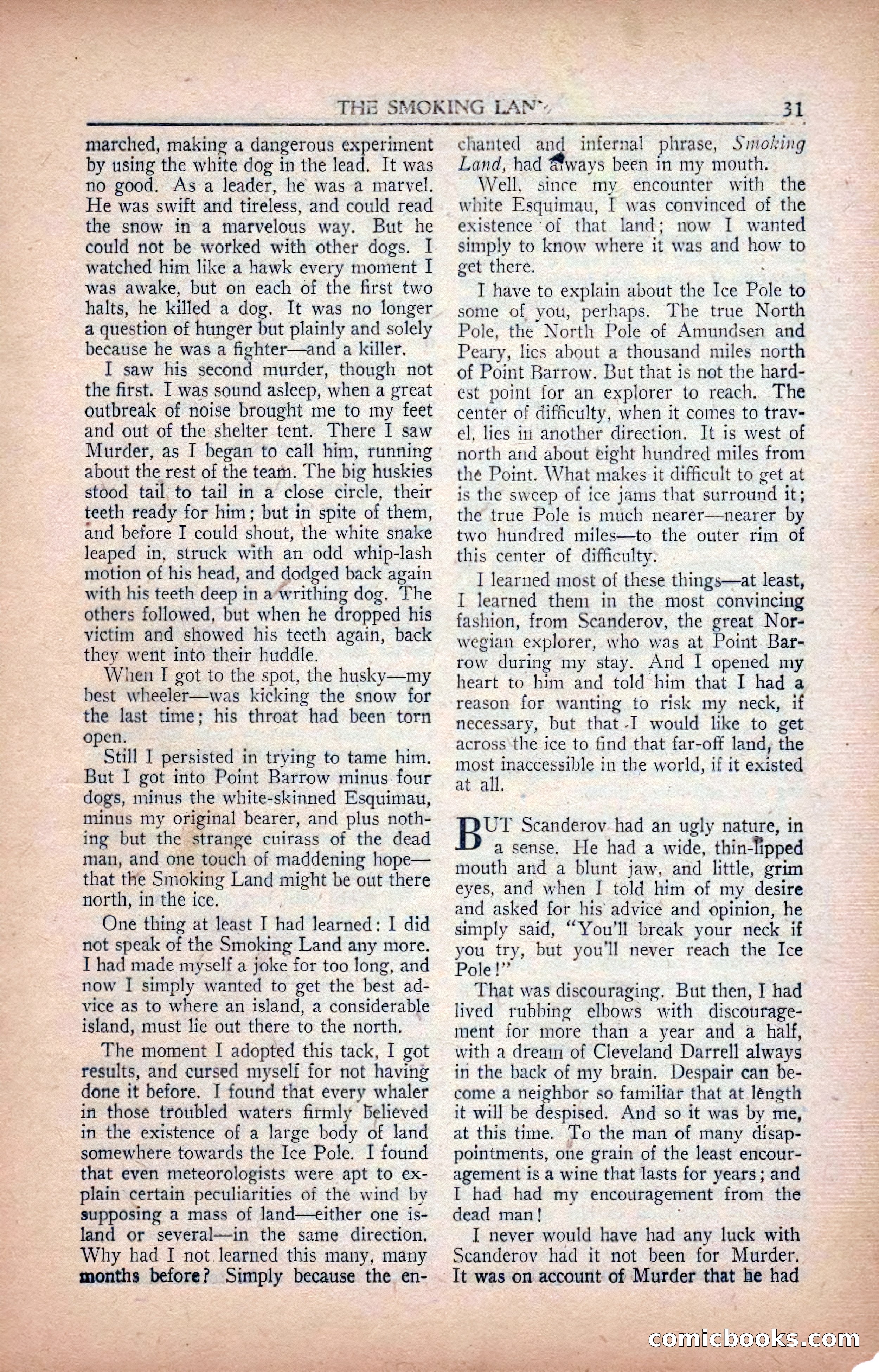
A restored page from Pulp Fiction, 1950. Page through the whole issue in the reader above.
📄 Transcribed text from this page (OCR, searchable)
Machine-transcribed from the original scan — historical spelling and the odd misread are preserved.
THe SMOKING LAN’: 31 marched, making a dangerous experiment by using the white dog in the lead, It was no good. As a leader, he was a marvel. He was swift and tireless, and could read the snow in a marvelous way. But he could not be worked with other dogs. I watched him like a hawk every moment I was awake, but on each of the first two halts, he killed a dog. It was no longer a question of hunger but plainly and solely because he was a fighter—and a killer. I saw his second murder, though not the first. I was sound asleep, when a great outbreak of noise brought me to my feet and out of the shelter tent. There I saw Murder, as I began to call him, running about the rest of the team. The big huskies stood tail to tail in a close circle, their teeth ready for him; but in spite of them, and before I could shout, the white snake leaped in, struck with an odd whip-lash motion of his head, and dodged back again with his teeth deep in a‘writhing dog. The others followed, but when he dropped his victim and showed his teeth again, back they went into their huddle. When I got to the spot, the husky—my best wheeler—was kicking the snow for the last time; his throat had been torn open. Still I persisted in trying to tame him. But I got into Point Barrow minus four dogs, minus the white-skinned Esquimau, minus my original bearer, and plus noth- ing but the strange cuirass of the dead man, and one touch of maddening hope— that the Smoking Land might be out there north, in the ice. One thing at least I had learned: 1 did not speak of the Smoking Land any more. I had made myself a joke for too long, and now I simply wanted to get the best ad- vice as to where an island, a considerable island, must lie out there to the north. The moment I adopted this tack, I got results, and cursed myself for not having done it before. I found that every whaler in those troubled waters firmly Believed in the existence of a large body of land somewhere towards the Ice Pole. I found that even meteorologists were apt to ex- plain certain peculiarities of the wind by supposing a mass of land—either one is- land or several—in the same direction. Why had I not. learned this many, many months before? Simply because the en- Persea tee re ree ah SO ee ars chanted and infernal phrase, Smoking Land, had ways been in my mouth. Well. since my encounter with the white Esquimau, I was convinced of the existence of that land: now I wanted simply to know where it was and how to get there. I have to explain about the Ice Pole to some of you, perhaps. The true North Pole, the North Pole of Amundsen and Peary, lies about a thousand miles north of Point Barrow. But that is not the hard- est point for an explorer to reach. The center of difficulty, when it comes to trav- el, lies in another direction. It is west of north and about eight hundred miles from the Point. What makes it difficult to get at is the sweep of ice jams that surround it; the true Pole is much nearer—nearer by two hundred miles—to the outer rim of this center of difficulty. I learned most of these things—at least, I learned them in the most convincing fashion, from Scanderov, the great Nor- wegian explorer, who was at Point Bar- row during my stay. And I opened my heart to him and told him that I had a reason for wanting to risk my neck, if necessary, but that -I would like to get across the ice to find that far-off land, the most inaccessible in the warld, if it existed at all. BU Scanderov had an ugly nature, in a sense. He had a wide, thin-Tipped mouth and a blunt jaw, and little, grim eyes, and when I told him of my. desire and asked for his advice and opinion, he simply said, “You'll break your neck if you try, but you'll never reach the Ice Pole!” That was discouraging. But then, I had lived rubbing elbows “with discourage- ment for more than a year and a half, with a dream of Cleveland Darrell always in the back of my brain. Despair can be- come a neighbor so familiar that at length it will be despised. And so it was by me, at this time. To the man of many disap- pointments, one grain of the least encour- agement is a wire that lasts for years ; and I had had my encouragement from the dead man! I never would have had any luck with Scanderov had it not been for Murder. It was on account of Murder that he had cComicbooks. com : oe Spa aes aes pe ER eee nn ee vo Ag > ~