
Pulp Fiction, 1950 · page 105 of 132
A. Merritt's Fantasy Magazine, April 1950 — page 105: what you’re looking at
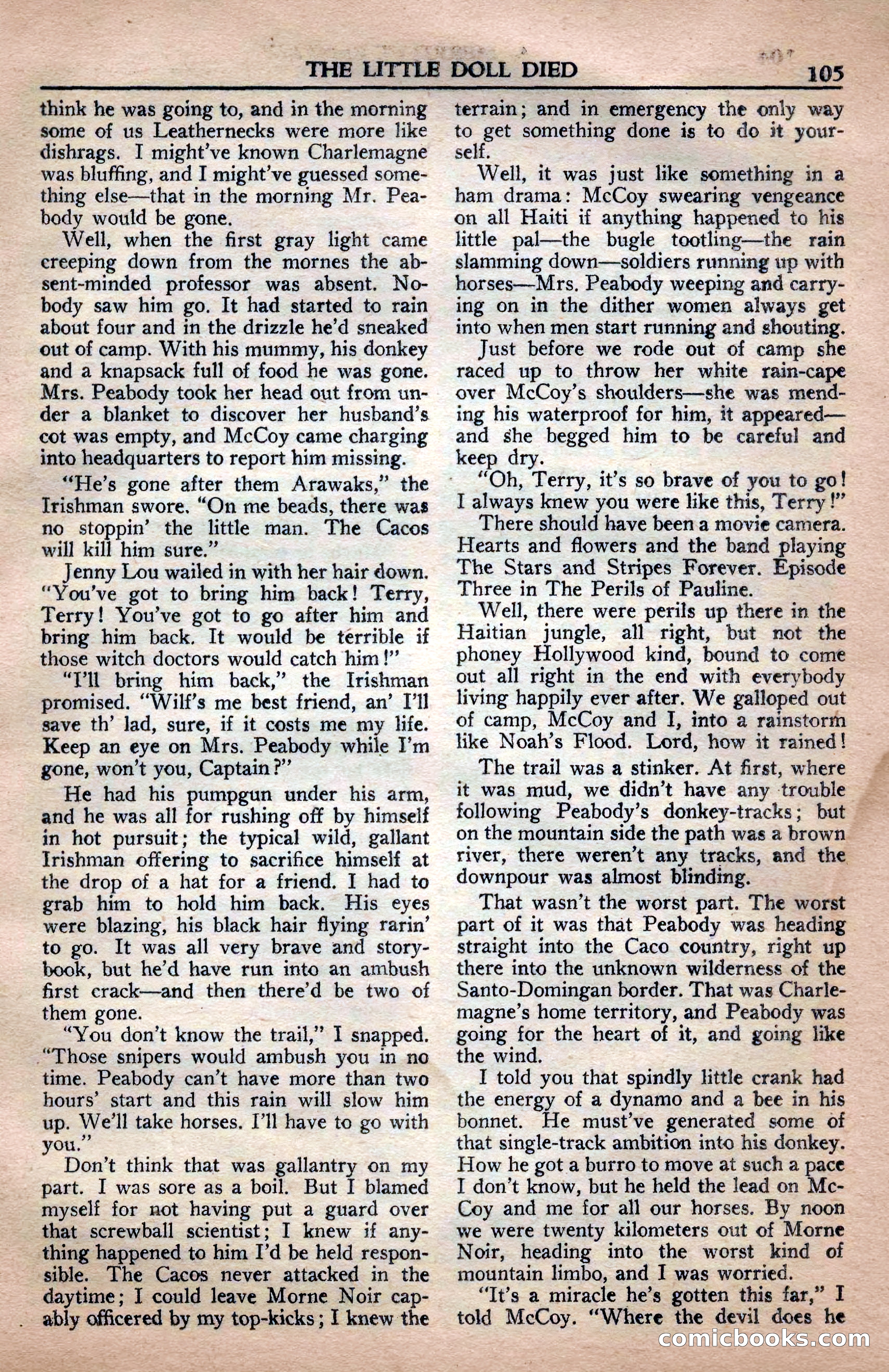
A restored page from Pulp Fiction, 1950. Page through the whole issue in the reader above.
📄 Transcribed text from this page (OCR, searchable)
Machine-transcribed from the original scan — historical spelling and the odd misread are preserved.
THE LITTLE DOLL DIED 2% 7 - 105 think he was going to, and in the morning some of us Leathernecks were more like dishrags. I might’ve known Charlemagne was bluffing, and I might’ve guessed some- thing else—that in the morning Mr. Pea- body would be gone. Well, when the first gray light came ereeping down from the mornes the ab- sent-minded professor was absent. No- body saw him go. It had started to rain about four and in the drizzle he’d sneaked out of camp. With his mummy, his donkey and a knapsack full of food he was gone. Mrs. Peabody took her head out from un- der a blanket to discover her husband’s cot was empty, and McCoy came charging into headquarters to report him missing. “He’s gone after them Arawaks,” the Irishman swore, “On me beads, there was no stoppin’ the little man. The Cacos will kill him sure.” Jenny Lou wailed in with her hair down. “You’ve got to bring him back! Terry, Terry! You’ve got to go after him and bring him back. It would be terrible if those witch doctors would catch him!” “Til bring him back,” the Irishman promised. “Wilf’s me best friend, an’ I'll save th’ lad, sure, if it costs me my hie. Keep an eye on Mrs. Peabody while I’m gone, won't you, Captain ?’’ He had his pumpgun under his arm, and he was all for rushing off by himself in hot pursuit; the typical wild, gallant Irishman offering to sacrifice himself at the drop of a hat for a friend. I had to grab him to hold him back. His eyes were blazing, his black hair flying rarin’ to go. It was all very brave and story- book, but he’d have run into an ambush first crack—and then there’d be two of them gone. “You don’t know the trail,’ I snapped. “Those snipers would ambush you in no time. Peabody can’t have more than two hours’ start and this rain will slow him up. We'll take horses, I’ll have to go with you.” Don’t think that was gallantry on my part. I was sore as a boil. But I blamed myself for not having put a guard over that screwball scientist; I knew if any- thing happened to him I’d be held respon- sible. The Cacos never attacked in the daytime; I could leave Morne Noir cap- ably officered by my top-kicks ; I knew the terrain; and in emergency the only way ie ces something done is to do it your- self. Well, it was just like something in a ham drama: McCoy swearing vengeance on all Haiti if anything happened to his little pal—the bugle tootling—the rain slamming down—soldiers running up with horses—Mrs. Peabody weeping and carry- ing on in the dither women always get into when men start running and shouting. Just before we rode out of camp she raced up to throw her white rain-cape over McCoy’s shoulders—she was mend- ing his waterproof for him, it appeared— and she begged him to be careful and keep dry. “Oh, Terry, it’s so brave of you to go! I always knew you were like this, Terry !”’ There should have been a movie camera. Hearts and flowers and the band playing The Stars and Stripes Forever. Episode Three in The Perils of Pauline. Well, there were perils up there in the Haitian jungle, all right, but not the phoney Hollywood kind, bound to come out all right in the end with everybody living happily ever after. We galloped out of camp, McCoy and I, into a rainstorm like Noah’s Flood. Lord, how it rained! The trail was a stinker. At first, where it was mud, we didn’t have any trouble following Peabody’s donkey-tracks; but a on the mountain side the path was a brown river, there weren’t any tracks, and the downpour was almost blinding. That wasn’t the worst part. The worst part of it was that Peabody was heading straight into the Caco country, right up there into the unknown wilderness of the Santo-Domingan border. That was Charle- magne’s home territory, and Peabody was going for the heart of it, and going like the wind, I told you that spindly little crank had the energy of a dynamo and a bee in his bonnet. He must’ve generated some of — that single-track ambition into his donkey. How he got a burro to move at such a pace I don’t know, but he held the lead on Mc- Coy and me for all our horses. By noon we were twenty kilometers out of Morne Noir, heading into the worst kind of mountain limbo, and I was worried. “It’s a miracle he’s gotten this far,” I told McCoy. “Where the devil does he | cComicbooks:. co Rn