
Pulp Fiction, 1950 · page 108 of 132
A. Merritt's Fantasy Magazine, April 1950 — page 108: what you’re looking at
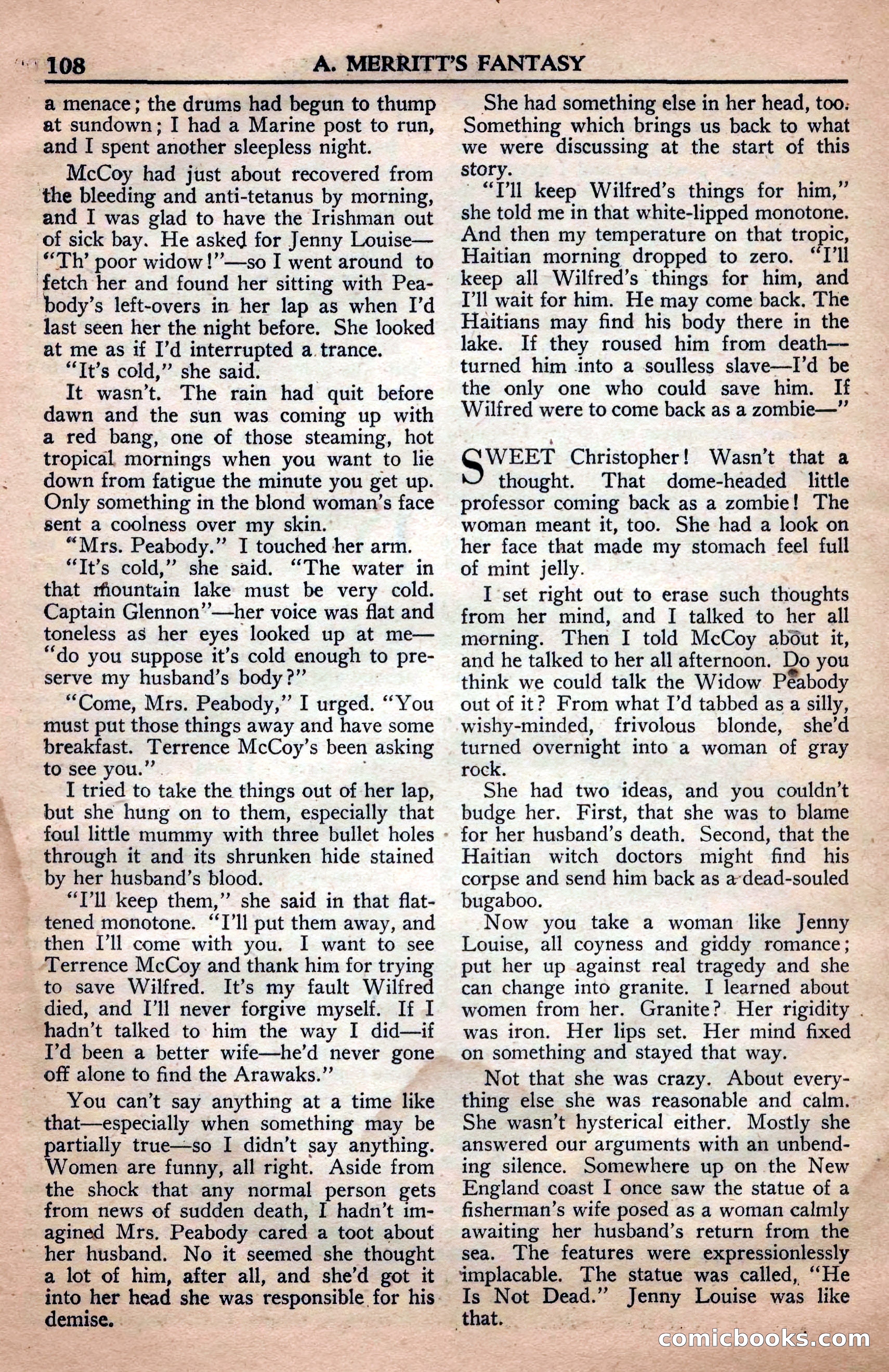
A restored page from Pulp Fiction, 1950. Page through the whole issue in the reader above.
📄 Transcribed text from this page (OCR, searchable)
Machine-transcribed from the original scan — historical spelling and the odd misread are preserved.
“108 ‘A. MERRITT’S FANTASY - a menace; the drums had begun to thump at sundown; I had a Marine post to run, and I spent another sleepless night. McCoy had just about recovered from the bleeding and anti-tetanus by morning, and I was glad to have the Irishman out of sick bay. He asked for Jenny Louise— “Th’ poor widow !”—so I went around to fetch her and found her sitting with Pea- body’s left-overs in her lap as when I’d - last seen her the night before. She looked at me as if I’d interrupted a. trance. “It’s cold,” she said. | It wasn’t. The rain had quit before dawn and the sun was coming up with a red bang, one of those steaming, hot tropical mornings when you want to lie down from fatigue the minute you get up. Only something in the blond woman’s face sent a coolness over my skin. “Mrs. Peabody.” I touched her arm. “It’s cold,” she said. “The water in that rfiountain lake must be very cold. Captain Glennon’’—her voice was flat and toneless as her eyes looked up at me— “do you suppose it’s cold enough to pre- serve my husband’s body ?” “Come, Mrs. Peabody,” I ged. “Vou must put those things away and have some breakfast. Terrence McCoy’s been asking to see you.” I tried to take the things out of her lap, but she hung on to them, especially that foul little mummy with three bullet holes - through it and its shrunken hide stained by her husband’s blood. “I'll keep them,” she said in that flat- - tened monotone. “I'll put them away, and then I’ll come with you. I want to see “Terrence McCoy and thank him for trying to save Wilfred. It’s my fault Wilfred _ died, and I'll never forgive myself. If I ‘hadn’t talked to him the way I did—if I'd been a better wife—he’d never gone off alone to find the Arawaks.”’ You can’t say anything at a time like - that—especially when something may be partially true—so I didn’t say anything. Women are funny, all right. Aside from the shock that any normal person gets from news of sudden death, I hadn’t im- agined Mrs. Peabody cared a toot about ‘ her husband. No it seemed she thought a lot of him, after all, and she'd got it © into her head she was responsible for his. demise. - that. She had something else in her head, too: Something which brings us back to what we were discussing at the start of this story. “Pll keep Wilfred’s things for him,” she told me in that white-lipped monotone. And then my temperature on that tropic, Haitian morning dropped to zero, “I'll keep all Wilfred’s things for him, and I'll wait for him. He may come back, The Haitians may find his body there in the lake. If they roused him from death— turned him into a soulless slave—lI’d be the only one who could save him. If .- Wilfred were to come back as a zombie—” WEET Christopher! Wasn't that a thought. That dome-headed little professor coming back as a zombie! The woman meant it, too. She had a look on her face that made my stomach feel full of mint jelly. I set right out to erase such thoughts from her mind, and I talked to her all morning. Then I told McCoy about it, and he talked to her all afternoon. Do you think we could talk the Widow Peabody out of it? From what I’d tabbed as a silly, wishy-minded, frivolous blonde, she’d turned overnight into a woman of gray rock. She had two ideas, and you couldn't budge her. First, that she was to blame for her husband’s death. Second, that the Haitian witch doctors might find his corpse and send him back as a-dead-souled bugaboo. Now you take a woman like Jenny Louise, all coyness and giddy romance; put her up against real tragedy and she can change into granite. I learned about women from her. Granite?. Her rigidity . was iron. Her lips set. Her mind fixed on something and stayed that way. Not that she was crazy. About every- thing else she was reasonable and calm. She wasn’t hysterical either. Mostly she answered our arguments with an unbend- ing silence. Somewhere up on the New England coast I once saw the statue of a fisherman’s wife posed as a woman calmly awaiting her husband’s return from the sea. The features were expressionlessly implacable. The statue was called, “He Is Not Dead.” Jest Louise was like (eo) mich of) (elo) KS. : — i ste — = a eo > Se ee