
Pulp Fiction, 1950 · page 118 of 132
A. Merritt's Fantasy Magazine, April 1950 — page 118: what you’re looking at
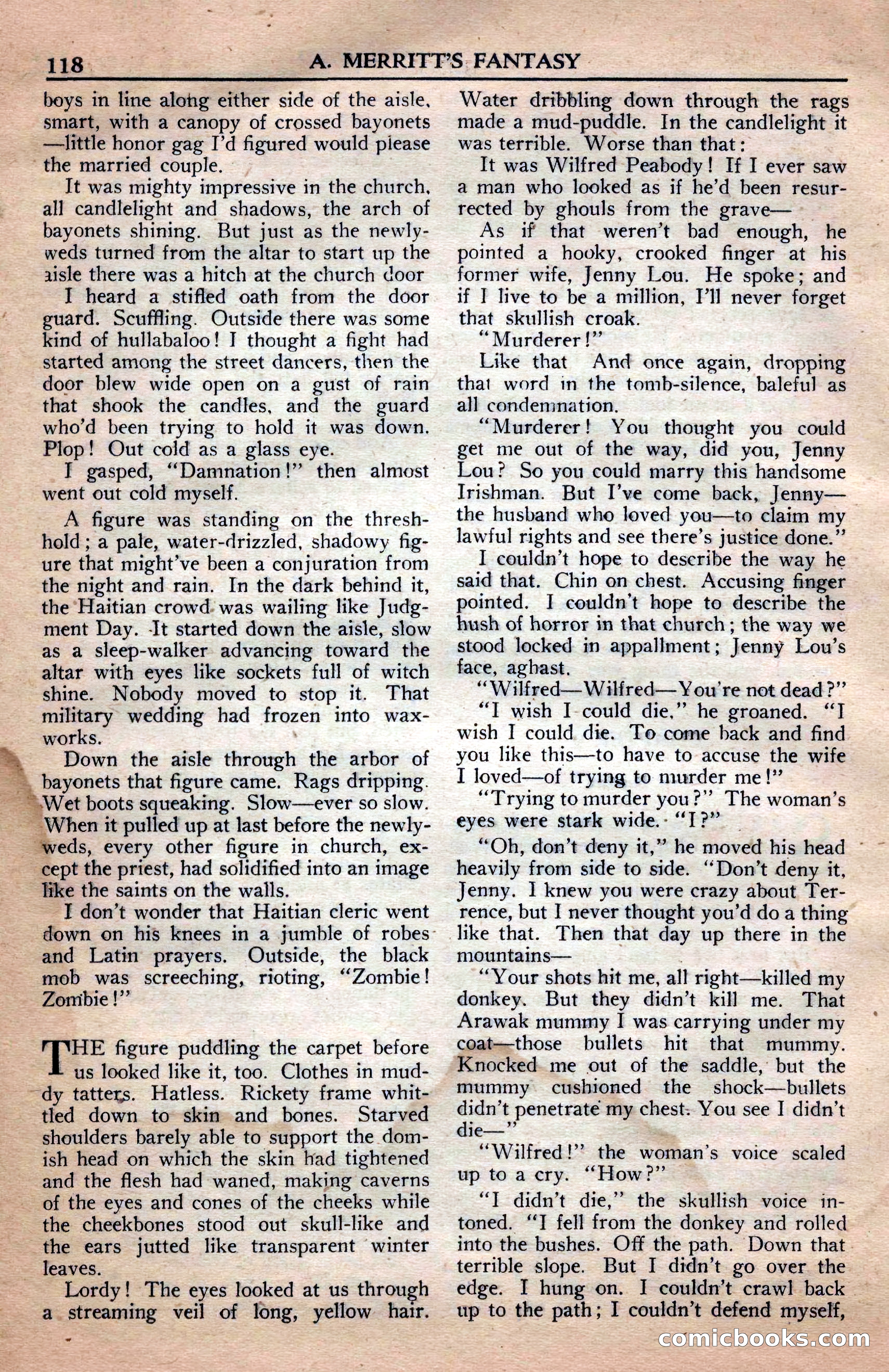
A restored page from Pulp Fiction, 1950. Page through the whole issue in the reader above.
📄 Transcribed text from this page (OCR, searchable)
Machine-transcribed from the original scan — historical spelling and the odd misread are preserved.
118. A. MERRITT’S: FANTASY | beys in line along either side of the aisle, smart, with a canopy of crossed bayonets —little honor gag I’d figured would piease ‘the married couple. It was mighty impressive in the church, all candlelight and shadows, the arch of bayonets shining. But just as the newly- weds turned from the altar to start up the aisle there was a hitch at the church door I heard a stifled oath from the door guard. Scuffling. Outside there was some kind of hullabaloo! I thought a fight had started among the street dancers, then the door blew wide open on a gust of rain that shook the candles, and the guard who'd been trying to hold it was down. Plop! Out cold as a glass eye. I gasped, “Damnation!” then almost went out cold myself. A figure was standing on the thresh- hold; a pale, water-drizzled, shadowy fig- ure that might’ve been a conjuration from the night and rain. In the dark behind it, the Haitian crowd. was wailing like Judg- ment Day. -It started down the aisle, slow as a sleep-walker advancing toward the altar with eyes like sockets full of witch shine. Nobody moved to stop it. That military wedding had frozen into wax- works, Down the aisle through the arbor of bayonets that figure came. Rags dripping. aa Wet boots squeaking. Slow—ever so slow. ~ When it pulled up at last before the newly- _ weds, every other figure in church, ex- cept the priest, had solidified into an image like the saints on the walls. I don’t wonder that Haitian cleric went down on his knees in a jumble of robes: and Latin prayers. Outside, the black mob was screeching, rioting, “Zombie! Zomibie !”’ cae figure puddling the carpet before - us looked like it, too. Clothes in mud- ~dy tatters. Hatless. Rickety frame whit- tled down to skin and bones. Starved shoulders barely able to support the dom- ish head on which the skin had tightened and the flesh had waned, making caverns of the eyes and cones of the cheeks while the cheekbones stood out skull-like and the ears jutted like transparent winter leaves. Lordy! The eyes looked at us through a streaming veil of long, yellow hair. ww Water dribbling down through the rags made a mud-puddle. In the candlelight it was terrible. Worse than that: It was Wilfred Peabody! If I ever saw a man who looked as if he’d been resur- rected by ghouls from the grave— As if that weren’t bad enough, he pointed a hooky, crooked finger at his former wife, Jenny Lou. He spoke; and if I live to be a million, I'l] never forget that skullish croak. “Murderer !” Like that And once again, dropping that word in the tomb-silence, baleful as all condemnation. “Murderer! You thought you could get me out of the way, did you, Jenny Lou? So you could marry this handsome Irishman. But I’ve come back, Jenny— the husband who loved you—to claim my lawful rights and see there’s justice done.” I couldn’t hope to deseribe the way he said that. Chin on chest. Accusing finger pointed. I couldn't hope to describe the hush of horror in that church; the way we stood locked in appallment ; Jenny Lou’s face, aghast. “Wilfred— W ilfred— Y ou're not dead ?” “T wish I-could die,” he groaned. “TI wish I could die. To come back and find you like this—to have to accuse the wife I loved—of trying to murder me!” “Trying to murder you?’ The woman’s eyes were stark wide.- “I?” “Oh, don’t deny it,” he moved his head - heavily from side to side. “Don’t deny it, Jenny. 1 knew you were crazy about Ter- rence, but I never thought you’d do a thing like that. Then that day up there in the mountains— “Your shots hit me, all right—killed my donkey. But they didn’t kill me. That Arawak mummy I was carrying under my coat—those bullets hit that mummy. Knocked. me out of the saddle, but the mummy cushioned the shock—bullets didn’t penetrate my chest: You see I didn’t die—”’ | ‘Wilfred!’ the woman’s voice scaled up to a cry. “How?” “T didn’t die,” the skullish voice in- toned. “J fell from the donkey and rolled into the bushes. Off the path. Down that. _ terrible slope. But I didn’t go over the edge. I hung on. I couldn’t crawl back — up to the path; I couldn’t defend myself, Ecomicbooks.co