
Pulp Fiction, 1950 · page 18 of 132
A. Merritt's Fantasy Magazine, April 1950 — page 18: what you’re looking at
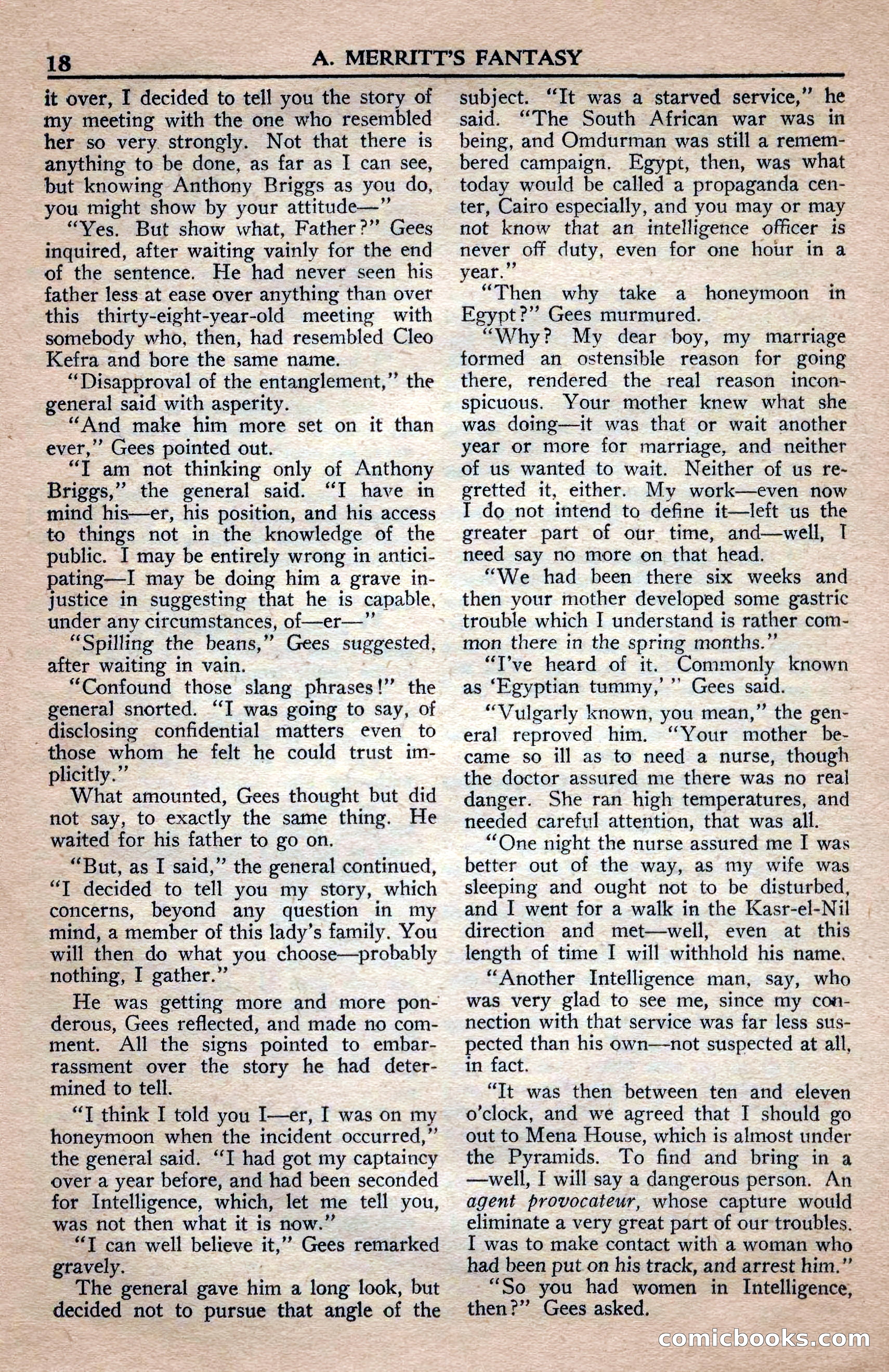
A restored page from Pulp Fiction, 1950. Page through the whole issue in the reader above.
📄 Transcribed text from this page (OCR, searchable)
Machine-transcribed from the original scan — historical spelling and the odd misread are preserved.
18 A. MERRITT’S FANTASY it over, I decided to tell you the story of my meeting with the one who resembled her so very. strongly. Not that there is anything to be done, as far as I can see, but knowing Anthony Briggs as you do, you might show by your attitude—” “Ves. But show what, Father?’ Gees inquired, after waiting vainly for the end of the sentence. He had never seen his father less at ease over anything than over this thirty-eight-year-old meeting with somebody who, then, had resembled Cleo Kefra and bore the same name. “Disapproval of the entanglement,” the general said with asperity. “And make him more set on it than ever,” Gees pointed out. “T am not thinking only of Anthony Briggs,” the general said. “I have in mind his—er, his position, and his access to things not in the knowledge of the public. I may be entirely wrong in antici- pating—I may be doing him a grave in- justice in suggesting that he is capable, under any circumstances, of —er—” “Spilling the beans,” Gees suggested, after waiting in vain. “Confound those slang phrases!’’ the general] snorted. “I was going to say, of disclosing confidential matters even to those whom he felt he could trust im- plicitly.”’ What amounted, Gees thought but did not say, to exactly the same thing. He waited for his father to go on. “But, as I said,” the general continued, “T decided to tell you my story, which concerns, beyond any question in my mind, a member of this lady’s family. You will then do what you. choose—probably nothing, I gather.” He was getting more and more pon- derous, Gees reflected, and made no com- ment. All the signs pointed to embar- rassment over the story he had deter- mined to tell. “T think I told you I—er, I was on my honeymoon when the incident occurred,” the general said. “I had got my captaincy over a year before, and had been seconded for Intelligence, which, let me tell you, was not then what it is now.’ “JT can well believe it,” Gees remarked gravely. The general gave iin a long look, but decided not to pursue that angle of the subject. “It was a starved service,” he said. “The South African war was in being, and Omdurman was still a remem- bered campaign. Egypt, then, was what today would be called a propaganda cen- ter, Cairo especially, and you may or may not know that an intelligence officer is never off duty, even for one hour in a year.” “Then why take a honeymoon in Egypt?’ Gees murmured. “Why? My dear boy, my marriage formed an ostensible reason for going there, rendered the real reason incon- spicuous. Your mother knew what she was doing—it was that or wait another year or more for marriage, and neither of us wanted to wait. Neither of us re- gretted it, either. My work—even now I do not intend to define it—left us the greater part of our time, and—well, I need say no more on that head. “We had been there six weeks and then your mother developed some gastric trouble which I understand is rather com- mon there in the spring months.” “T’ve heard of it. Commonly known as ‘Egyptian tummy,’ ’”’ Gees said. 7 “Vulgarly known, you mean,” the gen- eral reproved him. ‘Your mother be- came so ill as to need a nurse, though the doctor assured me there was no real danger. She ran high temperatures, and needed careful attention, that was all. “One night the nurse assured me I was better out of the way, as my wife was sleeping and ought not to be disturbed, and I went for a walk in the Kasr-el-Nil direction and met—well, even at this length of time I will withhold his name. “Another Intelligence man, say, who was very glad to see me, since my con- nection with that service was far less sus- pected than his own—not suspected at all, in fact. “It was then between ten and eleven o'clock, and we agreed that I should go out to Mena House, which is almost under the Pyramids. To find and bring in a —well, I will say a dangerous person. An agent provocateur, whose capture would eliminate a very great part of our troubles. I was to make contact with a woman who had been put. on his track, and arrest him.” “So you had women in Intelligence, then?” Gees asked. Eomichbooks..com