
Pulp Fiction, 1950 · page 48 of 132
A. Merritt's Fantasy Magazine, April 1950 — page 48: what you’re looking at
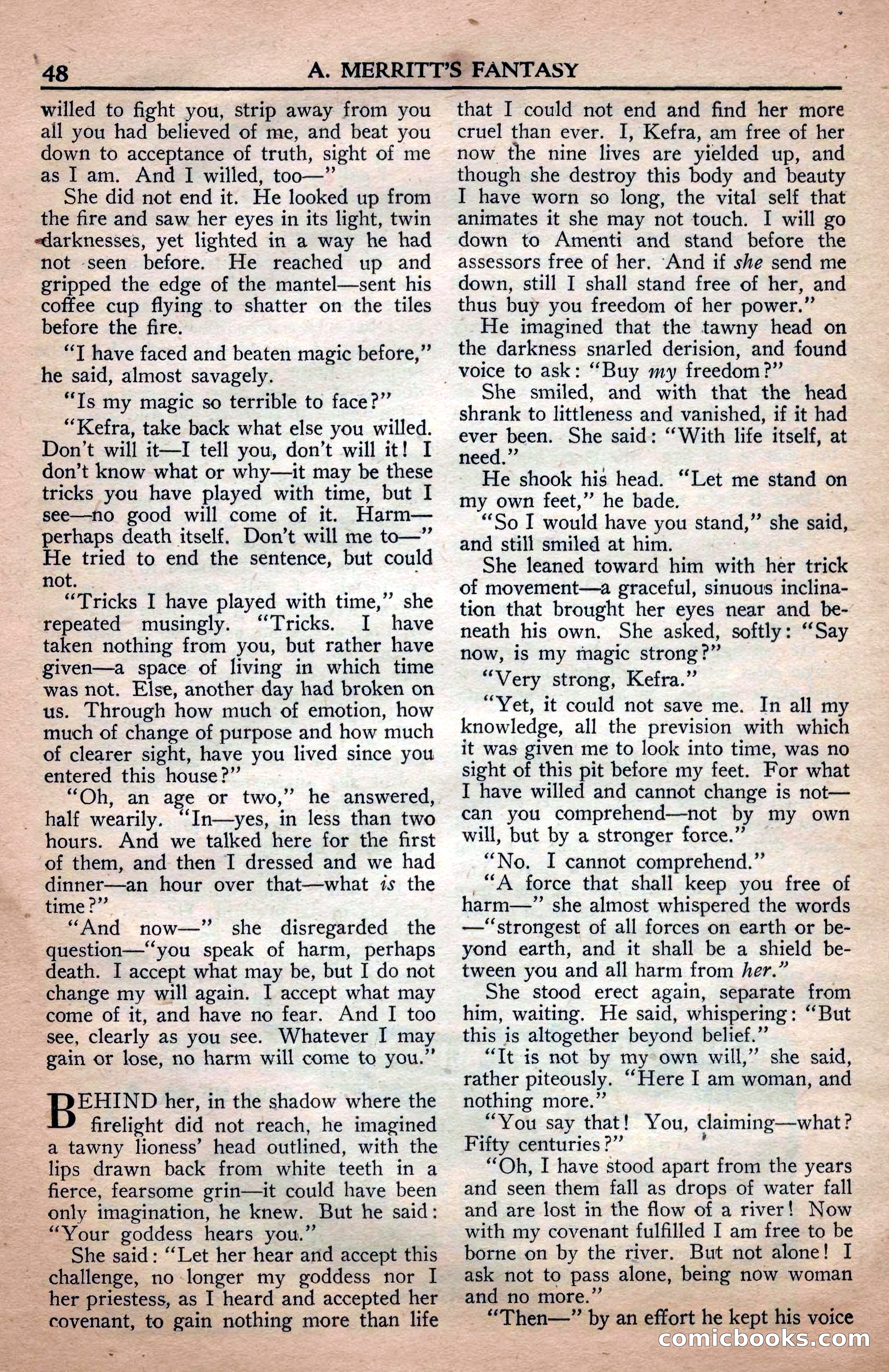
A restored page from Pulp Fiction, 1950. Page through the whole issue in the reader above.
📄 Transcribed text from this page (OCR, searchable)
Machine-transcribed from the original scan — historical spelling and the odd misread are preserved.
> 48 > A. MERRITT’S FANTASY willed to fight you, strip away from you all you had believed of me, and beat you down to acceptance of truth, sight of me as 1 am. And I willed, too—”’ She did not end it. He looked up from the fire and saw her eyes in its light, twin edarknesses, yet lighted in a way he had not seen before. He reached up and gripped the edge of the mantel—sent his coffee cup flying to shatter on the tiles before the fire. “T have faced and beaten magic before,” he said, almost savagely. “Is my magic so terrible to face?” “Kefra, take back what else you willed. Don’t will it—I tell you, don’t will it! I don’t know what or why—it may be these tricks you have played with time, but I see—no good will come of it. Harm— perhaps death itself. Don’t will me to—” He tried to end the sentence, but could not. . “Tricks I have played with time,” she repeated musingly. “Tricks. I have taken nothing from you, but rather have -given—a space of living in which time was not. Else, another day had broken on us. Through how much of emotion, how much of change of purpose and how much of clearer sight, have you lived since you entered this house?” “Oh, an age or two,” he answered, _ half wearily. ‘‘In—yes, in less than two hours. And we talked here for the first of them, and then I dressed and we had dinner—an hour over that—what 1s the time °” “And now—” she disregarded the question—‘“‘you speak of harm, perhaps death. I accept what may be, but I do not change my will again. I accept what may come of it, and have no fear. And I too see, clearly as you see. Whatever I may gain or lose, no harm will come to you.’ EHIND her, in the shadow where the firelight did not reach, he imagined a tawny lioness’ head outlined, with the lips drawn back from white teeth in a fierce, fearsome grin—it could have been only imagination, he knew. But he said: “Your goddess hears you.” She said: “‘Let her hear anid accept this _ challenge, no longer my goddess nor | _her priestess, as I heard and accepted her covenant, to gain nothing more than life ~ * that I could not end and find her more cruel than ever. I, Kefra, am free of her now the nine lives are yielded up, and though she destroy this body and beauty I have worn so long, the vital self that animates it she may not touch. I will go down to Amenti and stand before the assessors free of her. “And if she send me down, still I shall stand free of her, and thus buy you freedom of her power.” He imagined that the tawny head on the darkness snarled derision, and found _ voice to ask: “Buy my freedom?” She smiled, and with that the head shrank to littleness and vanished, if it had ever been. She said: ‘With life itself, at need.”’ He shook his head. my own feet,” he bade. “So I would have you stand,” she said, and still smiled at him. : She leaned toward him with her trick of movement—a graceful, sinuous inclina- tion that brought her eyes near and be- neath his own. She asked, softly: “Say now, is my magic strong?” “Very strong, Kefra.” “Yet, it could not save me. In all my knowledge, all the prevision with which it was given me to look into time, was no sight of this pit before my feet. For what I have willed and cannot change is not— can you comprehend—not by my own will, but by a stronger force.” “No. I cannot comprehend.” _“A force that shall keep you free of harm—”’ she almost whispered the words —“strongest of all forces on earth or be- yond earth, and it shall be a shield be- tween you and all harm from her.” She stood erect again, separate from him, waiting. He said, whispering: “But this is altogether beyond belief.” “Tt is not by my own will,” she said, rather piteously. “Here I am woman, and nothing more.’ “You say that! You, claiming—what ? Fifty centuries ?” “Oh, I have stood apart from the years and seen them fall as drops of water fall and are lost in the flow of a river! Now with my covenant fulfilled I am free to be borne on by the river. But not alone! I ask not to pass alone, being now woman and no more.’ “Then—” by an effort he kept his voice “Tet me stand on - comicbooks.com Ves ae Je