
Pulp Fiction, 1950 · page 50 of 132
A. Merritt's Fantasy Magazine, April 1950 — page 50: what you’re looking at
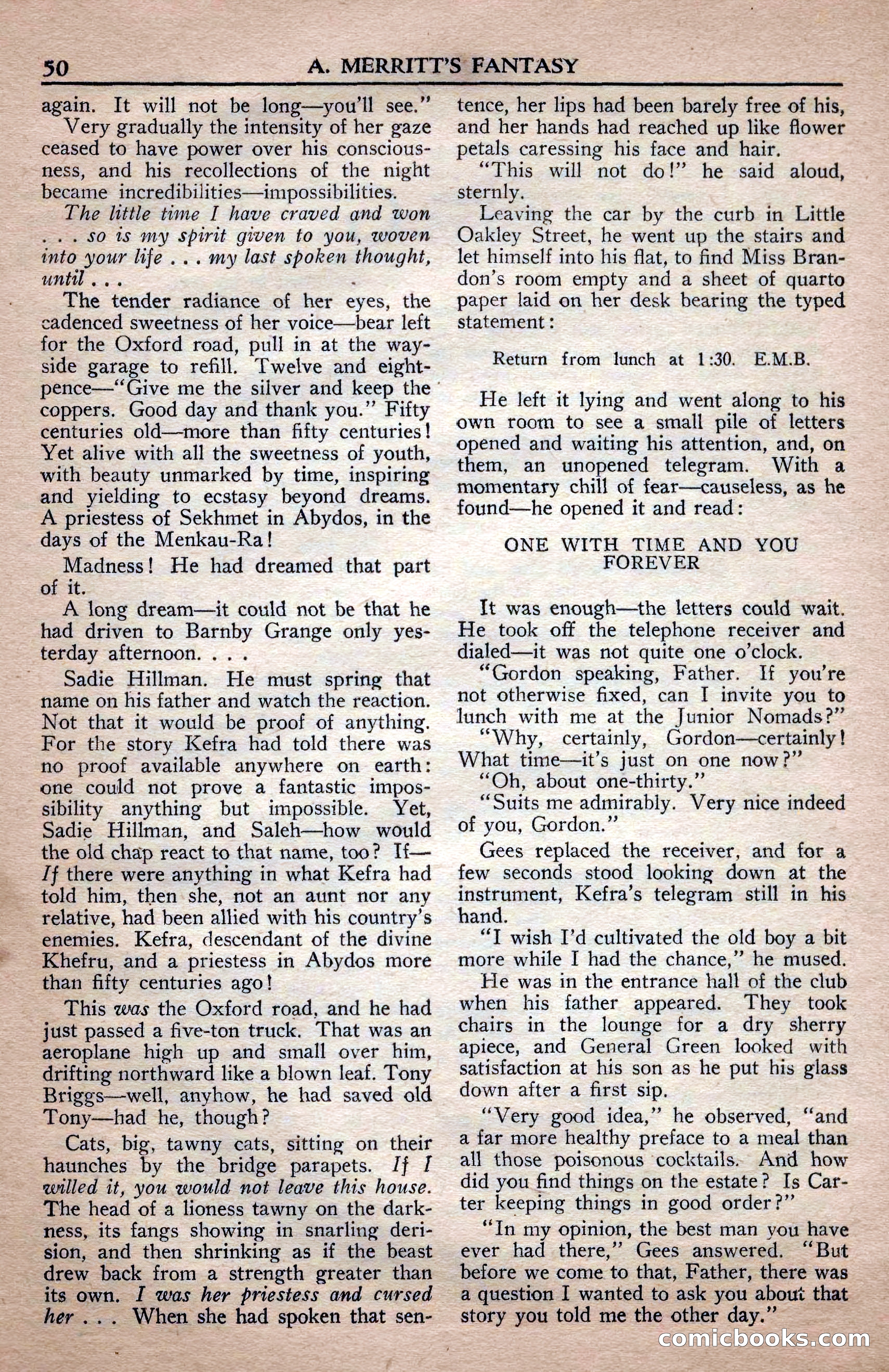
A restored page from Pulp Fiction, 1950. Page through the whole issue in the reader above.
📄 Transcribed text from this page (OCR, searchable)
Machine-transcribed from the original scan — historical spelling and the odd misread are preserved.
50 A. MERRITT’S FANTASY again. It will not be long—you'll see.” Very gradually the intensity of her gaze ceased to have power over his conscious- ness, and his recollections of the night became incredibilities—impossibilities. The little time I have craved and won . 50 1s my Spirit given to you, woven into your life... my last spoken thought, until... : The tender radiance of her eyes, the cadenced sweetness of her voice—bear left for the Oxford road, pull in at the way- side garage to refill. Twelve and eight- pence—“Give me the silver and keep the ' coppers. Good day and thank you.” Fifty centuries old—more than fifty centuries! Yet alive with all the sweetness of youth, with beauty unmarked by time, inspiring and yielding to ecstasy beyond dreams. A priestess of Sekhmet in Abydos, in the days of the Menkau-Ra! Madness! He had dreamed that part of it. A long dream—it could not be that he had driven to Barnby Grange only yes- terday afternoon. ... Sadie Hillman. He must spring that name on his father and watch the reaction. Not that it would be proof of anything. For the story Kefra had told there was no proof available anywhere on earth: one could not prove a fantastic impos- sibility anything but impossible. Yet, Sadie Hillman, and Saleh—how would the old chap react to that name, too? If— If there were anything in what Kefra had told him, then she, not an aunt nor any relative, had been allied with his country’s enemies. Kefra, descendant of the divine Khefru, and a priestess in Abydos more than fifty centuries ago! This was the Oxford road, and he had just passed a five-ton truck. That was an aeroplane high up and small over him, drifting northward like a blown leaf. Tony Briges—-well, anyhow, he had saved old Tony—had he, though? Cats, big, tawny cats, sitting on their haunches by the bridge parapets. If I mvilled it, you would not leave this house. The head of a lioness tawny on the dark- ness, its fangs showing in snarling deri- sion, and then shrinking as if the beast drew back from a strength greater than its own. I was her priestess and cursed her... When she had spoken that sen- tence, her lips had been barely free of his, and her hands had reached up like flower petals caressing his face and hair. “This will not do!” he said aloud, sternly. Leaving the car by the curb in Little Oakley Street, he went up the stairs and let himself into his flat, to find Miss Bran- don’s room empty and a sheet of quarto paper laid on her desk bearing the typed statement : Return from lunch at 1:30. E.M.B. He left it lying and went along to his own room to see a small pile of letters opened and waiting his attention, and, on them, an unopened telegram. With a momentary chill of fear—causeless, as he found—he opened it and read: ONE WITH TIME AND YOU FOREVER It was enough—the letters could wait. He took off the telephone receiver and dialed—it was not quite one o’clock. “Gordon speaking, Father. If you’re not otherwise fixed, can I invite you to lunch with me at the Junior Nomads?” “Why, certainly, Gordon—certainly! What time—it’s just on one now?” “Oh, about one-thirty.” “Suits me admirably. Very nice indeed of you, Gordon.”’ Gees replaced the receiver, and for a few seconds stood looking down at the instrument, Kefra’s telegram still in his hand. “TI wish I’d cultivated the old boy a bit more while I had the chance,” he mused. He was in the entrance hall of the club when his father appeared. They took chairs in the lounge for a dry sherry apiece, and General Green looked with satisfaction at his son as he put his glass down after a first sip. “Very good idea,” he observed, “and a far more healthy preface to a meal than all those poisonous cocktails. And how did you find things on the estate? Is Car- ter keeping things in good order?” “In my opinion, the best man you have ever had there,’ Gees answered. “But before we come to that, Father, there was a question I wanted to ask you about that story you told me the other day.” <Si€O com cCboo m