
Pulp Fiction, 1950 · page 71 of 132
A. Merritt's Fantasy Magazine, April 1950 — page 71: what you’re looking at
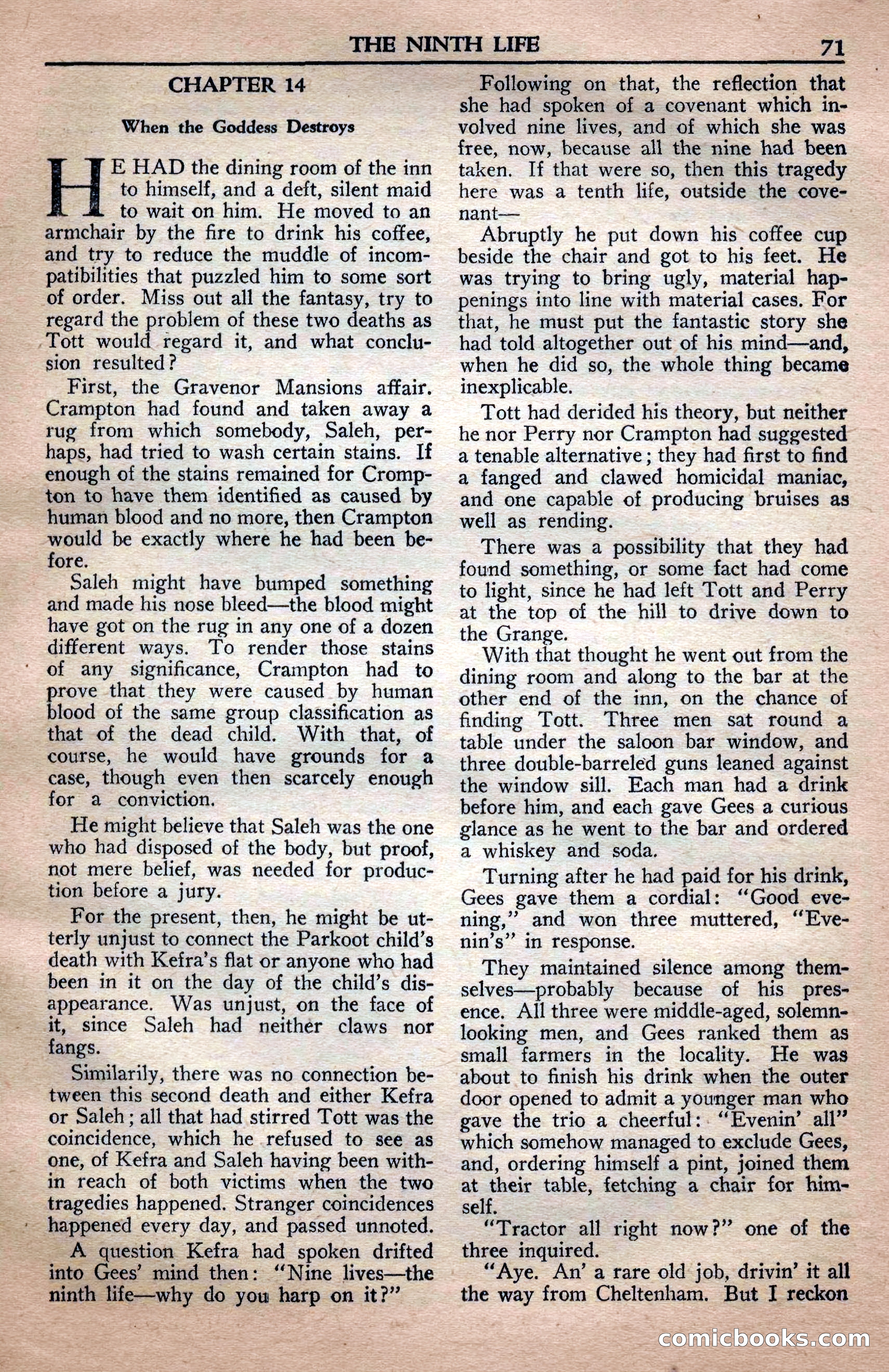
A restored page from Pulp Fiction, 1950. Page through the whole issue in the reader above.
📄 Transcribed text from this page (OCR, searchable)
Machine-transcribed from the original scan — historical spelling and the odd misread are preserved.
THE NINTH LIFE 71 CHAPTER 14 When the Goddess Destroys E HAD the dining room of the inn to himself, and a deft, silent maid to wait on him. He moved to an armchair by the fire to drink his coffee, and try to reduce the muddle of incom- patibilities that puzzled him to some sort of order. Miss out all the fantasy, try to regard the problem of these two deaths as -Tott would regard it, and what conclu- sion resulted? First, the Gravenor Mansions affair. Crampton had found and taken away a rug from which somebody, Saleh, per- haps, had tried to wash certain stains. If enough of the stains remained for Cromp- ton to have them identified as caused by human blood and no more, then Crampton = be exactly where he had been be- ore. Saleh might have bumped something and made his nose bleed—the blood might have got on the rug in any one of a dozen different ways. To render those stains of any significance, Crampton had to prove that they were caused by human blood of the same group classification as that of the dead child. With that, of course, he would have grounds for a case, though even then scarcely enough for a conviction. He might believe that Saleh was the one who had disposed of the body, but proof, not mere belief, was needed for produc- tion before a jury. For the present, then, he might be ut- terly unjust to connect the Parkoot child’s death with Kefra’s flat or anyone who had been in it on the day of the child’s dis- appearance. Was unjust, on the face of it, since Saleh had neithér claws nor fangs. Similarily, there was no connection be- tween this second death and either Kefra or Saleh; all that had stirred Tott was the coincidence, which he refused to see as one, of Kefra and Saleh having been with- in reach of both victims when the two tragedies happened. Stranger coincidences » happened every day, and passed unnoted. A question Kefra had spoken drifted into Gees’ mind then: ‘Nine lives—the ninth life—why do you harp on it?” Following on that, the reflection that she had spoken of a covenant which in- volved nine lives, and of which she was free, now, because all the nine had been taken. If that were so, then this tragedy here was a tenth life, outside the cove- nant— Abruptly he put down his coffee cup beside the chair and got to his feet. He was trying to bring ugly, material hap- penings into line with material cases. For that, he must put the fantastic story she had told altogether out of his mind—and, when he did so, the whole thing became inexplicable. Tott had derided his theory, but neither he nor Perry nor Crampton had suggested a tenable alternative ; they had first to find a fanged and clawed homicidal maniac, and one capable of producing bruises as well as rending. There was a possibility that they had found something, or some fact had come to light, since he had left Tott and Perry at the top of the hill to drive down to the Grange. With that thought he went out from the dining room and along to the bar at the other end of the inn, on the chance of finding Tott. Three men sat round a table under the saloon bar window, and three double-barreled guns leaned against the window sill. Each man had a drink before him, and each gave Gees a curious glance as he went to the bar and ordered a whiskey and soda. Turning after he had paid for his drink, Gees gave them a cordial: “Good eve- ning,” and won three muttered, “Eve- nin’s” in response. They maintained silence among them- selves—probably because of his pres- ence, All three were middle-aged, solemn- looking men, and Gees ranked them as small farmers in the locality. He was about to finish his drink when the outer door opened to admit a younger man who gave the trio a cheerful: “Evenin’ all” which somehow managed to exclude Gees, and, ordering himself a pint, joined them at their table, fetching a chair for him- self. “Tractor all right now?” one of the three inquired. “Aye. An’ a rare old job, drivin’ it all the way from Cheltenham. But I reckon (E(@) (e(0) aniicel exeKe) <3