
Pulp Fiction, 1950 · page 96 of 132
A. Merritt's Fantasy Magazine, April 1950 — page 96: what you’re looking at
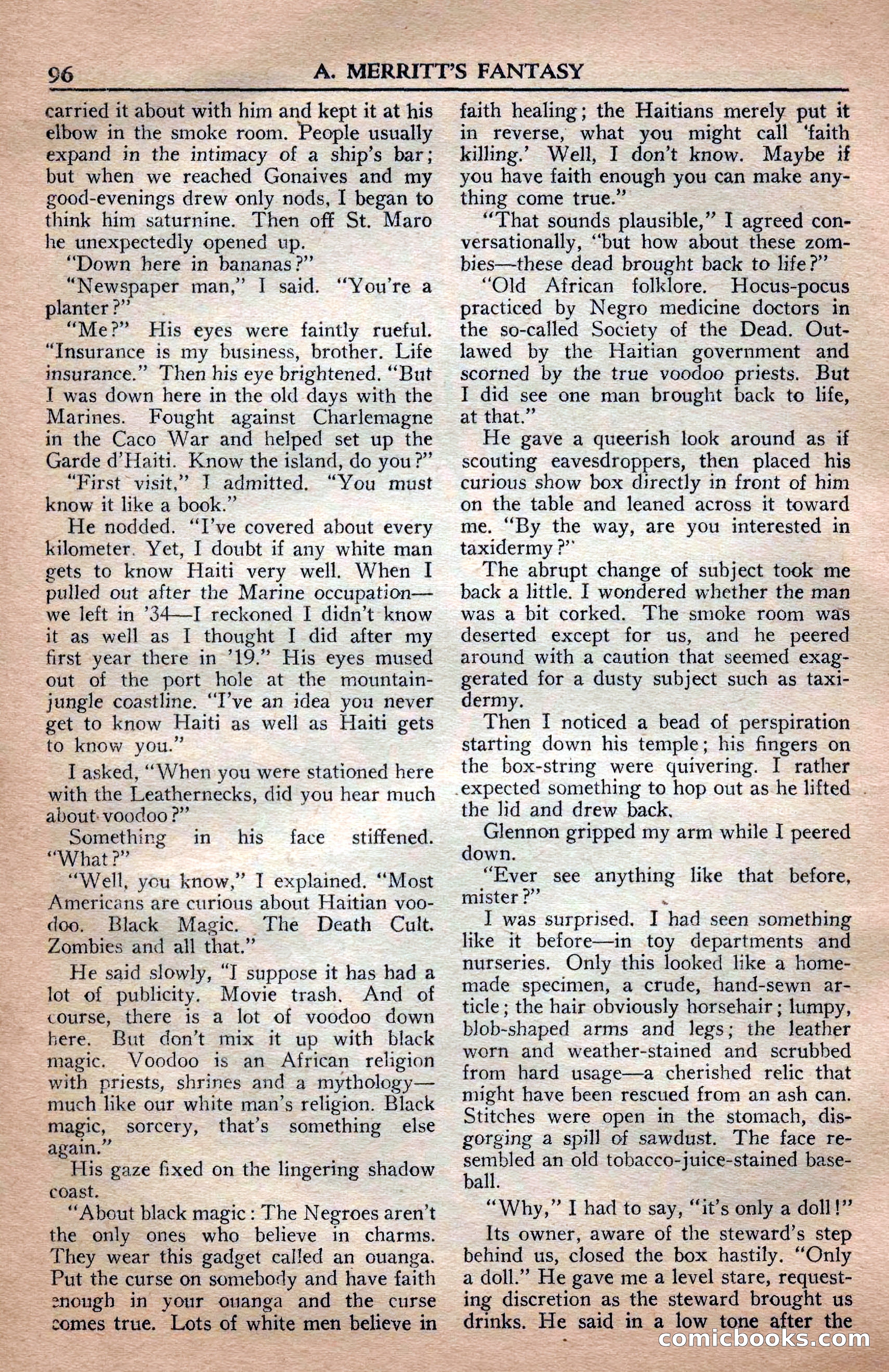
A restored page from Pulp Fiction, 1950. Page through the whole issue in the reader above.
📄 Transcribed text from this page (OCR, searchable)
Machine-transcribed from the original scan — historical spelling and the odd misread are preserved.
6 A. MERRITT’S FANTASY carried it about with him and kept it at his elbow in the smoke room. People usually expand in the intimacy of a ship’s bar; but when we reached Gonaives and my good-evenings drew only nods, I began to think him saturnine. Then off St. Maro he unexpectedly opened up. “Down here in bananas?” “Newspaper man,” I said. “You're a planter?” “Me?” His eyes were faintly rueful. “Insurance is my business, brother. Life insurance.” Then his eye brightened. “But I was down here in the old days with the Marines. Fought against Charlemagne in the Caco War and helped set up the Garde d’ Haiti. Know the island, do you ?”’ “First visit,’ I admitted. “You must know it like a book.” He nodded. “I’ve covered about every kilometer. Yet, I doubt if any white man gets to know Haiti very well. When I pulled out after the Marine occupation— we left in “34—I reckoned I didn’t know it as well as I thought I did after my first year there in 19.” His eyes mused out of the port hole at the mountain- jungle coastline. “I’ve an idea you never get to know Haiti as well as Haiti gets to know you.” I asked, “When you were stationed here with the Leathernecks, did you hear much about: voodoo P” Something in “What ?” “Well, you know,” I explained. “Most Americans are curious about Haitian voo- doo. Black Magic. The Death Cult. Zombies and all that.” He said slowly, “J suppose it has had a lot of publicity. Movie trash. And of course, there is a lot of voodoo down here. But don’t mix it up with black magic. Voodoo is an African religion with priests, shrines and a mythology— much like our white man’s religion. Black magic, sorcery, that’s something else again.” His gaze fixed on the lingering shadow coast. “About black magic: The Negroes aren’t the only ones who believe in charms. They wear this gadget called an ouanga. Put the curse on somebody and have faith enough in your ouanga and the curse his face stiffened. comes true. Lots of white men believe in faith healing; the Haitians merely put it in reverse, what you might call ‘faith killing.’ Well, I don’t know. Maybe if you have faith enough you can make any- thing come true.” | “That sounds plausible,” I agreed con- versationally, “but how about these zom- bies—these dead brought back to life?” “Old African folklore. Hocus-pocus practiced by Negro medicine doctors in the so-called Society of the Dead. Out- lawed by the Haitian government and scorned by the true voodoo priests. But I did see one man brought back to life, at that.” He gave a queerish look around as if scouting eavesdroppers, then placed his curious show box directly in front of him on the table and leaned across it toward me. “By the way, are you interested in taxidermy ?”’ The abrupt change of subject took me back a little. I wondered whether the man was a bit corked. The smoke room was deserted except for us, and he peered around with a caution that seemed exag- gerated for a dusty subject such as taxi- dermy. Then I noticed a bead of perspiration starting down his temple; his fingers on the box-string were quivering. I rather expected something to hop out as he lifted . the lid and drew back, Glennon gripped my arm while I peered down. “Ever see anything like that before, mister?” I was surprised. I had seen something like it before—in toy departments and nurseries. Only this looked like a home- made specimen, a crude, hand-sewn ar- ticle ; the hair obviously horsehair ; lumpy, blob-shaped arms and legs; the leather worn and weather-stained and scrubbed from hard usage—a cherished relic that might have been rescued from an ash can. Stitches were open in the stomach, dis- gorging a spill of sawdust. The face re- sembled an old tobacco-juice-stained base- ball. “Why,” I had to say, “it’s only a doll!” Its owner, aware of the steward’s step behind us, closed the box hastily. “Only a doll.” He gave me a level stare, request- ing discretion as the steward brought us drinks. He said in a low tone after the — CeCoyag) ieBook s.com