
Pulp Fiction, 1915 · page 108 of 228
Adventure, November 1915 — page 108: what you’re looking at
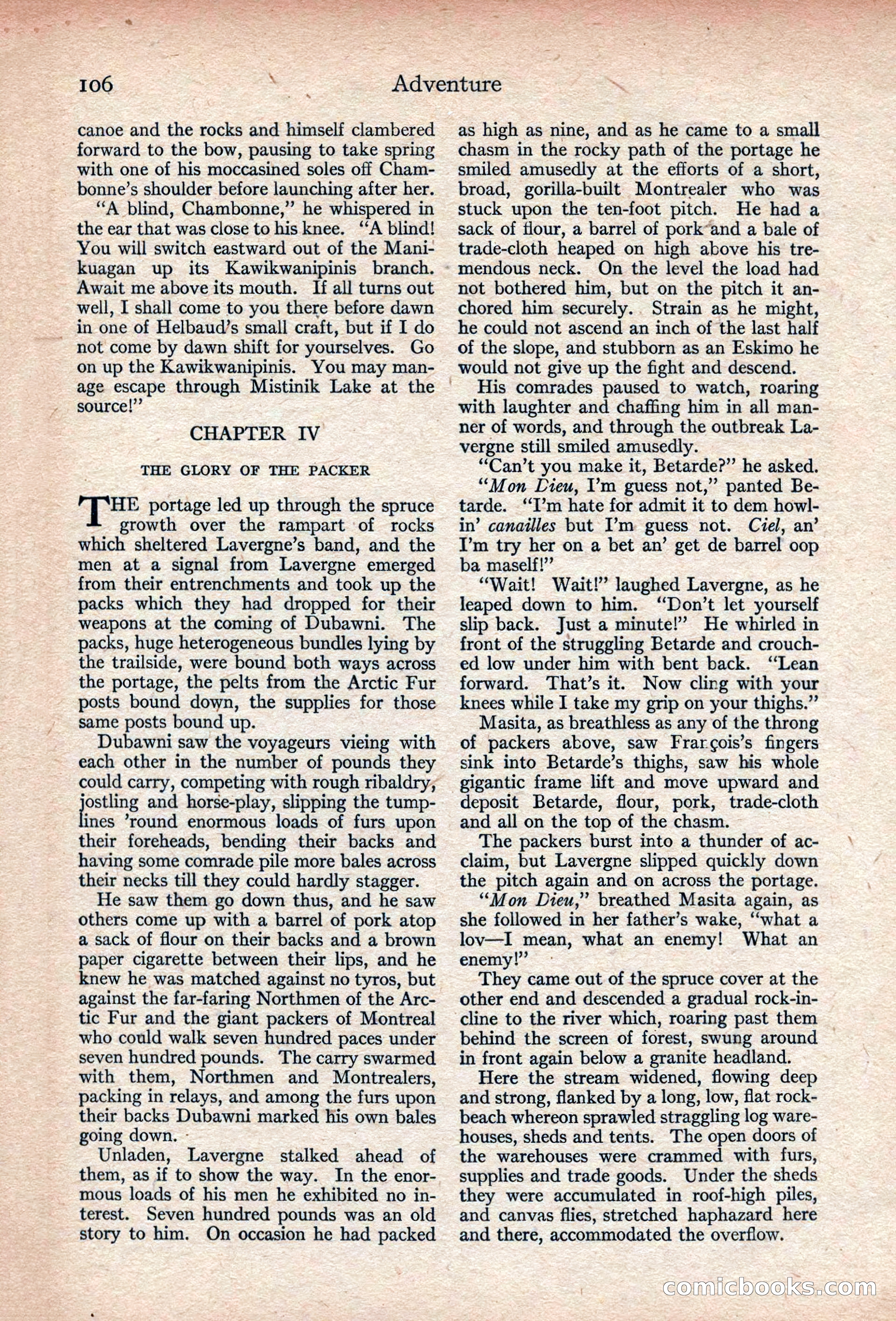
A restored page from Pulp Fiction, 1915. Page through the whole issue in the reader above.
📄 Transcribed text from this page (OCR, searchable)
Machine-transcribed from the original scan — historical spelling and the odd misread are preserved.
106 oe canoe and the rocks and himself clambered - forward to the bow, pausing to take spring with one of his moccasined soles off Cham- bonne’s shoulder before launching after her. ‘“‘A blind, Chambonne,” he whispered in the ear that was close to his knee. ‘‘A blind! You will switch eastward out of the Mani- kuagan up its Kawikwanipinis branch. Await me above its mouth. If all turns out well, I shall come to you there before dawn _ in one of Helbaud’s small craft, but if I do not come by dawn shift for yourselves. Go on up the Kawikwanipinis. You may man- age escape through Mistinik Lake at the © 9 ! source CHAPTER IV THE GLORY OF THE PACKER PP BE portage led up through the spruce growth over the rampart of rocks which sheltered Lavergne’s band, and the men at a signal from Lavergne emerged from their entrenchments and took up the packs which they had dropped for their weapons at the coming of Dubawni. The packs, huge heterogeneous bundles lying by the trailside, were bound both ways across the portage, the pelts from the Arctic Fur posts bound down, the supplies for those same posts bound up. Dubawni saw the voyageurs vieing with each other in the number of pounds they could carry, competing with rough ribaldry, qoatling and horse-play, slipping the tump- ines ’round enormous loads of furs upon their foreheads, bending their backs and having some comrade pile more bales across their necks till they could hardly stagger. He saw them go down thus, and he saw others come up with a barrel of pork atop a sack of flour on their backs and a brown paper cigarette between their lips, and he knew he was matched against no tyros, but against the far-faring Northmen of the Arc- tic Fur and the giant packers of Montreal who could walk seven hundred paces under seven hundred pounds. The carry swarmed with them, Northmen and Montrealers, packing in relays, and among the furs upon their backs Dubawni marked his own bales going down. - : Unladen, Lavergne stalked ahead of them, as if to show the way. In the enor- mous loads of his men he exhibited no in- terest. Seven hundred pounds was an old story to him. On occasion he had packed Adventure as high as nine, and as he came to a small chasm in the rocky path of the portage he smiled amusedly at the efforts of a short, broad, gorilla-built Montrealer who was stuck upon the ten-foot pitch. He had a sack of flour, a barrel of pork“and a bale of trade-cloth heaped on high above his tre- ‘ mendous neck. On the level the load had not bothered him, but on the pitch it an- chored him securely. Strain as he might, he could not ascend an inch of the last half of the slope, and stubborn as an Eskimo he would not give up the fight and descend. His comrades paused to watch, roaring with laughter and chaffing him in all man- ner of words, and through the outbreak La- vergne still smiled amusedly. “Can’t you make it, Betarde?”’ he asked. “Mon Dieu, I’m guess not,” panted Be- tarde. “I’m hate for admit it to dem howl- in’ canailles but I’m guess not. Ciel, an’ I’m try her on a bet an’ get de barrel oop ba maself!’’ “Wait! Wait!” laughed Lavergne, as he leaped down to him. ‘Don’t let yourself slip back. Just a minute!’ He whirled in front of the struggling Betarde and crouch- ed low under him with bent back. “Lean forward. That’s it. Now cling with your knees while I take my grip on your thighs.” Masita, as breathless as any of the throng of packers above, saw Frarcois’s fingers sink into Betarde’s thighs, saw his whole gigantic frame lift and move upward and deposit Betarde, flour, pork, trade-cloth and all on the top of the chasm. The packers burst into a thunder of ac- claim, but Lavergne slipped quickly down the pitch again and on across the portage. “Mon Dieu,’ breathed Masita again, as she followed in her father’s wake, “what a lov—I mean, what an enemy! What an enemy!” They came out of the spruce cover at the other end and descended a gradual rock-in- cline to the river which, roaring past them _ behind the screen of forest, swung around in front again below a granite headland. Here the stream widened, flowing deep and strong, flanked by a long, low, flat rock- beach whereon sprawled straggling log ware- houses, sheds and tents. The open doors of the warehouses were crammed with furs, supplies and trade goods. Under the sheds they were accumulated in roof-high piles, and canvas flies, stretched haphazard here and there, accommodated the overflow. Gomichboo S (CO)