
Pulp Fiction, 1915 · page 143 of 228
Adventure, November 1915 — page 143: what you’re looking at
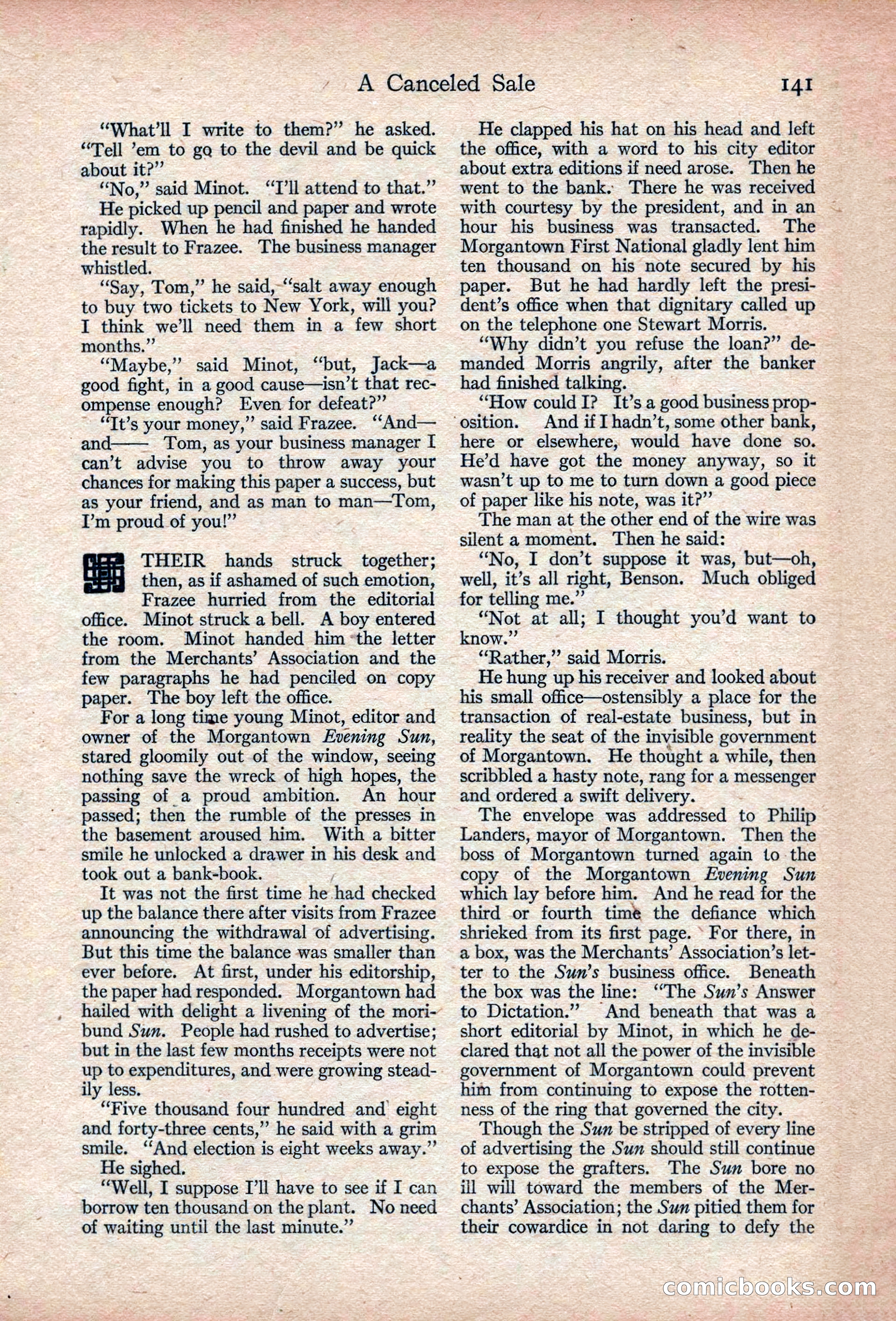
A restored page from Pulp Fiction, 1915. Page through the whole issue in the reader above.
📄 Transcribed text from this page (OCR, searchable)
Machine-transcribed from the original scan — historical spelling and the odd misread are preserved.
A Canceled Sale “What’ll I write to them?” he asked. “Tell ’em to gq to the devil and be quick about it?” “No,” said Minot. “T’ll attend to that.” He picked up pencil and paper and wrote rapidly. When he had finished he handed the result to Frazee. The business manager whistled. “Say, Tom,” he said,-“‘salt away enough to buy two tickets to N ew York, will you? I think we'll need them in a few short months,” “Maybe,” said Minot, “but, Jack—a good fight, in a good cause—isn’t that rec- ompense enough? Even for defeat?” ~ “Tt’s your money,” said Frazee. “And— -and—— Tom, as your business manager I can’t advise you to throw away your chances for making this paper a success, but as your friend, and as man to man—Tom, {?? I’m proud of you! THEIR hands struck together; then, as if ashamed of such emotion, Frazee hurried from the editorial office. Minot struck a bell. A boy entered the room. Minot handed him “the letter from the Merchants’ Association and the few paragraphs he had penciled on copy paper. The boy left the office. For a long time young Minot, editor and owner of the Morgantown Evening Sun, stared gloomily out of the window, seeing nothing save the wreck of high hopes, the passing of a proud ambition. An hour passed; then the rumble of the presses in the basement aroused him. With a bitter smile he unlocked a drawer in his desk and took out a bank-book. It was not the first time he had checked up the balance there after visits from Frazee announcing the withdrawal of advertising. But this time the balance was smaller than ever before. At first, under his editorship, the paper had responded. Morgantown had hailed with delight a livening of the mori- bund Sum. People had rushed to advertise; but in the last few months receipts were not up to eepemaitures, and were growing stead- ily less. “Five thotsand four hundred and’ eight and forty-three cents,”’ he said with a grim smile. “And election is eight weeks away.” He sighed. “Well, I suppose I’ll have to see if I can borrow ten thousand on the plant. No need of waiting until the last minute.” ‘osition. I4I He clapped his hat on his head and left the office, with a word to his city editor about extra editions if need arose. Then he went to the bank. There he was received with courtesy by the president, and in an hour his business was transacted. The Morgantown First National gladly lent him ten thousand on his note secured by his paper. But he had hardly left the presi- dent’s office when that dignitary called up on the telephone one Stewart Morris. “Why didn’t you refuse the loan?” de- manded Morris angrily, after the banker had finished talking. “How could I? It’s a good business prop- And if Ihadn’t, some other bank, here or elsewhere, would have done so. He’d have got the money anyway, so it wasn’t up to me to turn down a good piece of paper like his note, was it?” The man at the other end of the wire was silent a moment. Then he said: “No, I don’t suppose it was, but—oh, well, it’s all right, Benson. Much obliged for telling me.’ “Not at all; I thought you’d want to know.” “Rather,” said Morris. He hung up his receiver and looked about his small office—ostensibly a place for the transaction of real-estate business, but in reality the seat of the invisible government of Morgantown. He thought a while, then scribbled a hasty note, rang for a messenger and ordered a swift delivery. The envelope was addressed to Philip Landers, mayor of Morgantown. Then the boss of Morgantown turned again to the copy of the Morgantown Evening Sun which lay before him. And he read for the third or fourth time the defiance which shrieked from its first page. - For there, in a box, was the Merchants’ Association’s let- ter to the Sun’s business office. Beneath the box was the line: “The Sun’s Answer to Dictation.” And beneath that was a short editorial by Minot, in which he de- clared that not all the power of the invisible government of Morgantown could prevent him from continuing to expose the rotten-_ ness of the ring that governed the city. Though the Sun be stripped of every line of advertising the Sun should still continue to expose the grafters. The Sum bore no iil will toward the members of the Mer- chants’ Association; the Sun pitied them for — their cowardice in not daring to defy the com (Q) JOOKS (E(9)