
Pulp Fiction, 1915 · page 147 of 228
Adventure, November 1915 — page 147: what you’re looking at
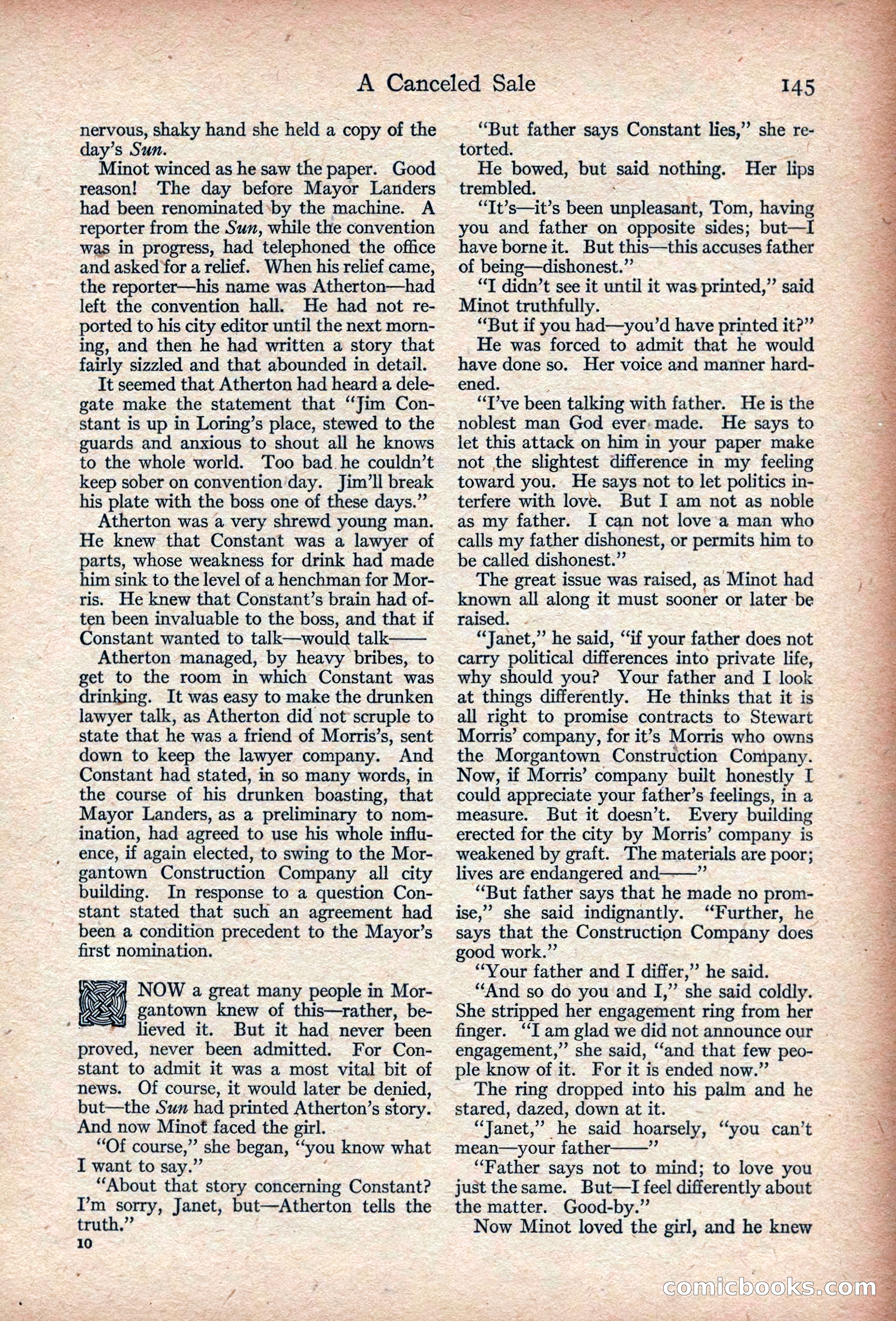
A restored page from Pulp Fiction, 1915. Page through the whole issue in the reader above.
📄 Transcribed text from this page (OCR, searchable)
Machine-transcribed from the original scan — historical spelling and the odd misread are preserved.
A Canceled Sale nervous, shaky hand she held a copy of the day’s Sun. Minot winced as he saw the paper. Good reason! The day before Mayor Landers had been renominated*by the machine. A reporter from the Sun, while the convention was in progress, had telephoned the office and asked for a relief. When his relief came, the reporter—his name was Atherton—had left the convention hall. He had not re- ported to his city editor until the next morn- ing, and then he had written a story that fairly sizzled and that abounded in detail. It seemed that Atherton had heard a dele- gate make the statement that “Jim Con- stant is up in Loring’s place, stewed to the guards and anxious to shout all he knows to the whole world. Too bad.he couldn’t keep sober on convention day. Jim/’ll break his plate with the boss one of these days.” Atherton was a very shrewd young man. He knew that Constant was a lawyer of parts, whose weakness for drink had made him sink to the level of a henchman for Mor- ris. He knew that Constant’s brain had of- ten been invaluable to the boss, and that if Constant wanted to talk—would talk—— Atherton managed, by heavy bribes, to get to the room in which Constant was drinking. It was easy to make the drunken lawyer talk, as Atherton did not scruple to state that he was a friend of Morris’s, sent down to keep the lawyer company. And Constant had stated, in so many words, in the course of his drunken boasting, that Mayor Landers, as a preliminary to nom- ination, had agreed to use his whole influ- ence, if again elected, to swing to the Mor- gantown Construction Company all city building. In response to a question Con- stant stated that such an agreement had been a condition precedent to the Mayor’s first nomination. NOW a great many people in Mor- vy, gantown knew of this—rather, be- ; " lieved it. But it had never been a, never been admitted. For Con- stant to admit it was a most vital bit of news. Of course, it would later be denied, but—the Sum had printed Atherton’s story. And now Minot faced the girl. “Of course,” she began, “you know what I want to say.’ “About that story concerning Constant? I’m sorry, Janets but—Atherton tells the truth,” 10 145 “But father says Constant lies,” she re- torted. aot He bowed, but said nothing. Her lips trembled. “Tt’s—it’s been ciple: Tom, having you and father on opposite sides; but—I have borne it. But this—this accuses father of being—dishonest.”’ “T didn’t see it until it was printed,” said Minot truthfully. “But if you had—you’d have printed it?” He was forced to admit that he would have done so. Her voice and manner hard- ened. “T’ve been talking with father. He is the noblest man God ever:made. He says to let this attack on him in your paper make not the slightest difference in my feeling toward you. He says not to let politics in- terfere with love. But I am not as noble as my father. I can not love'a man who calls my father dishonest, or permits him to be called dishonest.”’ The great issue was raised, as Minot had— known all along it must sooner or later be raised. | “Janet,” he said, “if your father does not carry political differences into private life, why should your Your father and I look at things differently. He thinks that it is all right to promise contracts to Stewart Morris’ company, for it’s Morris who owns the Morgantown Construction Conipany. Now, if Morris’ company built honestly I could appreciate your father’s feelings, in a measure. But it doesn’t. Every building erected for the city by Morris’ company is weakened by graft. The materials are poor; lives are endangered and——” “But father says that he made no prom- > ise,’ she said indignantly. “Further, he says that the Construction Company does good work.” “Your father and I differ,” he said. “‘And so do you and I,” she said coldly. She stripped her engagement ring from her finger. engagement,” she said, “and that few peo- ple know of it. For it is ended now.” The ring dropped into his palm and he stared, dazed, down at it. “Janet,” he said hoarsely, mean—your father-——”’ “Father says not to mind; to love you “vou can’t just thesame. But—I feel differently about © the matter. Good-by. Now Minot loved ar girl, and he knew econnichboolks “T am glad we did not announce our . (C0)