
Pulp Fiction, 1915 · page 157 of 228
Adventure, November 1915 — page 157: what you’re looking at
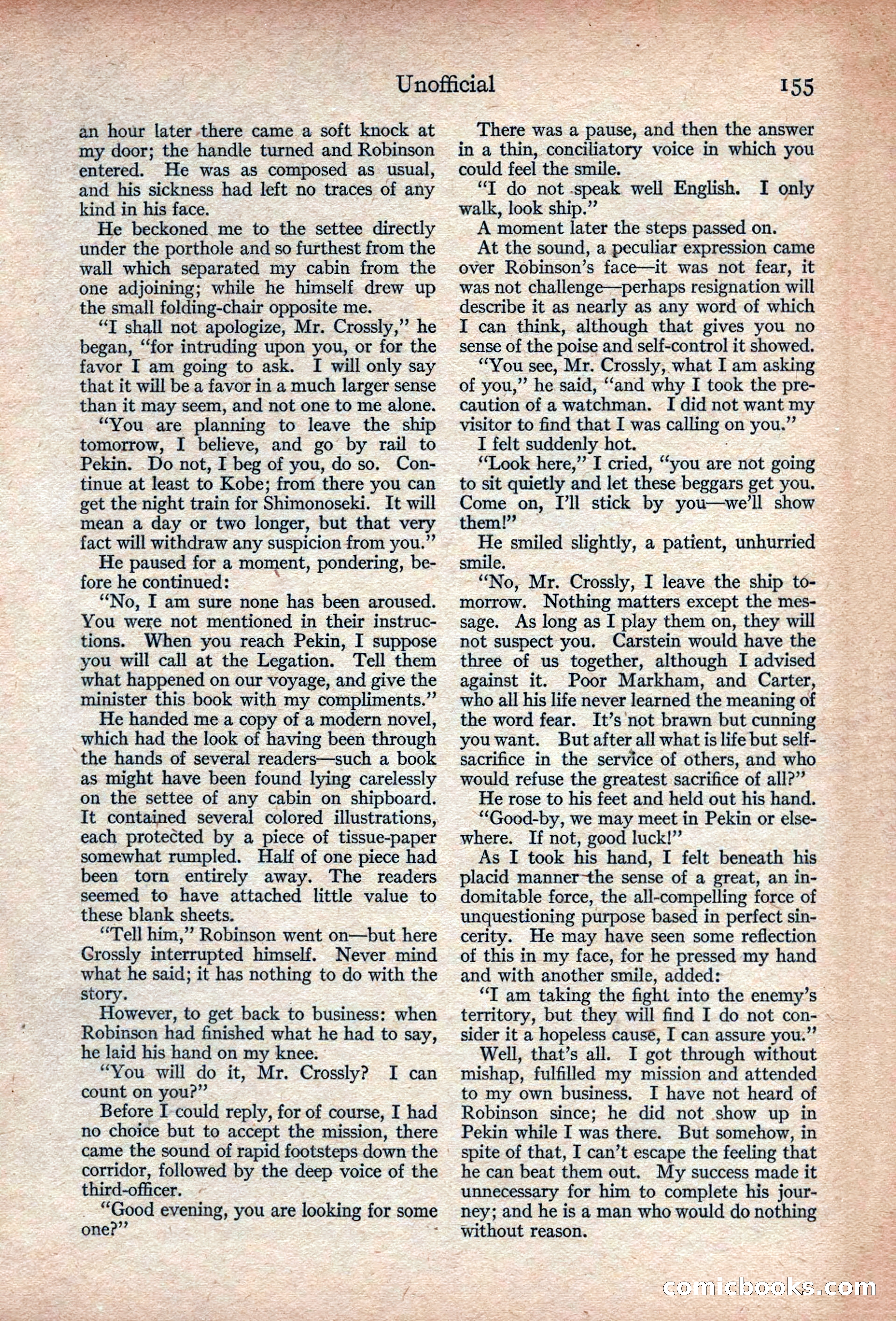
A restored page from Pulp Fiction, 1915. Page through the whole issue in the reader above.
📄 Transcribed text from this page (OCR, searchable)
Machine-transcribed from the original scan — historical spelling and the odd misread are preserved.
| Unofficial an hour later there came a soft knock at my door; the handle turned and Robinson entered. He was as composed as usual, and his sickness had left no traces of any kind in his face. He beckoned me to the settee directly under the porthole and so furthest from the wall which separated my cabin from the one adjoining; while he himself drew up the small folding-chair opposite me. “T shall not apologize, Mr. Crossly,”’ he began, ‘for intruding upon you, or for the favor I am going to ask. I will only say that it will be a favor in a much larger sense than it may seem, and not one to me alone. “You are planning to leave the ship tomorrow, I believe, and go by rail to Pekin. Do not, I beg of you, do so, Con- tinue at least to Kobe; from there you can get the night train for Shimonoseki. It will mean a day or two longer, but that very fact will withdraw any suspicion from you.’ He paused for a moment, pondering, be- fore he continued: “No, I am sure none has been aroused. You were not mentioned in their instruc- tions. When you reach Pekin, I suppose you will call at the Legation. Tell them what happened on our voyage, and give the minister this book with my compliments.” He handed me a copy of a modern novel, which had the look of having been through the hands of several readers—such a book as might have been found lying carelessly on the settee of any cabin on shipboard. It contained several colored illustrations, each protected by a piece of tissue-paper somewhat rumpled. Half of one piece had been torn entirely away. The readers seemed to have attached little value to these blank sheets. ‘Tell him,”’ Robinson went on—but here Grossly interrupted himself. Never mind what he said; it has nothing to do with the story. However, to get back to business: when Robinson had finished what he had to say, he laid his hand on my knee. “You will do it, Mr. Crossly? I can count on you?” Before I-could reply, for of course, I had no choice but to accept the mission, there came the sound of rapid footsteps down the | corridor, followed by the deep voice of the third-officer. | Sti evening, you are looking for some one?” There was a pause, and then the answer in a thin, conciliatory voice in which you could feel the smile. “T do not .speak well English. I only walk, look ship.” A moment later the steps passed on. At the sound, a peculiar expression came over Robinson’s face—it was not fear, it was not challenge—perhaps resignation will describe it as nearly as any word of which I can think, although that gives you no sense of the poise and self-control it showed. “You see, Mr. Crossly, what I am asking of you, ” he said, ‘‘and why I took the pre- caution of a watchman. I did not want my visitor to find that I was calling on you.’ I felt suddenly hot. “Look here,” I cried, “you are not going to sit quietly and let these beggars get you. Come on, I'll stick by you—we’ll show them!” He smiled slightly, a patient, unhurried smile ~ “No, Mr. Crossly, I leave the ship to- morrow. Nothing matters except the mes- sage. As long as I play them on, they will not suspect you. Carstein would have the three of us together, although I advised against it. Poor Markham, and Carter, who all his life never learned the meaning of the word fear. It’s not brawn but cunning — you want. But after all what is life but self- sacrifice in the service of others, and who would refuse the greatest sacrifice of all?” He rose to his feet and held out his hand. ““Good-by, we may meet in Pekin or else- where. If not, good luck!” As I took his hand, I felt beneath his placid manner-the sense of a great, an in- domitable force, the all-compelling force of unquestioning purpose based in perfect sin- cerity. He may have seen some reflection of this in my face, for he pressed my hand and with another smile, added: “T am taking the fight into the enemy’s | territory, but they will find I do not con- » ~ sider it a hopeless causé, I can assure you.” Well, that’s all. I got through without mishap, fulfilled my mission and attended to my own business. I have not heard of Robinson since; he did not show up in Pekin while I was there. But somehow, in spite of that, I can’t escape the feeling that he can beat them out. My success made it unnecessary for him to complete his jour- ney; and he is a man who would do nothing without reason. (COMAIUG IOoOKk