
Pulp Fiction, 1915 · page 187 of 228
Adventure, November 1915 — page 187: what you’re looking at
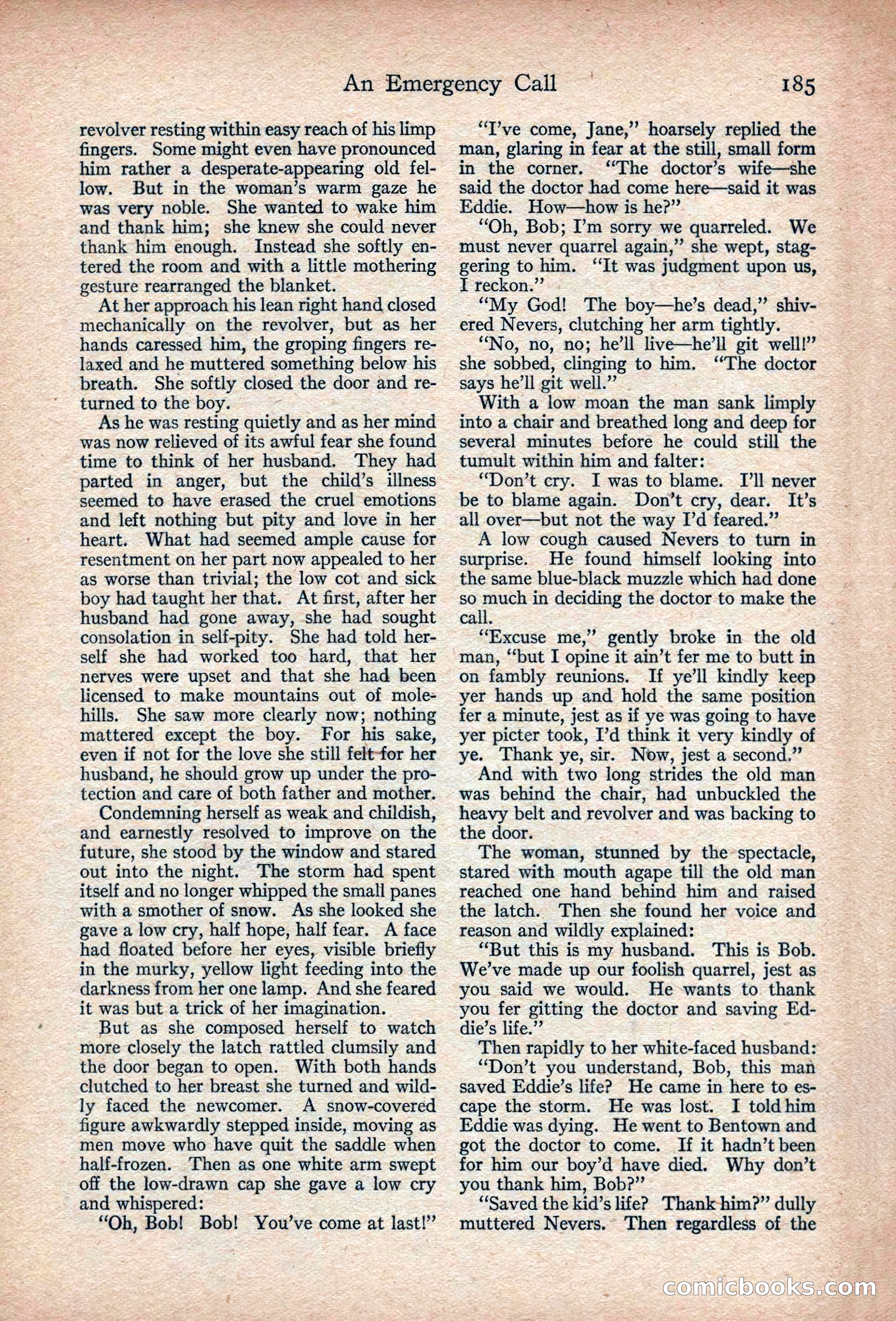
A restored page from Pulp Fiction, 1915. Page through the whole issue in the reader above.
📄 Transcribed text from this page (OCR, searchable)
Machine-transcribed from the original scan — historical spelling and the odd misread are preserved.
An Emergency Call revolver resting within easy reach of his limp. fingers. Some might even have pronounced him rather a desperate-appearing old fel- low. But in the woman’s warm gaze he was very noble. She wanted to wake him and thank him; she knew she could never thank him enough. Instead she softly en- tered the room and with a little mothering gesture rearranged the blanket. At her approach his lean right hand closed mechanically on the revolver, but as her hands caressed him, the groping fingers re- laxed and he muttered something below his breath. She softly closed the door and re- turned to the boy. é As he was resting quietly and as her mind was now relieved of its awful fear she found time to think of her husband. They had parted in anger, but the child’s illness seemed to have erased the cruel emotions and left nothing but pity and love in her heart. What had seemed ample cause for resentment on her part now appealed to her as worse than trivial; the low cot and sick boy had taught her that. At first, after her husband had gone away, she had sought consolation in self-pity. She had told her- self she had worked too hard, that her nerves were upset and that she had been licensed to make mountains out of mole- hills. She saw more clearly now; nothing mattered except the boy. For his sake, even if not for the love she still felt-for her husband, he should grow up under the pro- tection and care of both father and mother. Condemning herself as weak and childish, and earnestly resolved to improve on the future, she stood by the window and stared out into the night. The storm had spent itself and no longer whipped the small panes with a smother of snow. As she looked she gave a low cry, half hope, half fear. A face had floated before her eyes, visible briefly in the murky, yellow light feeding into the darkness from her one lamp. And she feared it was but a trick of her imagination. But as she composed herself to watch more closely the latch rattled clumsily and the door began to open. With both hands clutched to her breast she turned and wild- ly faced the newcomer. A snow-covered figure awkwardly stepped inside, moving as men move who have quit the saddle when half-frozen. Then as one white arm swept off the low-drawn cap she gave a low cry and whispered: “Oh, Bob! Bob! You’ve come at last!’ 185 “T’ye come, Jane,” hoarsely replied the man, glaring in fear at the still, small form in the corner. “The doctor’s wife—she said the doctor had come here—said it was Eddie. How—how is he?” “Oh, Bob; I’m sorry we quarreled. We must never quarrel again,” she wept, stag- gering to him. ‘It was judgment upon us, I reckon.” “My God! The boy—he’s dead,” shiv- ered Nevers, clutching her arm tightly. “No, no, no; he’ll live—he’ll git well!” she sobbed, clinging to him. ‘The doctor says he’ll git well.”’ With a low moan the man sank limply into a chair and breathed long and deep for several minutes before he could still the tumult within him and falter: “Don’t cry. I was to blame. I’ll never be to blame again. Don’t cry, dear. It’s all over—but not the way Id feared.” A low cough caused Nevers to turn in surprise. He found himself looking into the same blue-black muzzle which had done so much in deciding the doctor to make the call. “Excuse me,” gently broke in the old man, “but I opine it ain’t fer me to butt in on fambly reunions. If ye’ll kindly keep yer hands up and hold the same position fer a minute, jest as if ye was going to have yer picter took, I’d think it very kindly of ye. Thank ye, sir. Now, jest a second,” And with two long strides the old man was behind the chair, had unbuckled the heavy belt and revolver and was backing to the door. The woman, stunned by the spectacle, stared with mouth agape till the old man reached one hand behind him and raised the latch. Then she found her voice and reason and wildly explained: “But this is my husband. This is Bob. We’ve made up our foolish quarrel, jest as you said we would. He wants to thank you fer gitting the doctor and saving Ed- die’s life.” Then rapidly to her white-faced husband: “Don’t you understand, Bob, this man saved Eddie’s life? He came in here to es- cape the storm. He was lost. I told him Eddie was dying. He went to Bentown and got the doctor to come. If it hadn’t been for him our boy’d have died. Why don’t you thank him, Bob?” “Saved the kid’s life? Thankhim?” dully muttered Nevers. Then regardless of the Gomichoo Ss