
Pulp Fiction, 1915 · page 189 of 228
Adventure, November 1915 — page 189: what you’re looking at
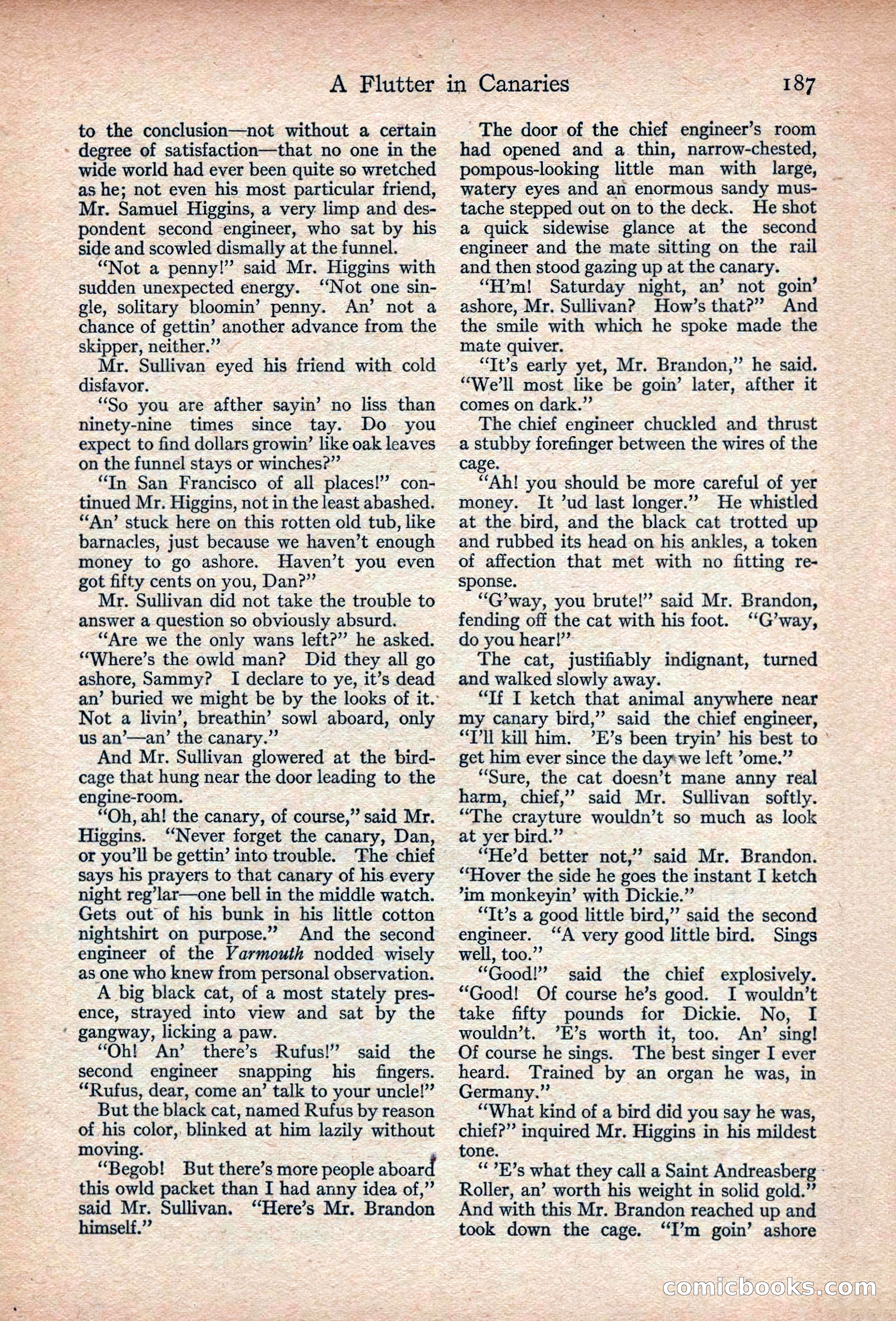
A restored page from Pulp Fiction, 1915. Page through the whole issue in the reader above.
📄 Transcribed text from this page (OCR, searchable)
Machine-transcribed from the original scan — historical spelling and the odd misread are preserved.
em = ~~ Fh EE oo as a POR EI “= ap. > a eg A Flutter to the conclusion—not without a certain ~ degree of satisfaction—that no one in the wide world had ever been quite so wretched as he; not even his most particular friend, Mr. Samuel Higgins, a very limp and des- pondent second engineer, who sat by his side and scowled dismally at the funnel. “Not a penny!” said Mr. Higgins with sudden unexpected energy. ‘Not one sin- gle, solitary bloomin’ penny. An’ not a chance of gettin’ another advance from the skipper, neither.” Mr. Sullivan eyed his friend with cold disfavor. “So you are afther sayin’ no liss than ninety-nine times since tay. Do- you expect to find dollars growin’ like oak leaves on the funnel stays or winches?” “In San Francisco of all places!” con- tinued Mr. Higgins, not in the least abashed. ‘An’ stuck here on this rotten old tub, like barnacles, just because we haven’t enough money to go ashore. Haven’t you even got fifty cents on you, Dan?” Mr. Sullivan did not take the trouble to answer a question so obviously absurd. ““Are we the only wans left?” he asked. “‘Where’s the owld man? Did they all go ashore, Sammy? I declare to ye, it’s dead an’ buried we might be by the looks of it. Not a livin’, breathin’ sowl aboard, only us an’—an’ the canary.” And Mr. Sullivan glowered at the bird- cage that hung near the door leading to the engine-room. “Oh, ah! the canary, of course,” said Mr. Higgins. “Never forget the canary, Dan, or you'll be gettin’ into trouble. The chief says his prayers to that canary of his every night reg’lar—one bell in the middle watch. Gets out of his bunk in his little cotton nightshirt on purpose.” And the second engineer of the Yarmouth nodded wisely as one who knew from personal observation. A big black cat, of a most stately pres- ence, strayed into view and sat by the ‘ gangway, licking a paw. “Oh! An’ there’s Rufus!” said the second engineer snapping his fingers. “Rufus, dear, come an’ talk to your uncle!” - But the black cat, named Rufus by reason of his color, blinked at him lazily without movin “Begob! But there’s more people aboard this owld packet than I had anny idea of,” said Mr. Sullivan, ‘“Here’s Mr. Brandon himself.” 3 in Canaries 187 The door of the chief engineer’s room had opened and a. thin, narrow-chested, pompous-looking little man with large, _ watery eyes and an enormous sandy mus- tache stepped out on to the deck. He shot a quick sidewise glance at the second engineer and the mate sitting on the rail and then stood gazing up at the canary. “H’m! Saturday night, an’ not goin’ ashore, Mr. Sullivan? How’s that?” And the smile with which he spoke made the mate quiver. “Tt’s early yet, Mr. Brandon, ” he said. “We'll most like be goin’ later, afther it comes on dark.” The chief engineer chuckled and thrust a stubby forefinger between the wires of the cage. ‘“‘Ah! you should be more careful of yer money. It ’ud last longer.” He whistled at the. bird, and the black cat trotted up and rubbed its head on his ankles, a token of affection that met with no fitting re- sponse. “G’way, you brute!” said Mr. Brandon, fending off the cat with his foot. ‘“‘G’way, do you hear!’’ The cat, justifiably indignant, turned and walked slowly away. “Tf I ketch that animal anywhere near my canary bird,” said the chief engineer, “Vil kill him. get him ever since the day: we left ’ome.’ “Sure, the cat doesn’t mane anny real harm, chief, ” said Mr. Sullivan softly. “The crayture wouldn’t so much as look at yer bird.” ~ “He’d better not,” said Mr. Brandon. “‘Hover the side he goes the instant I ketch "im monkeyin’ with Dickie.” “It’s a good little bird,’”’ said the second engineer. “A very good little bird. Sings well, too.” “Good!” said the chief explosively. “Good! Of course he’s good. I wouldn’t take fifty pounds for Dickie. No, I wouldn’t. ’E’s worth it, too. An’ sing! Of course he sings. The best singer I ever heard. Trained by an organ he was, in Germany.” “What kind of a bird did you say he was, chief?” inquired Mr. Higgins in his mildest tone. *°R’s what they call a Saint Andreasberg ° Roller, an’ worth his weight in solid gold.” And with this Mr. Brandon reached up and took down the cage. “I’m goin’ ashore GEomichoo ’E’s been tryin’ his best to ° (©) rons oS —_ aes x aT —— eas Fete, Wea oS eg LAL S