
Pulp Fiction, 1915 · page 191 of 228
Adventure, November 1915 — page 191: what you’re looking at
A restored page from Pulp Fiction, 1915. Page through the whole issue in the reader above.
📄 Transcribed text from this page (OCR, searchable)
Machine-transcribed from the original scan — historical spelling and the odd misread are preserved.
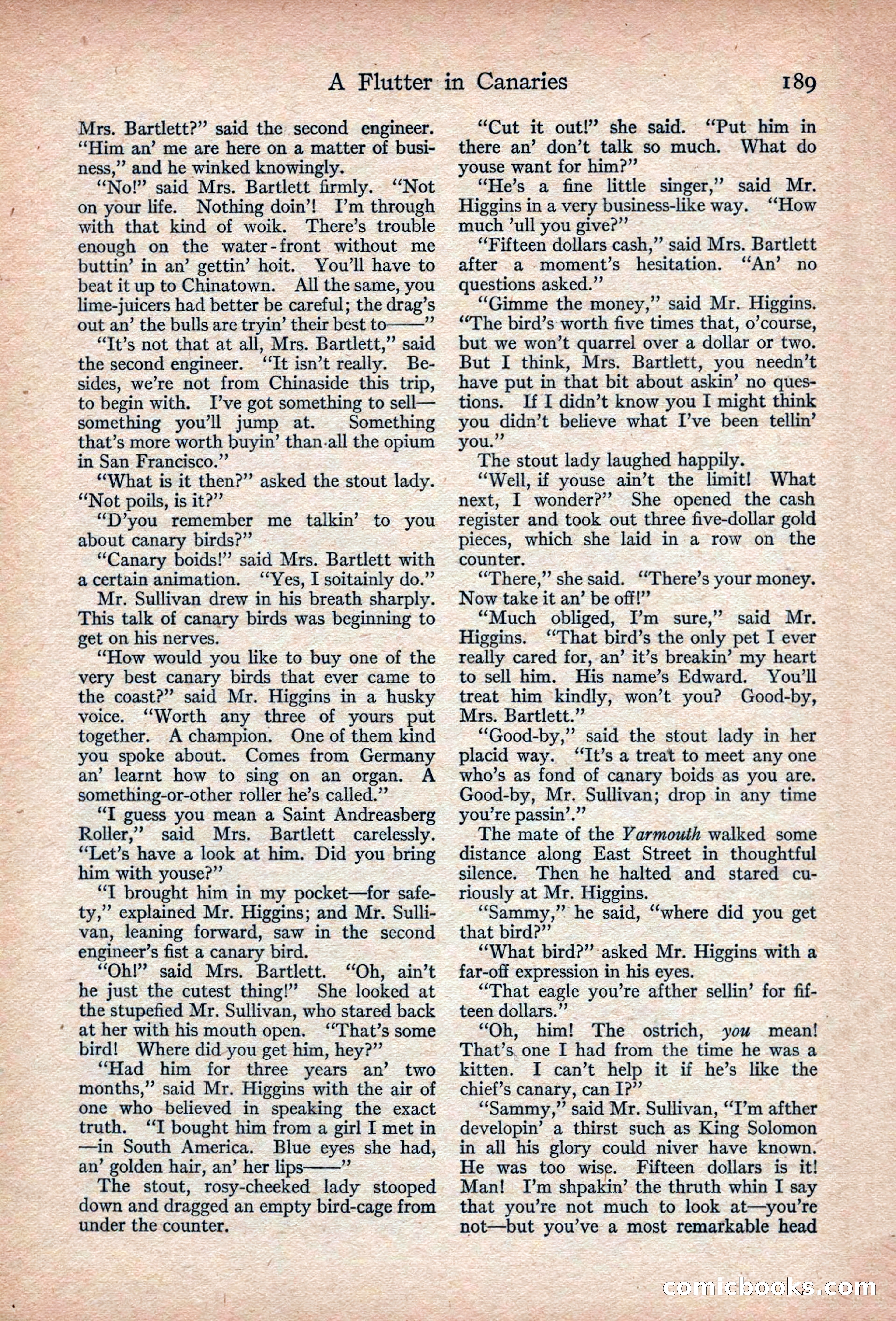
A Flutter in Canaries Mrs. Bartlett?” said the second engineer. “Him an’ me are here on a matter of busi- ness,” and he winked knowingly. “No!” said Mrs. Bartlett firmly. “Not on your life. Nothing doin’! I’m through with that kind of woik. There’s trouble enough on the water-front without me buttin’ in an’ gettin’ hoit. You'll have to beat it up to Chinatown. All the same, you lime-juicers had better be careful; the drag’s out an’ the bulls are tryin’ their best to——” “Tt’s not that at all, Mrs. Bartlett,” said the second engineer. “It isn’t really. Be- sides, we’re not from Chinaside this trip, to begin with. I’ve got something to sell— something you'll jump at. Something that’s more worth buyin’ than.-all the opium in San Francisco.” “What is it then?” asked the stout lady. “Not poils, is it?” “D’you remember me talkin’ to you about canary birds?” “Canary boids!” said Mrs. Bartlett with a certain animation. ‘Yes, I soitainly do.”’ Mr. Sullivan drew in his breath sharply. This talk of canary birds was beginning to get on his nerves. “How would you like to buy one of the very best canary birds that ever came to the coast?” said Mr. Higgins in a husky voice. “Worth any three of yours put together. A champion. One of them kind you spoke about. Comes from Germany an’ learnt how to sing on an organ. A something-or-other roller he’s called.” “T guess you mean a Saint Andreasberg Roller,” said Mrs. Bartlett carelessly. “Let’s have a look at him. Did you bring him with youse?”’ “T brought him in my pocket—for safe- ty,” explained Mr. Higgins; and Mr. Sulli- van, leaning forward, saw in the second engineer’s fist a canary bird. _ “Ohl? said Mrs. Bartlett. he just the cutest thing!’ the stupefied Mr. Sullivan, who stared back ‘ at her with his mouth open. ‘That’s some bird! Where did you get him, hey?” “Had him for three years an’ two months,” said Mr. Higgins with the air of one who believed in speaking the exact truth. “TI bought him from a girl I met in —in South America. Blue eyes she had, an’ golden hair, an’ her lips——”’ The stout, Tosy-cheeked. lady stooped down and dragged an empty bird-cage from under the counter. “Oh, ain’t She looked at - 189 “Cut It out!” she said. “Put him in there an’ don’t talk so anes What do youse want for him?” “He’s a fine little singer,” said Mr. Higgins in a very business-like way. “How much ’ull you give?” “Fifteen dollars cash,” said Mrs. Bartlett after a-moment’s hesitation. ‘An’ no questions asked.” “Gimme the money,” said Mr. Higgins. “The bird’s worth five times that, o’course, but we won’t quarrel over a dollar or two. But I think, Mrs. Bartlett, you needn’t have put in that bit about askin’ no ques- tions. If I didn’t know you I might think you didn’t believe what I’ve Seen tellin’ you.” The stout lady laughed happily. “Well, if youse ain’t the limit! What next, I wonder?” She opened the cash register and took out three five-dollar gold pieces, which she laid in a row on the counter. “There,”’ she said. Now take it an’ be off!” “Much obliged, I’m sure,” said Mr. Higgins. ‘“That bird’s the only pet I ever really cared for, an’ it’s breakin’ my heart to sell him. His name’s Edward. You'll treat him kindly, won’t you? Good-by, Mrs. Bartlett.” “Good-by,”’ said the stout lady in her placid way. “It’s a treat to meet any one who’s as fond of canary boids as you are. Good-by, Mr. Sullivan; drop in any time you're passin’,” The mate of the Yarmouth walked some distance along East Street in thoughtful silence. Then he halted and stared cu- riously at Mr. Higgins. “Sammy,” he said, “where did you get that bird?” “What bird?” asked Mr. Higgins with a far-off expression in his eyes. “That eagle you’re afther sellin’ for fif- teen dollars.”’ “Oh, him! That’s one I had from the time he was a kitten. I can’t help it if he’s like the chief’s canary, can 1?” “Sammy,” said Mr. Sullivan, “I’m afther developin’ a thirst such as King Solomon in all his glory could niver have known. He was too wise. Fifteen dollars is it! Man! I’m shpakin’ the thruth whin I say that you’re not much to look at—you’re not—but you’ve a most remarkable head 3OO ECOMNE SS ate 4 “‘There’s your money. The ostrich, you mean! (El)