
Pulp Fiction, 1915 · page 196 of 228
Adventure, November 1915 — page 196: what you’re looking at
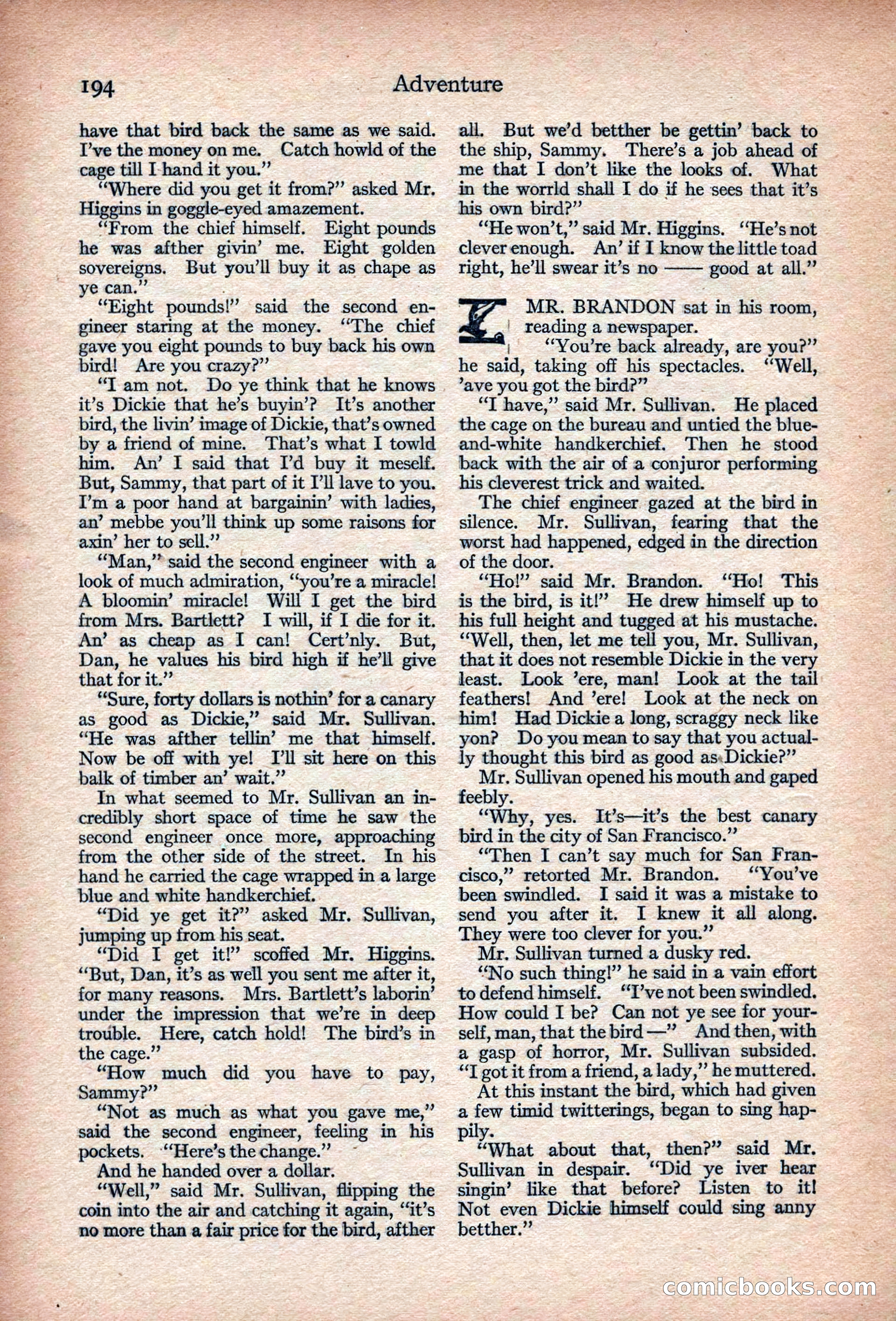
A restored page from Pulp Fiction, 1915. Page through the whole issue in the reader above.
📄 Transcribed text from this page (OCR, searchable)
Machine-transcribed from the original scan — historical spelling and the odd misread are preserved.
194 have that bird back the same as we said. I’ve the money on me. | Catch howld of the cage till I-hand it you.” “Where did you get it from?” asked Mr. Higgins in goggle-eyed amazement. “From the chief himself. Eight pounds he was afther givin’ me, Eight golden sovereigns. But you'll buy it as chape as ye can.’ “Eight pounds!” said the second en- gineer staring at the money. ‘The chief gave you eight pounds to buy back his own bird! Are you crazy?”’ “Tam not. Do ye think that he knows it’s Dickie that he’s buyin’? It’s another bird, the livin’ image of Dickie, that’s owned by a friend of mine. That’s what I towld him, An’ I said that [’'d buy it meself. But, Sammy, that part of it I'll lave to you. I’m a poor hand at bargainin’ with ladies, an’ mebbe you'll think up some raisons for axin’ her to sell.” “Man,” said the second engineer with a look of much admiration, “‘you’re a miracle! A bloomin’ miracle! Will I get the bird from Mrs. Bartlett? I will, if I die for it. An’ as cheap as I can! Cert’nly. But, Dan, he values his bird high ul he’ll give that for it.” “Sure, forty dollars is nothin’ for a canary as good as Dickie,” said Mr. Sullivan. “He was afther tellin’ me that himself. Now be off with ye! T’ll sit here on this balk of timber an’ wait.” In what seemed to Mr. Sullivan an in- credibly short space of time he saw the second engineer once more, approaching from the other side of the street. In his hand he carried the cage wrapped in a large blue and white handkerchief. “Did ye get it?” asked Mr. Sullivan, jumping up from his seat. “Did I get it!” scoffed Mr. Higgins. “But, Dan, it’s as well you sent me after it, for many reasons. Mrs. Bartlett’s laborin’ under the impression that we’re in deep trouble. Here, catch hold! The bird’s in the cage.” “Flow much did you have to pay, Sammy?” “Not as much as what you gave me,” said the second engineer, feeling in his pockets. “‘Here’sthechange.” — And he handed over a dollar. “Well,” said Mr. Sullivan, flipping the coin into the air and catching it again, “it’s no more than a fair price for the bird, afther ee es) Ln oe >a ee Ff Sg a ag = OP BS As a ee Se SO ee Se A Pte eee ee > a ye esse ee KS al, eA Adventure all, But we'd betther be gettin’ back to the ship, Sammy. There’s a job ahead of me that I don’t like the looks of. What in the worrld shall I do if he sees that it’s his own bird?” “He won't,” said Mr. Higgins. cleverenough. An’ if I know thelittle toad right, he’ll swear it’s no —— good at all.” MR. BRANDON sat in his room, | reading a newspaper. i “You're back already, are your” he said, taking off his spectacles. ‘Well, ’ave you got the bird?” “T have,” said Mr. Sullivan. He placed the cage on the bureau and untied the blue- and-white handkerchief. Then he stood back with the air of a conjuror performing his cleverest trick and waited. The chief engineer gazed at the bird in silence. Mr. Sullivan, fearing that the worst had happened, edged in the direction of the door. “Ho!” said Mr. Brandon. “Ho! This is the bird, is it!” He drew himself up to his full height and tugged at his mustache. “Well, then, let me tell you, Mr. Sullivan, that it does not resemble Dickie in the very least. Look ’ere, man! Look at the tail feathers! And ’ere! Look at the neck on him! Had Dickie a long, scraggy neck like yon? Do you mean to say that you actual- ly thought this bird as good as«Dickie?”’ Mr. Sullivan opened his mouth and gaped feebly. “Why, yes. It’s—it’s the best canary bird in the city of San Francisco.’ “Then I can’t say much for San Fran- cisco,” retorted Mr. Brandon. ‘‘You’ve been swindled. I said it was a mistake to send you after it. I knew it all along. They were too clever for you.” Mr. Sullivan turned a dusky red. “No such thing!” he said in a vain effort to defend himself. “I’ve not been swindled. How could I be? Can not ye see for your- self, man, that the bird ——” And then, with a gasp of horror, Mr. Sullivan subsided. “T got it from a friend, a lady,” he muttered. At this instant the bird, which had given = ie timid twitterings, began to sing hap- Pe What about that, then?” said Mr. Sullivan in despair. “Did ye iver hear singin’ like that before? Listen to itl! Not even Dickie himself could sing anny betther.”’ ee Rh ag Pre eae Seay Pee = ‘“He’s not (EO PNIE OOO KS (Eo)