
Pulp Fiction, 1915 · page 205 of 228
Adventure, November 1915 — page 205: what you’re looking at
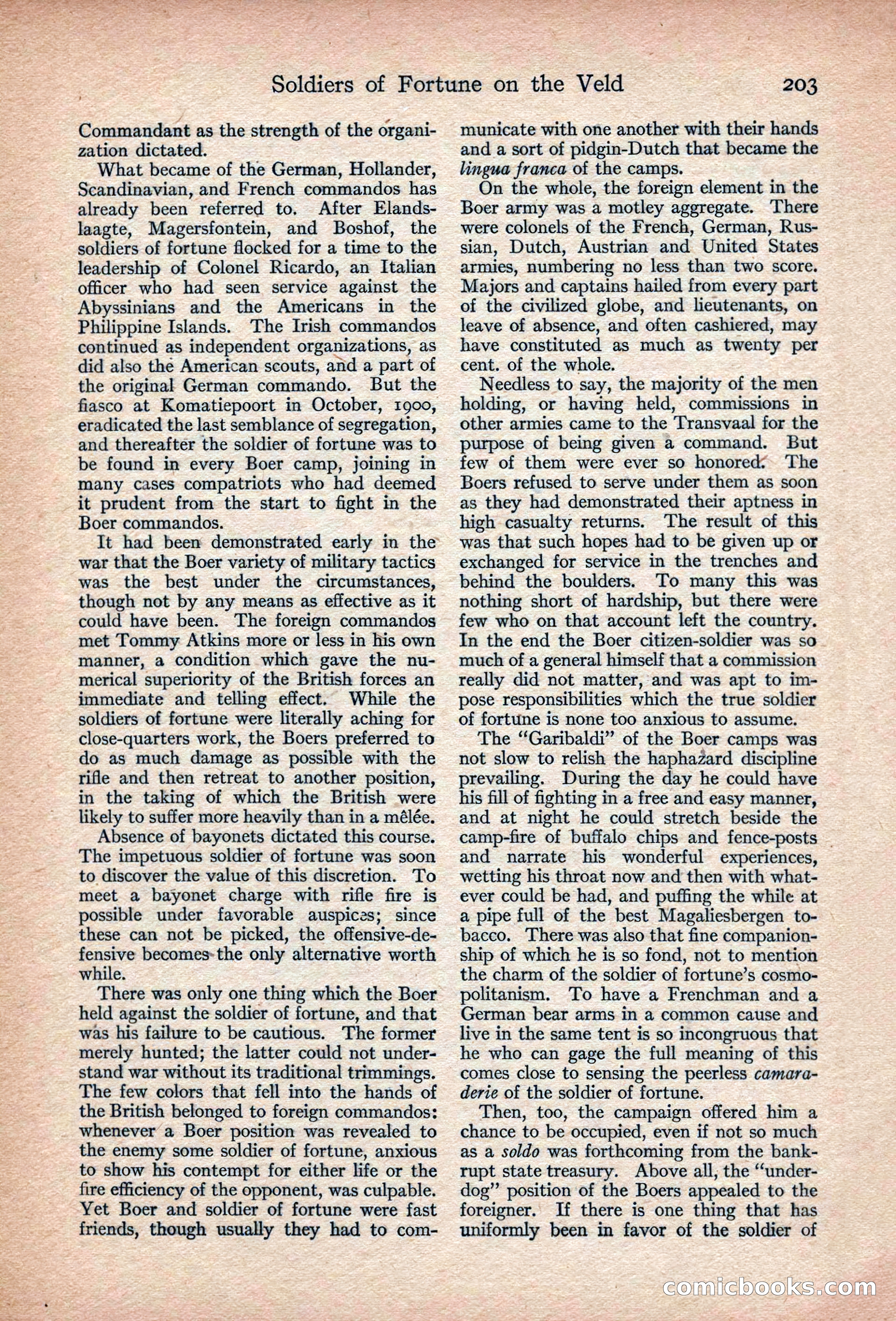
A restored page from Pulp Fiction, 1915. Page through the whole issue in the reader above.
📄 Transcribed text from this page (OCR, searchable)
Machine-transcribed from the original scan — historical spelling and the odd misread are preserved.
Soldiers of Fortune on the Veld Commandant as the strength of the organi- zation dictated. What became of the German, Hollander, Scandinavian, and French commandos has already been referred to, After Elands- laagte, Magersfontein, and Boshof, the soldiers of fortune flocked for a time to the leadership of Colonel Ricardo, an Italian officer who had seen service against the Abyssinians and the Americans in the Philippine Islands. The Irish commandos continued as independent organizations, as did also the American scouts, and a part of the original German commando. But the fiasco at Komatiepoort in October, 1900, eradicated the last semblance of segregation, and thereafter the soldier of fortune was to be found in every Boer camp, joining in many cases compatriots who had deemed it prudent from the start to fight in the Boer commandos. It had been demonstrated early in the war that the Boer variety of military tactics was the best under the circumstances, though not by any means as effective as it could have been. The foreign commandos met Tommy Atkins more or less in his own manner, a condition which gave the nu- merical superiority of the British forces an immediate and telling effect. While the soldiers of fortune were literally aching for close-quarters work, the Boers preferred to do as much damage as possible with the rife and then retreat to another position, in the taking of which the British were likely to suffer more heavily than in a mélée. Absence of bayonets dictated this course. The impetuous soldier of fortune was soon to discover the value of this discretion. To meet a bayonet charge with rifle fire is possible under favorable auspices; since these can not be picked, the offensive-de- fensive becomes-the only alternative worth while. There was only one thing which the Boer held against the soldier of fortune, and that was his failure to be cautious. The former merely hunted; the latter could not under- stand war without its traditional trimmings. The few colors that fell into the hands of the British belonged to foreign commandos: whenever a Boer position was revealed to the enemy some soldier of fortune, anxious to show his contempt for either life or the fire efficiency of the opponent, was culpable. Yet Boer and soldier of fortune were fast friends, though usually they had to com- 203 municate with one another with their hands and a sort of pidgin-Dutch that became the lingua franca of the camps. On the whole, the foreign element in the Boer army was a motley aggregate. There were colonels of the French, German, Rus- sian, Dutch, Austrian and United States armies, numbering no less than two score. Majors and captains hailed from every part of the civilized globe, and lieutenants, on leave of absence, and often cashiered, may have constituted as much as twenty per cent. of the whole. Needless to say, the majority of the men holding, or having held, commissions in other armies came to the Transvaal for the purpose of being given a command. But few of them were ever so honored: The Boers refused to serve under them as soon as they had demonstrated their aptness in high casualty returns. The result of this was that such hopes had to be given up or exchanged for service in the trenches and behind the boulders. To many this was nothing short of hardship, but there were few who on that account left the country. In the end the Boer citizen-soldier was so much of a general himself that a commission really did not matter, and was apt to im- pose responsibilities which the true soldier of fortune is none too anxious to assume. The “Garibaldi” of the Boer camps was not slow to relish the haphazard discipline prevailing. During the day he could have his fill of fighting in a free and easy manner, and at night he could stretch beside the camp-fire of buffalo chips and fence-posts | and narrate his wonderful experiences, wetting his throat now and then with what- ever could be had, and puffing the while at a pipe full of the best Magaliesbergen to- bacco. There was also that fine companion- ship of which he is so fond, not to mention the charm of the soldier of fortune’s cosmo- politanism. To have a Frenchman and a German bear arms in a common cause and live in the same tent is so incongruous that he who can gage the full meaning of this comes close to sensing the peerless camara- derie of the soldier of fortune. Then, too, the campaign offered him a chance to be occupied, even if not so much as a soldo was forthcoming from the bank- rupt state treasury. Above all; the “under- dog” position of the Boers appealed to the foreigner. If there is one thing that has uniformly been in favor of the soldier of Gomicbooks (<0) im