
Pulp Fiction, 1915 · page 214 of 228
Adventure, November 1915 — page 214: what you’re looking at
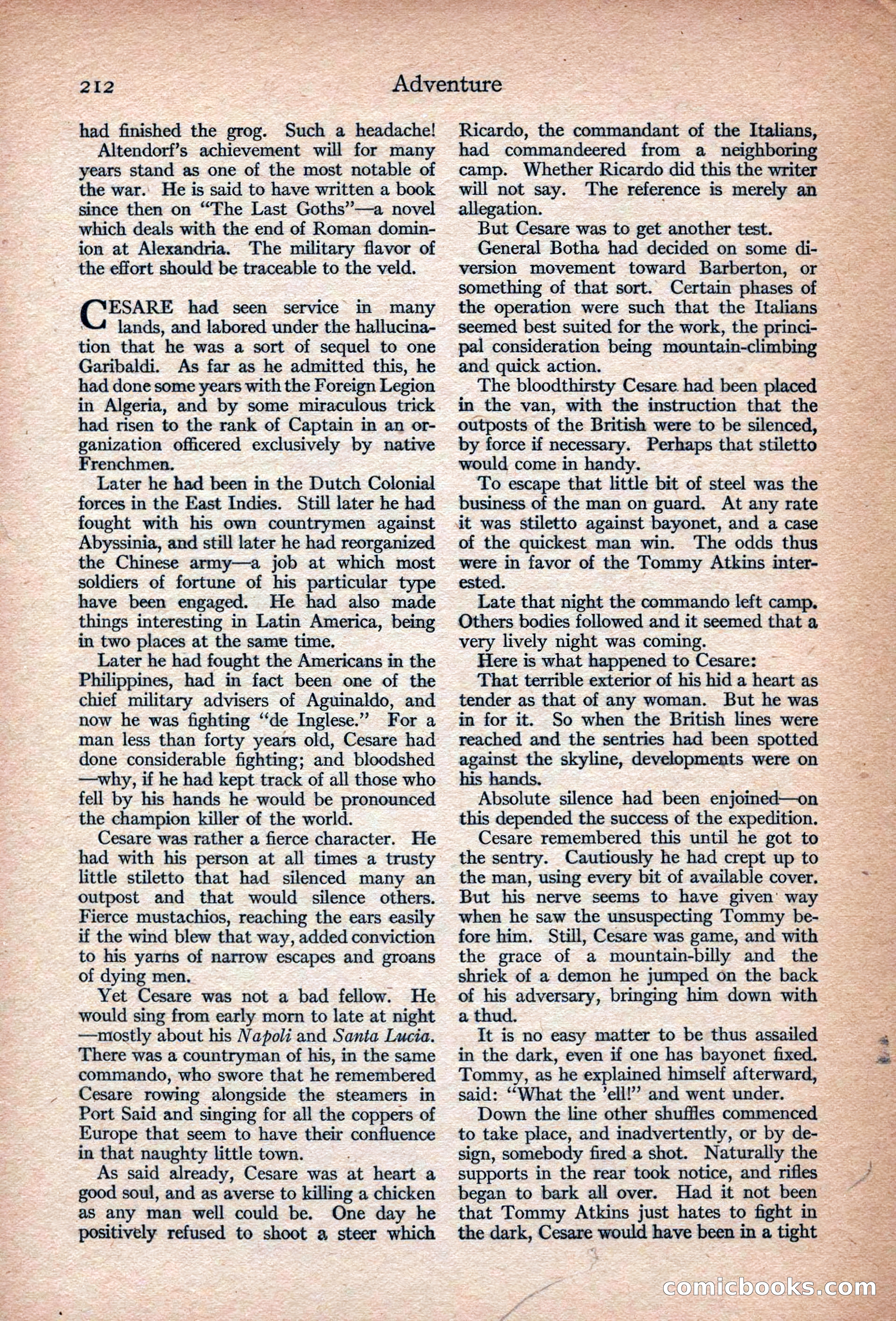
A restored page from Pulp Fiction, 1915. Page through the whole issue in the reader above.
📄 Transcribed text from this page (OCR, searchable)
Machine-transcribed from the original scan — historical spelling and the odd misread are preserved.
Z Ie Fe: i to ae é ae nee ao Dual 212 had finished the grog. Such a headache! Altendorf’s achievement will for many years stand as one of the most notable of the war. He is said to have written a book since then on “The Last Goths”—a novel which deals with the end of Roman domin- ion at Alexandria. The military flavor of the effort should be traceable to the veld. es had seen service in many lands, and labored under the hallucina- tion that he was a sort of sequel to one Garibaldi. As far as he admitted this, he had done some years with the Foreign Legion in Algeria, and by some miraculous trick had risen to the rank of Captain in an or- ganization officered exclusively by native Frenchmen. Later he had been in the Dutch Colonial forces in the East Indies. Still later he had fought with his own countrymen against Abyssinia, and still later he had reorganized the Chinese army—a job at which most soldiers of fortune of his particular type have been engaged. He had also made things interesting in Latin America, being in two places at the same time, Later he had fought the Americans in the Philippines, had in fact been one of the chief military advisers of Aguinaldo, and now he was fighting “de Inglese.” For a man less than forty years old, Cesare had done considerable fighting; and bloodshed —why, if he had kept track of all those who fell by his hands he would be pronounced - the champion killer of the world. Cesare was rather a fierce character. He had with his person at all times a trusty little stiletto that had silenced many an outpost and that would silence others. Fierce mustachios, reaching the ears easily if the wind blew that way, added conviction to his yarns of narrow escapes and groans of dying men. Yet Cesare was not a bad fellow. He would sing from early morn to late at night —miostly about his Napoli and Santa Lucia. There was a countryman of his, in the same commando, who swore that he remembered Cesare rowing alongside the steamers in Port Said and singing for all the coppers of Europe that seem to have their confluence in that naughty little town. As said already, Cesare was at heart a good soul, and as averse to killing a chicken as any man well could be. One day he positively refused to shoot a steer which Se ee ae ee ft ne eg we geen ge I, 9 Se Eh ere As ans ae A Tn. Ry SOP al OE agers pe ae Adventure Ricardo, the commandant of the Italians, had commandeered from a _ neighboring camp. Whether Ricardo did this the writer will not say. allegation. But Cesare was to get another test. General Botha had decided on some di- The reference is merely an version movement toward Barberton, or — something of that sort. Certain phases of the operation were such that the Italians seemed best suited for the work, the princi- pal consideration being mountain-climbing and quick action. 3 The bloodthirsty Cesare had been placed in the van, with the instruction that the outposts of the British were to be silenced, by force if necessary. Perhaps that stiletto would come in handy. To escape that little bit of steel was the business of the man on guard, At any rate it was stiletto against bayonet, and a case of the quickest man win. The odds thus were in favor of the Tommy Atkins inter- ested. Late that night the commando left camp. Others bodies followed and it seemed that a very lively night was coming. Here is what happened to Cesare: ~ That terrible exterior of his hid a heart as tender as that of any woman. But he was in for it. So when the British lines were reached and the sentries had been spotted against the skyline, developments were on his hands. Absolute silence had been enjoined—on this depended the success of the expedition. Cesare remembered this until he got to the sentry. Cautiously he had crept up to the man, using every bit of available cover. But his nerve seems to have given’ way when he saw the unsuspecting Tommy be- fore him. Still, Cesare was game, and with the grace of a mountain-billy and the shriek of a demon he jumped on the back of his adversary, bringing him down with a thud. It is no easy matter to be thus assailed in the dark, even if one has bayonet fixed, © Tommy, as he explained himself afterward, said: “What the ’ell!’’ and went under. Down the line other shuffles commenced to take place, and inadvertently, or by de- sign, somebody fired a shot. Naturally the supports in the rear took notice, and rifles began to bark all over. Had it not been that Tommy Atkins just hates to fight in the dark, Cesare would have beeninatight | GComichooks