
Pulp Fiction, 1915 · page 220 of 228
Adventure, November 1915 — page 220: what you’re looking at
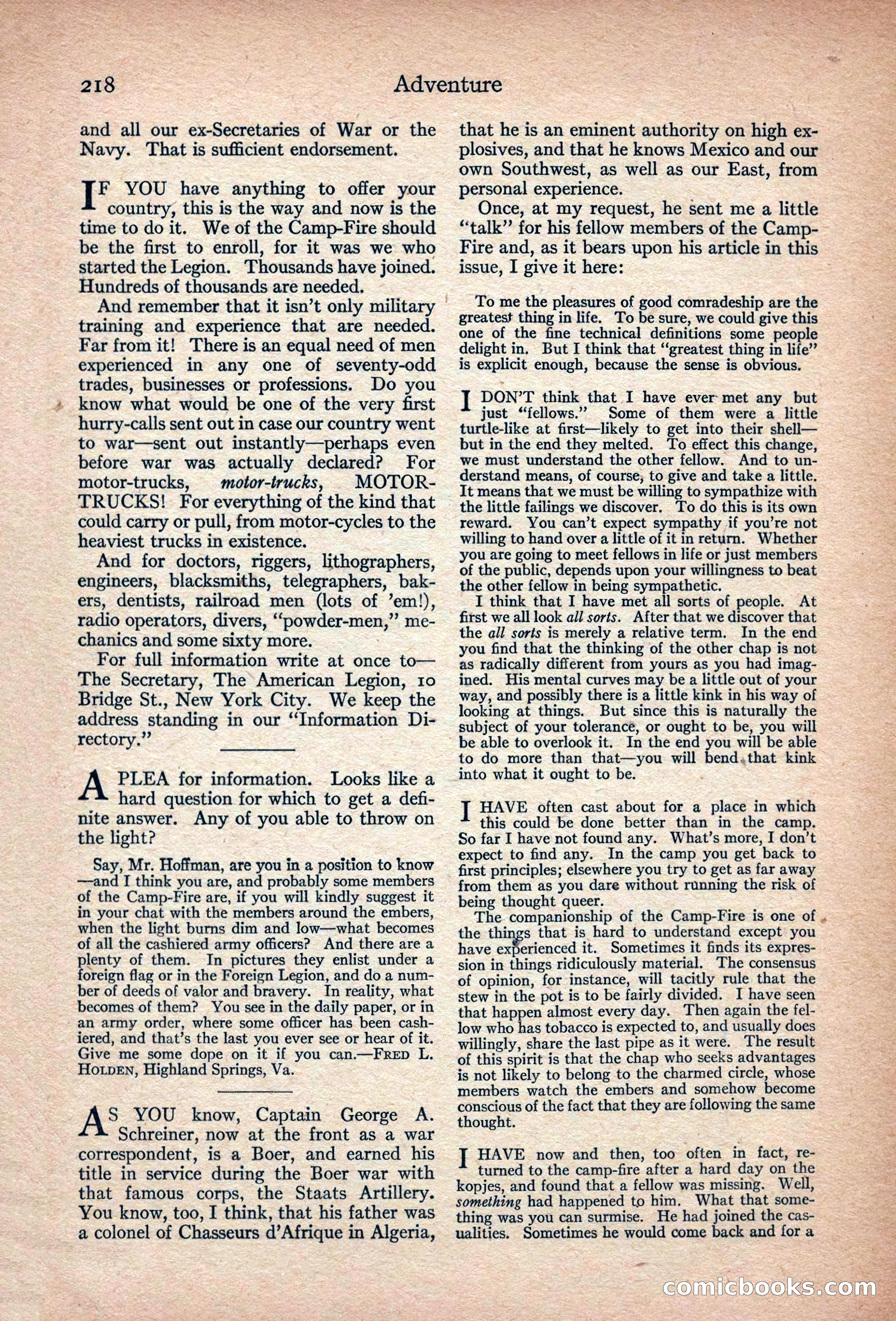
A restored page from Pulp Fiction, 1915. Page through the whole issue in the reader above.
📄 Transcribed text from this page (OCR, searchable)
Machine-transcribed from the original scan — historical spelling and the odd misread are preserved.
218 and all our ex-Secretaries of War or the Navy. That is sufficient endorsement. [° YOU have anything to offer your country, this is the way and now is the time to do it. We of the Camp-Fire should be the first to enroll, for it was we who started the Legion. Thousands have joined. Hundreds of thousands are needed. And remember that it isn’t only military — training and experience that are needed. Far from it! There is an equal need of men experienced in any one of seventy-odd trades, businesses or professions. Do you know what would be one of the very first hurry-calls sent out in case our country went to war—sent out instantly—perhaps even before war was actually declared? For motor-trucks, motor-irucks, MOTOR- TRUCKS! For everything of the kind that could carry or pull, from motor-cycles to the heaviest trucks in existence. And for doctors, riggers, lithographers, engineers, blacksmiths, telegraphers, bak- ers, dentists, railroad men (lots of ’em!), radio operators, divers, ‘‘powder-men,” me- chanics and some sixty more. : For full information write at once to— The Secretary, The American Legion, 10 Bridge St., New York City. We keep the address standing in our “Information Di- rectory.” : PLEA for information. Looks like a hard question for which to get a defi- nite answer. Any of you able to throw on the light? Say, Mr. Hoffman, are you in a position to know —and I think you are, and probably some members of the Camp-Fire are, if you will kindly suggest it in your chat with the members around the embers, when the light burns dim and low—what becomes of all the cashiered army officers? And there are a plenty of them. In pictures they enlist under a foreign flag or in the Foreign Legion, and do a num- ber of deeds of valor and bravery. In reality, what becomes of them? You see in the daily paper, or in - an army order, where some officer has been cash- iered, and that’s the last you ever see or hear of it. Give me some dope on it if you can.—Frep L. Hoven, Highland Springs, Va. As YOU know, Captain George A. Schreiner, now at the front as a war correspondent, is a Boer, and earned his title in service during the Boer war with that famous corps, the Staats Artillery. You know, too, I think, that his father was a colonel of Chasseurs d’Afrique in Algeria, . zh Adventure that he is an eminent authority on high ex- plosives, and that he knows Mexico and our © own Southwest, as well as our East, from personal experience. Once, at my request, he sent me a little “talk” for his fellow members of the Camp- Fire and, as it bears upon his article in this issue, I give it here: To me the pleasures of good comradeship are the greatest thing in life. To be sure, we could give this one of the fine technical definitions some people delight in, But I think that “greatest thing in life’ is explicit enough, because the sense is obvious. DON’T think that I have ever met any but just “fellows.”’ Some of them were a little turtle-like at first—likely to get into their shell— but in the end they melted. To effect this change, we must understand the other fellow. And to un- derstand means, of course; to give and take a little. It means that we must be willing to sympathize with the little failings we discover. To do this is its own reward. You can’t expect sympathy if you’re not willing to hand over a little of it in return. Whether you are going to meet fellows in life or just members of the public, depends upon your willingness to beat the other fellow in being sympathetic. I think that I have met all sorts of people. At first we all look all sorts. After that we discover that the all sorts is merely a relative term. In the end you find that the thinking of the other chap is not as radically different from yours as you had imag- ined. His mental curves may be a little out of your way, and possibly there is a little kink in his way of looking at things. But since this is naturally the subject of your tolerance, or ought to be, you will be able to overlook it. In the end you will be able to do more than that—you will bend,that kink into what it ought to be. | HAVE often cast about for a place in which this could be done better than in the camp. So far I have not found any. What’s more, I don’t expect to find any. In the camp you get back to first principles; elsewhere you try to get as far away from them as you dare without running the risk of being thought queer. The companionship of the Camp-Fire is one of the things that is hard to understand except you have experienced it. Sometimes it finds its expres- sion in things ridiculously material. The consensus of opinion, for instance, will tacitly rule that the stew in the pot is to be fairly divided. I have seen that happen almost every day. Then again the fel- low who has tobacco is expected to, and usually does willingly, share the last pipe as it were. The result of this spirit is that the chap who seeks advantages is not likely to belong to the charmed circle, whose members watch the embers and somehow become conscious of the fact that they are following the same thought. | HAVE now and then, too often in fact, re- turned to the camp-fire after a hard day on the kopjes, and found that a fellow was missing. Well, something had happened to him, What that some- thing was you can surmise. He had joined the cas- ualities. Sometimes he would come back and fora << Gomichooks 4 com