
Pulp Fiction, 1915 · page 78 of 228
Adventure, November 1915 — page 78: what you’re looking at
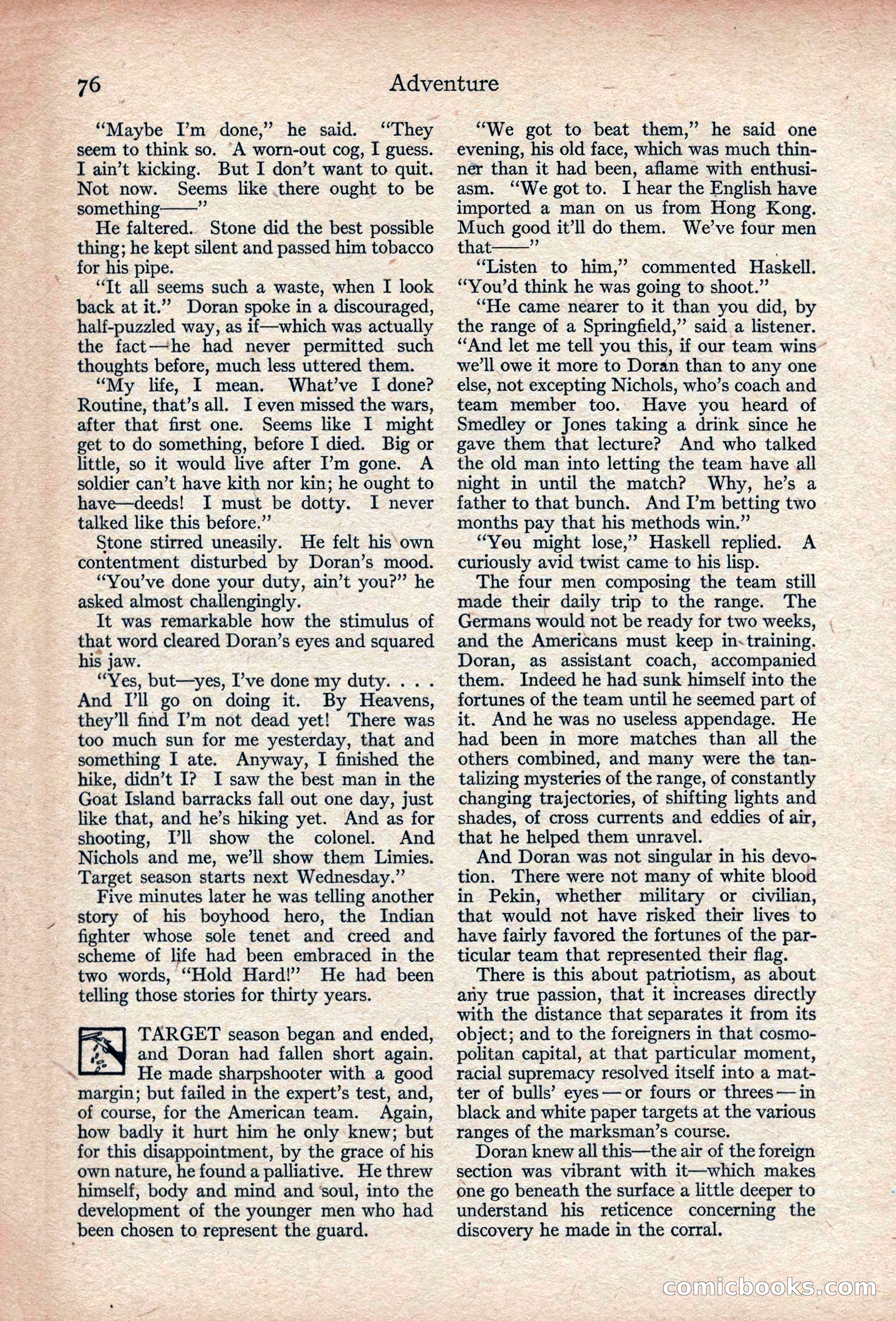
A restored page from Pulp Fiction, 1915. Page through the whole issue in the reader above.
📄 Transcribed text from this page (OCR, searchable)
Machine-transcribed from the original scan — historical spelling and the odd misread are preserved.
EN ar 76 “Maybe I’m done,” he said. seem to think so. “A worn-out cog, I guess. I ain’t kicking. But I don’t want to quit. Not now. Seems like there ought to be something ss He faltered. Stone did the best possible thing; he kept silent and passed him tobacco for his pipe. “Tt all seems such a waste, when I look back at it.”’ Doran spoke in a discouraged, half-puzzled way, as ifi—which was actually the fact—he had never permitted such thoughts before, much less uttered them. “My life, I mean. What’ve I done? Routine, that’s all. I even missed the wars, after that first one. Seems like I might get to do something, before I died. Big or little, so it would live after ’m gone. A soldier can’t have kith nor kin; he ought to have—deeds! I must be dotty. I never talked like this before.”’ Stone stirred uneasily. He felt his'own contentment disturbed by Doran’s mood. “You've done your duty, ain’t you?” he asked almost challengingly. It was remarkable how the stimulus of that word cleared Doran’s eyes and squared his jaw. “Ves, but—yes, I’ve done my duty. . And I'll go on doing it. By Heavens, they'll find ’'m not dead yet! There was too much sun for me yesterday, that and something I ate. Anyway, I finished the hike, didn’t I? I saw the best man in the Goat Island barracks fall out one day, just like that, and he’s hiking yet. And as for shooting, Dll show the colonel. And Nichols and me, we'll show them Limies. Target season starts next Wednesday.” Five minutes later he was telling another story of his boyhood hero, the Indian fighter whose sole tenet and creed and scheme of life had been embraced in the two words, “Hold Hard!’ He had been telling those stories for thirty years. TARGET season began and ended, and Doran had fallen short again. He made sharpshooter with a good margin; but failed in the expert’s test, and, of course, for the American team. Again, how badly it hurt him he only knew; but for this disappointment, by the grace of his own nature, he found a palliative. He threw himself, body and mind and ‘soul, into the development of the younger men who had been chosen to represent the guard. “They Adventure z “We got to beat them,” he said one evening, his old face, which was much thin- ner than it had been, aflame with enthusi- asm. “We got to. I hear the English have imported a man on us from Hong Kong. Much good it’ll do them. We’ve four men that eS “Listen to him,’ commented Haskell. “You’d think he was going to shoot.” “Hie came nearer to it than you did, by the range of a Springfield,” said a listener. ‘“‘And let me tell you this, if our team wins~ we'll owe it more to Doran than to any one else, not excepting Nichols, who’s coach and team member too. Have you heard of Smedley or Jones taking a drink since he gave them that lecture? And who talked the old man into letting the team have all night in until the match? Why, he’s a father to that bunch. And I’m betting two months pay that his methods win.” “You might lose,’ Haskell replied. <A curiously avid twist came to his lisp. The four men composing the team still made their daily trip to the range. The Germans would not be ready for two weeks, and the Americans must keep in-training. Doran, as assistant coach, accompanied them. Indeed he had sunk himself into the fortunes of the team until he seemed part of it. And he was no useless appendage. He had been in more matches than all the others combined, and many were the tan- talizing mysteries of the range, of constantly changing trajectories, of shifting lights and shades, of cross currents and eddies of air, that he helped them unravel. And Doran was not singular in his devo- tion. There were not many of white blood in Pekin, whether military or civilian, that would not have risked their lives to have fairly favored the fortunes of the par- ticular team that represented their flag. There is this about patriotism, as about any true passion, that it increases directly with the distance that separates it from its object; and to the foreigners in that cosmo- politan capital, at that particular moment, racial supremacy resolved itself into a mat- ter of bulls’ eyes—or fours or threes — in black and white paper targets at the various ranges of the marksman’s course. Doran knew all this—the air of the foreign section was vibrant with it—which makes one go beneath the surface a little deeper to understand his reticence concerning the discovery he made in the corral. Eomichbook (C@)