
Pulp Fiction, 1915 · page 84 of 228
Adventure, November 1915 — page 84: what you’re looking at
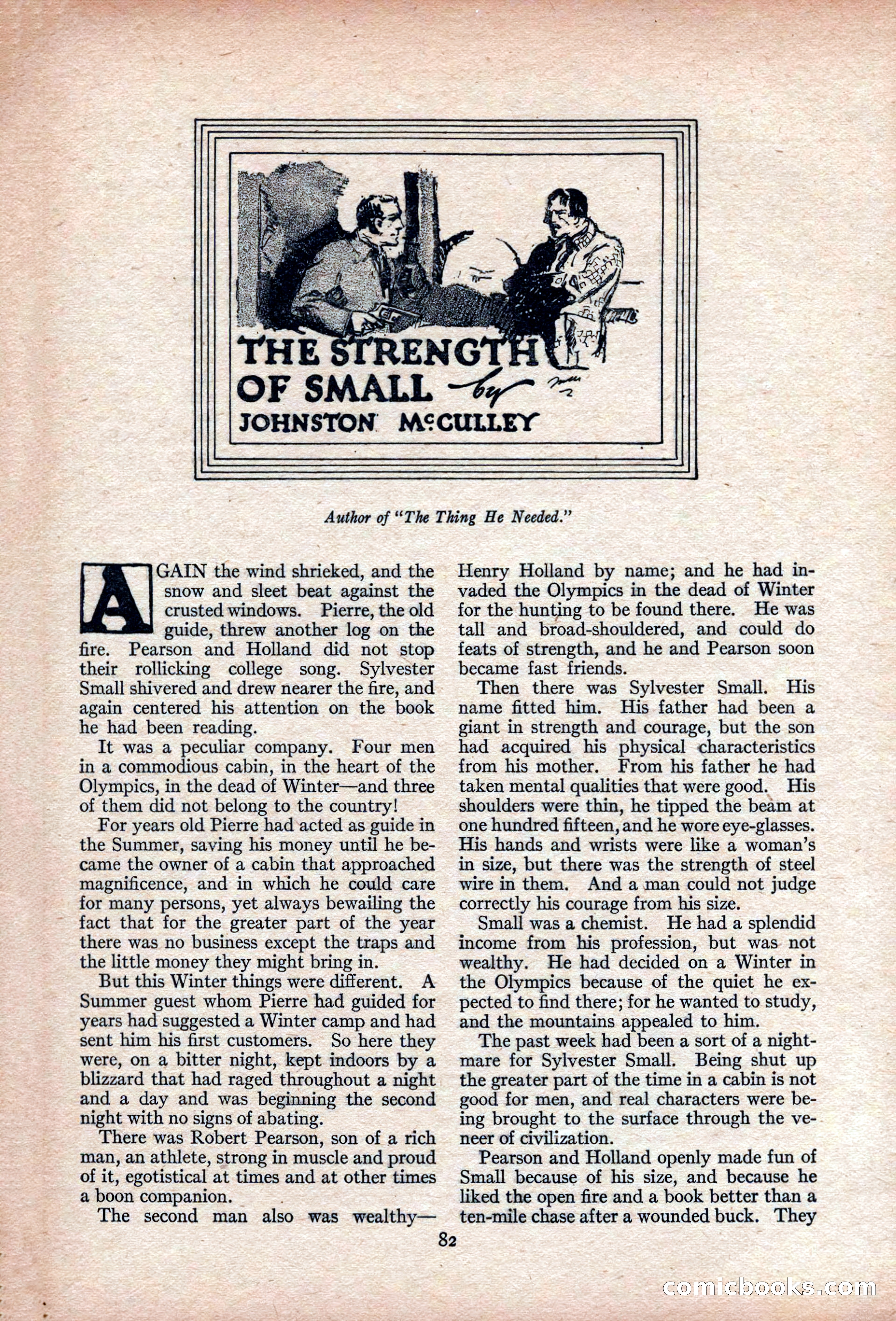
A restored page from Pulp Fiction, 1915. Page through the whole issue in the reader above.
📄 Transcribed text from this page (OCR, searchable)
Machine-transcribed from the original scan — historical spelling and the odd misread are preserved.
JOHNSTON M<SCULLEY Author of “The Thing He Needed.” GAIN the wind shrieked, and the snow and sleet beat against the crusted windows. Pierre, the old guide, threw another log on the fire. Pearson and Holland did not stop their rollicking college song. Sylvester Small shivered and drew nearer the fire, and again centered his attention on the book he had been reading. It was a peculiar company. Four men in a commodious cabin, in the heart of the Olympics, in the dead of Winter—and three of them did not belong to the country! For years old Pierre had acted as guide in the Summer, saving his money until he be- came the owner of a cabin that approached magnificence, and in which he could care for many persons, yet always bewailing the fact that for the greater part of the year there was no business except the traps and the little money they might bring in. But this Winter things were different. A Summer guest whom Pierre had guided for years had suggested a Winter camp and had sent him his first customers. So here they were, on a bitter night, kept indoors by a blizzard that had raged throughout a night and a day and was beginning the second night with no signs of abating. There was Robert Pearson, son of a rich man, an athlete, strong in muscle and proud of it, egotistical at times and at other times a boon companion. The second man also was wealthy— 82 Henry Holland by name; and he had in- vaded the Olympics in the dead of Winter for the hunting to be found there. He was tall and broad-shouldered, and could do feats of strength, and he and Pearson soon became fast friends. Then there was Sylvester Small. His name fitted him. His father had been a giant in strength and courage, but the son had acquired his physical characteristics from his mother. From his father he had taken mental qualities that were good. His shoulders were thin, he tipped the beam at one hundred fifteen, and he wore eye-glasses. His hands and wrists were like a woman’s in size, but there was the strength of steel wire in them. And aman could not judge correctly his courage from his size. Small was a chemist. He had a splendid income from his profession, but was not wealthy. He had decided on a Winter in the Olympics because of the quiet he ex- pected to find there; for he wanted to study, and the mountains appealed to him. The past week had been a sort of a night- mare for Sylvester Small. Being shut up the greater part of the time in a cabin is not good for men, and real characters were be- ing brought to the surface through the ve-. neer of civilization. Pearson and Holland openly made fun of Small because of his size, and because he liked the open fire and a book better than a ten-mile chase after a wounded buck. They AMUIELAOOLK (C@)