
Pulp Fiction, 1915 · page 97 of 228
Adventure, November 1915 — page 97: what you’re looking at
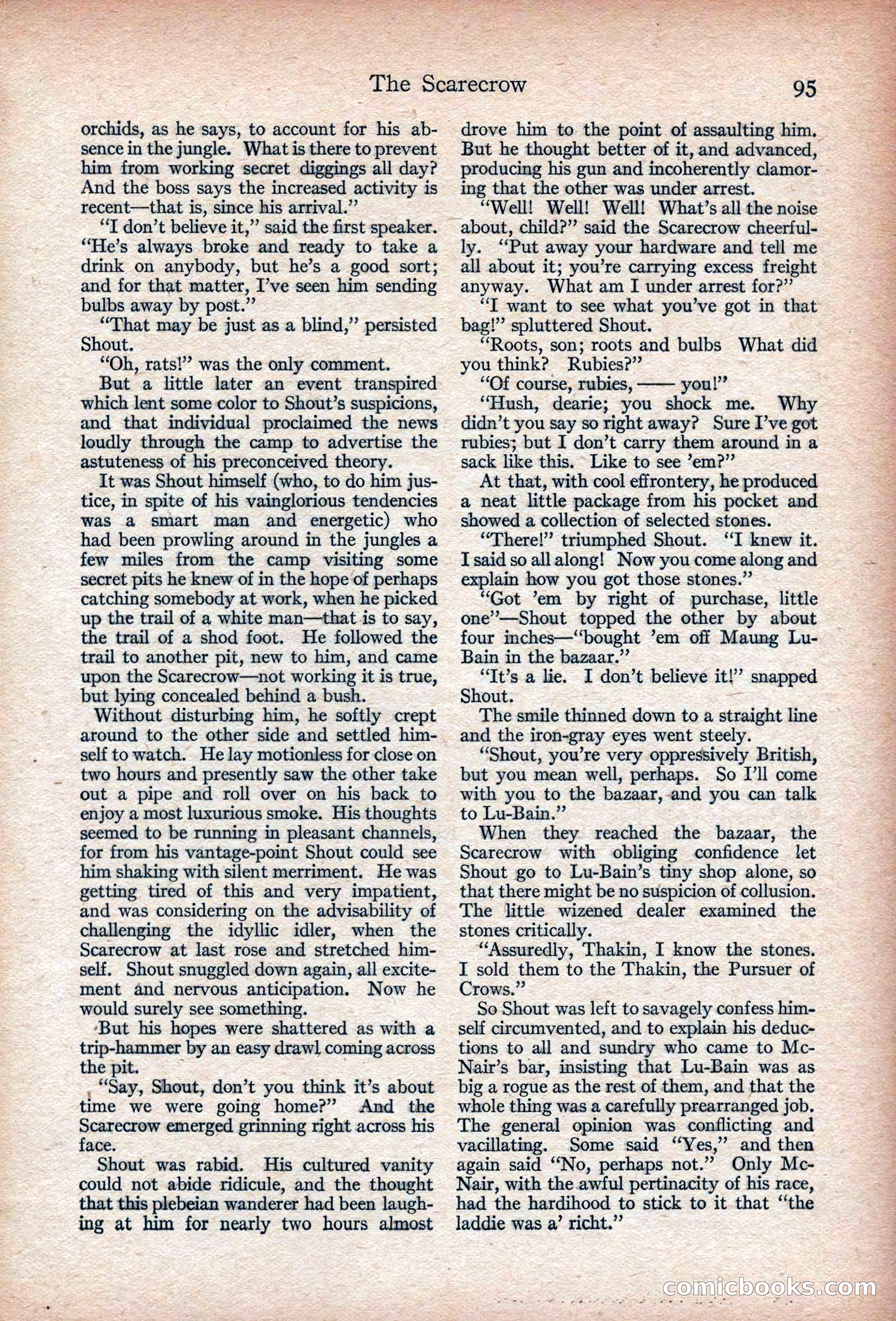
A restored page from Pulp Fiction, 1915. Page through the whole issue in the reader above.
📄 Transcribed text from this page (OCR, searchable)
Machine-transcribed from the original scan — historical spelling and the odd misread are preserved.
The Scarecrow orchids, as he says, to account for his ab- sence in the jungle. What is there to prevent him from working secret diggings all day? And the boss says the increased activity is recent—that is, since his arrival.” “T don’t believe it,” said the first speaker. “He’s always broke and ready to take a drink on anybody, but he’s a good sort; and for that matter, I’ve seen him sending bulbs away by post.” “That may be just as a blind,” persisted Shout. “Oh, rats!’ was the only comment. But a little later an event transpired which lent some color to Shout’s suspicions, and that individual proclaimed the news loudly through the camp to advertise the astuteness of his preconceived theory. It was Shout himself (who, to do him jus- tice, in spite of his vainglorious tendencies was a smart man and energetic) who had been prowling around in the jungles a few miles from the camp visiting some secret pits he knew of in the hope of perhaps catching somebody at work, when he picked up the trail of a white man—that is to say, the trail of a shod foot. He followed the trail to another pit, new to him, and came upon the Scarecrow—not working it is true, but lying concealed behind a bush. Without disturbing him, he softly crept around to the other side and settled him- self to watch. He lay motionless for close on two hours and presently saw the other take out a pipe and roll over on his back to enjoy a most luxurious smoke. His thoughts seemed to be running in pleasant channels, for from his vantage-point Shout could see him shaking with silent merriment. He was getting tired of this and very impatient, and was considering on the advisability of challenging the idyllic idler, when the Scarecrow at last rose and stretched him- self. Shout snuggled down again, all excite- ment and nervous anticipation. Now he would surely see something. ‘But his hopes were shattered as with a trip-hammer by an easy drawl coming across the pit. | . “Say, Shout, don’t you think it’s about time we were going home?” And the Scarecrow emerged grinning right across his face. Shout was rabid. His cultured vanity could not abide ridicule, and the thought that this plebeian wanderer had been laugh- ing at him for nearly two hours almost 95 drove him to. the point of assaulting him. But he thought better of it, and advanced, producing his gun and incoherently clamor- ing that the other was under arrest. “Well! Well! Well! What’s all the noise about, child?” said the Scarecrow cheerful- ly. “Put away your hardware and tell me all about it; you’re carrying excess freight anyway. What am I under arrest for?” “T want to see what you’ve got in that bag!” spluttered Shout. “Roots, son; roots and bulbs What did you think? Rubies?” “Of course, rubies, —— you!” “Hush, dearie; you shock me. Why didn’t you say so right away? Sure I’ve got rubies; but I don’t carry them around in a sack like this. Like to see ’em?”’ At that, with cool effrontery, he produced a neat little package from his pocket and showed a collection of selected stones. “There!” triumphed Shout. “I knew it. I said so allalong! Now you come along and lain how you got those stones.” “Got ’em by right of purchase, little one’—Shout topped the other by about four inches—“bought ’em off Maung Lu- Bain in the bazaar.” “It’s a lie. I don’t believe it!” snapped Shout. : The smile thinned down to a straight line and the iron-gray eyes went steely. “Shout, you’re very oppressively British, but you mean well, perhaps. So I’ll come with you to the bazaar,-and you can talk to Lu-Bain.” : When they reached the bazaar, the Scarecrow with obliging confidence let Shout go to Lu-Bain’s tiny shop alone, so that there might be no suspicion of collusion. The little wizened dealer examined the stones critically. “Assuredly, Thakin, I know the stones. I sold them to the Thakin, the Pursuer of Crows.” So Shout was left to savagely confess him- self circumvented, and to explain his deduc- tions to all and sundry who came to Mc- Nair’s bar, insisting that Lu-Bain was as big a rogue as the rest of them, and that the whole thing was a carefully prearranged job. The general opinion was conflicting and vacillating. Some said “Yes,” and then again said ‘No, perhaps not.” Only Mc- Nair, with the awful pertinacity of his race, had the hardihood to stick to it that “the laddie was a’ richt.” (E@)