
Pulp Fiction, 1916 · page 159 of 228
Adventure Magazine, March 1916 — page 159: what you’re looking at
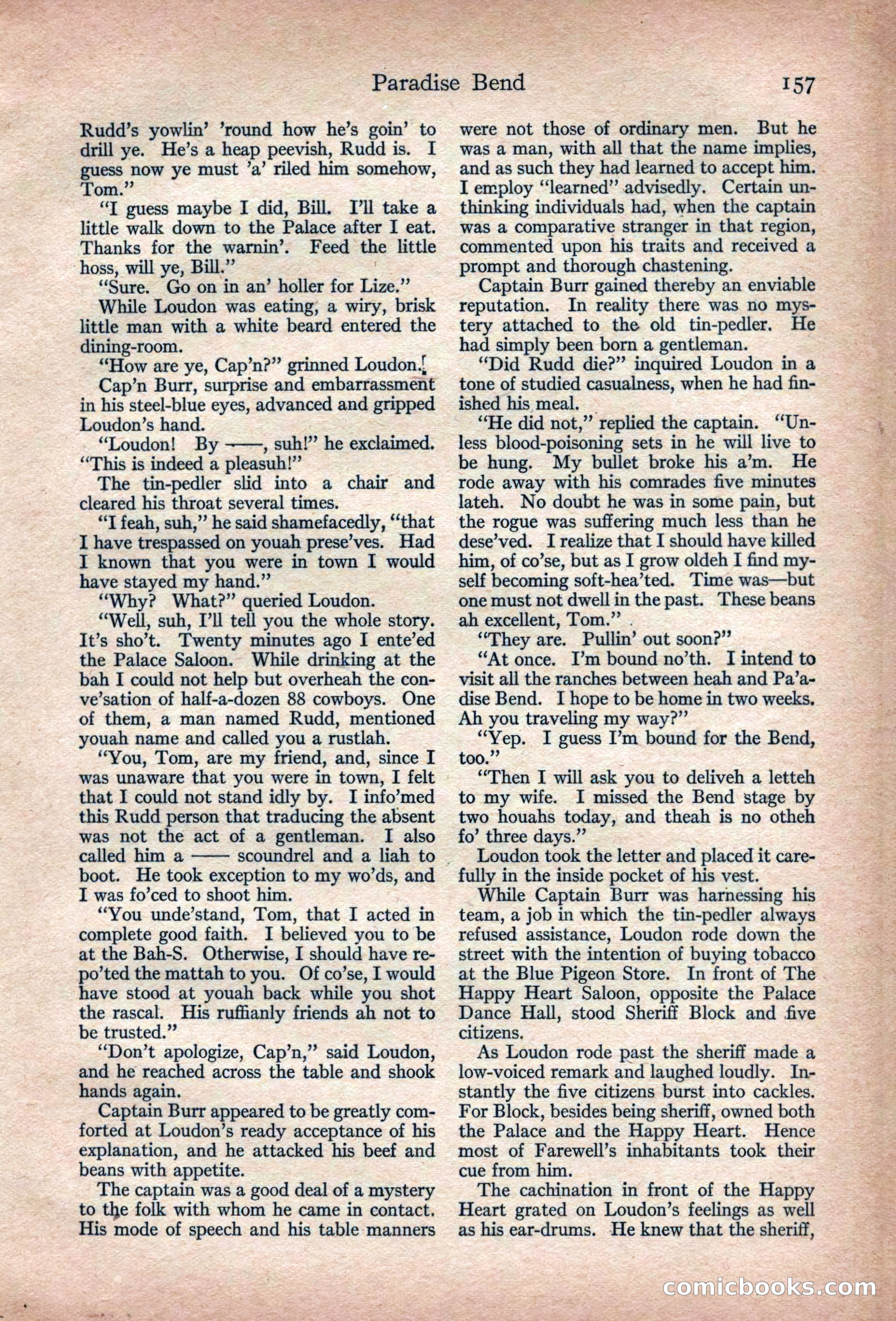
A restored page from Pulp Fiction, 1916. Page through the whole issue in the reader above.
📄 Transcribed text from this page (OCR, searchable)
Machine-transcribed from the original scan — historical spelling and the odd misread are preserved.
Paradise Bend Rudd’s yowlin’ ’round how he’s goin’ to drill ye. He’s a heap peevish, Rudd is. I guess now ye must ’a’ riled him somehow, Tom.” “T guess maybe I did, Bill. I'll take a little walk down to the Palace after I eat. Thanks for the warnin’. Feed the little hoss, will ye, Bill.” “Sure. Go on in an’ holler for Lize.” While Loudon was eating, a wiry, brisk little man with a white beard entered the dining-room. “How are ye, Cap’n?” grinned Loudon, Cap’n Burr, surprise and embarrassment in his steel-blue eyes, advanced and gripped Loudon’s hand. “Loudon! By ——, suh!” he exclaimed. “This is indeed a pleasuh!”’ The tin-pedler slid into a chair and cleared his throat several times. “T feah, suh,”’ he said shamefacedly, “‘that I have trespassed on youah prese’ves. Had I known that you were in town I would have stayed my hand.” “Why? What?” queried Loudon. “Well, suh, I’ll tell you the whole story. It’s sho’t. Twenty minutes ago I ente’ed the Palace Saloon. While drinking at the bah I could not help but overheah the con- ve’sation of half-a-dozen 88 cowboys. One of them, a man named Rudd, mentioned youah name and called you a rustlah. ‘You, Tom, are my friend, and, since I was unaware that you were in town, I felt that I could not stand idly by. I info’med this Rudd person that traducing the absent was not the act of a gentleman. I also called him a —— scoundrel and a liah to | boot. He took exception to my wo’ds, and I was fo’ced to shoot him. “You unde’stand, Tom, that I acted in complete good faith. I believed you to be at the Bah-S. Otherwise, I should have re- po’ted the mattah to you. Of co’se, I would have stood at youah back while you shot the rascal. His ruffianly friends ah not to be trusted.” “Don’t apologize, Cap’n,” said Loudon, and he reached across the table and shook hands again. Captain Burr appeared to be greatly com- forted at Loudon’s ready acceptance of his explanation, and he attacked his beef and beans with appetite. The captain was a good deal of a mystery to the folk with whom he came in contact. His mode of speech and his table manners I, 79 were not those of ordinary men. But he was a man, with all that the name implies, and as such they had learned to accept him. I employ “learned” advisedly. Certain un- thinking individuals had, when the captain was a comparative stranger in that region, commented upon his traits and received a prompt and thorough chastening. Captain Burr gained thereby an enviable reputation. In reality there was no mys- tery attached to hae old tin-pedler. He had simply been born a gentleman. “Did Rudd die?” inquired Loudon in a tone of studied casualness, when he had fin- ished his meal. ‘He did not,” replied the captain. ‘“Un- less blood-poisoning sets in he will live to be hung. My bullet broke his a’m. He rode away with his comrades five minutes lateh. No doubt he was in some pain, but the rogue was suffering much less than he dese’ved. I realize that I should have killed him, of co’se, but as I grow oldeh I find my- self becoming soft-hea’ted. Time was—but one must not dwell in the past. These beans ah excellent, Tom.” . “They are. Pullin’ out soon?” “At once. I’m bound no’th. I intend to visit all the ranches between heah and Pa’a- dise Bend. I hope to be home in two weeks, Ah you traveling my way?” “Yep. I guess I’m bound for the Bend, too.” “Then I will ask you to deliveh a letteh to my wife. I missed the Bend stage by two houahs today, and theah is no otheh fo’ three days.”’ Loudon took the letter and placed it care- fully in the inside pocket of his vest. While Captain Burr was harnessing his team, a job in which the tin-pedler always refused assistance, Loudon rode down the street with the intention of buying tobacco at the Blue Pigeon Store. In front of The Happy Heart Saloon, opposite the Palace Dance Hall, stood Sheriff Block and five citizens. As Loudon rode past the sheriff made a low-voiced remark and laughed loudly. In- stantly the five citizens burst into cackles. For Block, besides being sheriff, owned both the Palace and the Happy Heart. Hence most of Farewell’s inhabitants took their cue from him. The cachination in front of the Happy Heart grated on Loudon’s feelings as well as his ear-drums. He knew that the sheriff, 157 — ae GComichoo (E “S' (Elo) ' wf ° Soe | _