
Pulp Fiction, 1916 · page 18 of 228
Adventure Magazine, March 1916 — page 18: what you’re looking at
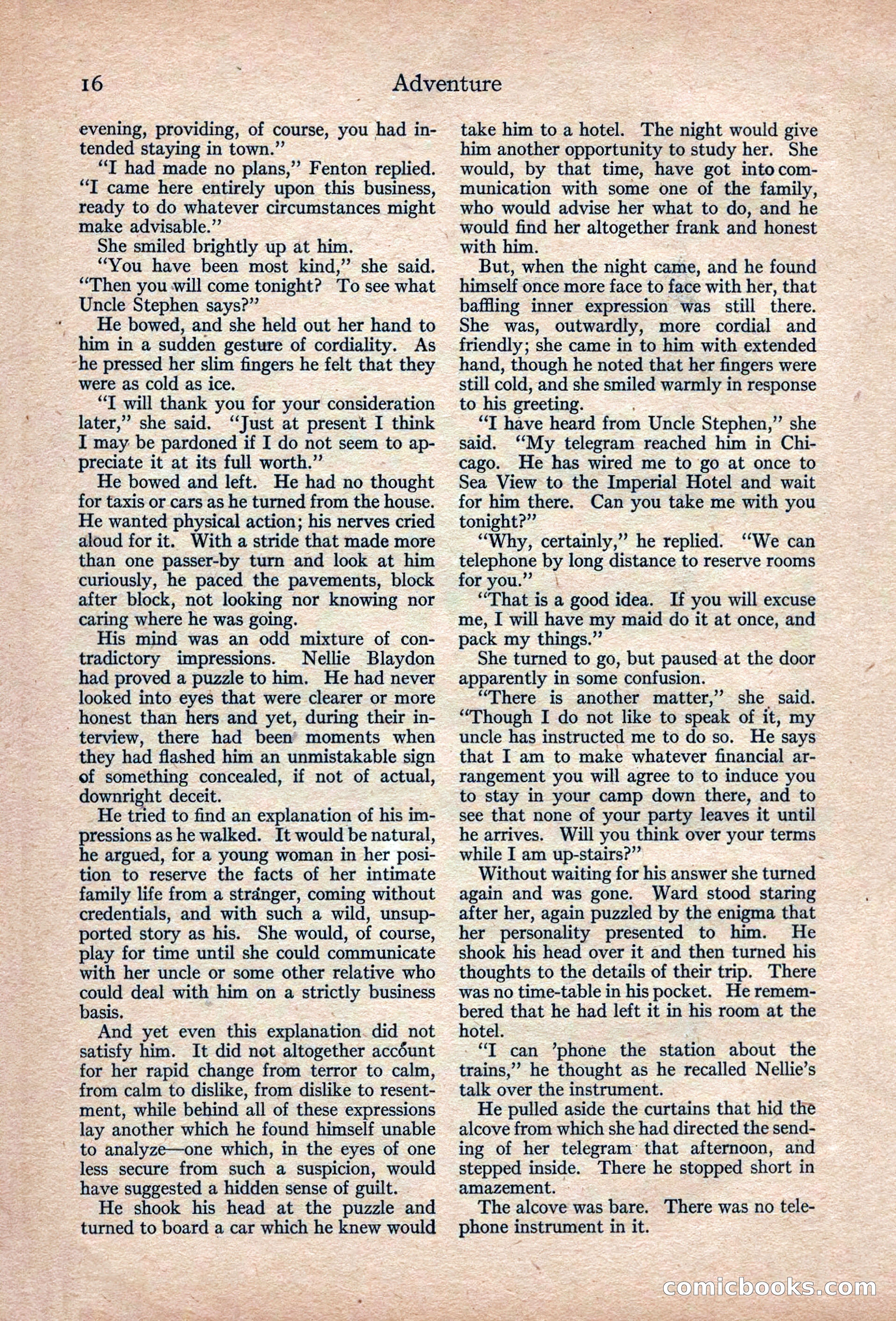
A restored page from Pulp Fiction, 1916. Page through the whole issue in the reader above.
📄 Transcribed text from this page (OCR, searchable)
Machine-transcribed from the original scan — historical spelling and the odd misread are preserved.
‘ 16 ! Adventure evening, providing, of course, you had in- tended staying in town.” “T had made no plans,”’ Fenton replied. “I came here entirely upon this business, ready to do whatever circumstances might make advisable.” She smiled brightly up at him. “You have been most kind,” she said. “Then you will come tonight? To see what Uncle Stephen says?” He bowed, and she held out her hand to him in a sudden gesture of cordiality. As -he pressed her slim fingers he felt that they were as cold as ice. 3 | will thank you for your consideration later,” she said. ‘Just at present I think I may: be pardoned if I do not seem to ap- - preciate it at its full worth.” He bowed and left. He had no thought for taxis or cars as he turned from the house. He wanted physical action; his nerves cried aloud for it. With a stride that made more than one passer-by turn and look at him curiously, he paced the pavements, block after block, not looking nor knowing nor caring where he was going. His mind was an odd mixture of con- tradictory impressions. Nellie Blaydon had proved a puzzle to him. He had never looked into eyes that were clearer or more honest than hers and yet, during their in- terview, there had been’ moments when they had flashed him an unmistakable sign of something concealed, if not of actual, downright deceit. He tried to find an explanation of his im- pressions as he walked. It would be natural, he argued, for a young woman in her posi- tion to reserve the facts of her intimate family life from a strdnger, coming without credentials, and with such a wild, unsup- ported story as his. She would, of course, play for time until she could communicate with her uncle or some other relative who could deal with him on a strictly business basis. And yet even this explanation. did not satisfy him. It did not altogether accéunt for her rapid change from terror to calm, from calm to dislike, from dislike to resent- ment, while behind all of these expressions lay another which he found himself unable ~ to analyze—one which, in the eyes of one less secure from such a suspicion, would have suggested a hidden sense of guilt. He shook his head at the puzzle and turned to board a car which he knew would take him to a hotel. him another opportunity to study her. She would, by that time, have got intocom- munication with some one of the family, who would advise her what to do, and he _ would find her altogether frank and honest with him. But, when the night came, and he found himself once more face to face with her, that baffling inner expression was still there. She was, outwardly, more cordial and friendly; she came in to him with extended hand, though he noted that her fingers were still cold, and she smiled warmly in response to his greeting. “T have heard from Uncle Stephen,”’ she said. “My telegram reached him in Chi- cago. He has wired me to go at once to Sea View to the Imperial Hotel and wait for him there. Can you take me with you tonight?” “Why, certainly,” he replied. ‘‘We can telephone by long distance to reserve rooms for you.’ “That is a good idea. If you will excuse me, I will have my maid do it at once, and pack my things.” She turned to go, but paused at the door apparently in some confusion. | “There is another matter,’ she said. “Though I do not like to speak of it, my uncle has instructed me to do so. He says that I am to make whatever financial ar- rangement you will agree to to induce you to stay in your camp down there, and to see that none of your party leaves it until he arrives. Will you think over your terms while I am up-stairs?”’ Without waiting for his answer she turned again and was gone. Ward stood staring after her, again puzzled by the enigma that her personality presented to him. He shook his head over it and then turned his thoughts to the details of their trip. There was no time-table in his pocket. He remem- bered that he had left it in his room at the hotel. -*T can ’phone the station about the trains,” he thought as he recalled Nellie’s talk over the instrument. He pulled aside the curtains that hid the alcove from which she had directed the send- ing of her telegram’ that afternoon, and stepped inside. There he stopped short in amazement. — The alcove was bare. There was no tele- phone instrument in it. The night would give comichbooks (FE)