
Pulp Fiction, 1916 · page 21 of 228
Adventure Magazine, March 1916 — page 21: what you’re looking at
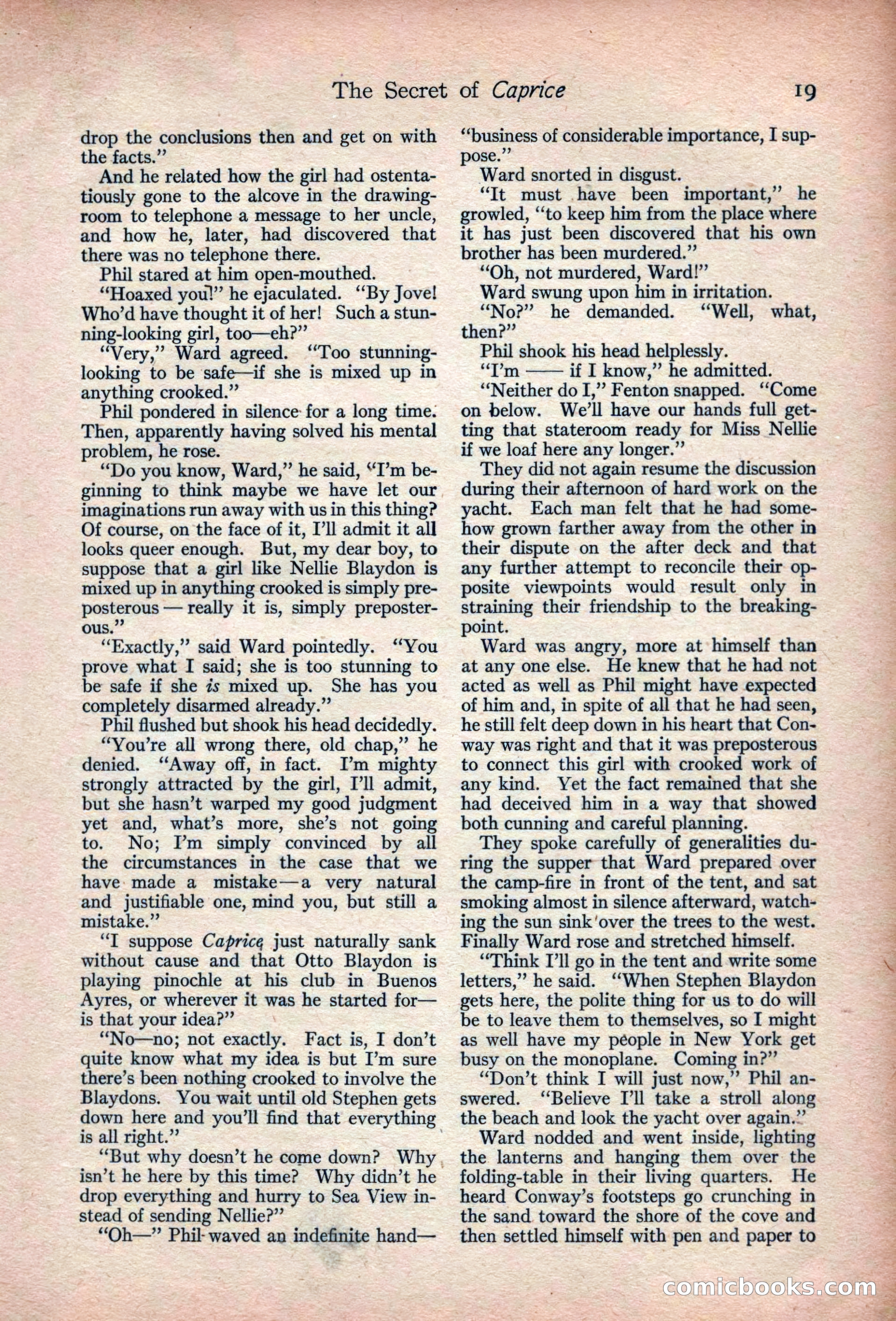
A restored page from Pulp Fiction, 1916. Page through the whole issue in the reader above.
📄 Transcribed text from this page (OCR, searchable)
Machine-transcribed from the original scan — historical spelling and the odd misread are preserved.
. —~ ‘<> . ” r . —? “cates = Vy v ~ # > . Sg re ARCA ae os ‘ ie ee ee . > + 4 « The Secret drop the conclusions then and get on with the facts.” And he related how the girl had ostenta- tiously gone to the alcove in the drawing- room to telephone a message to her uncle, and how he, later, had discovered that there was no telephone there. Phil stared at him open-mouthed. “Hoaxed you!’ he ejaculated. “By Jove! Who’d have thought it of her! Such a stun- ning-looking girl, too—eh?”’ “Very,” Ward agreed. ‘Too stunning- looking to be safe—if she is mixed up in anything crooked.” Phil pondered in silence for a long time. Then, apparently having solved his mental problem, he rose. “Do you know, Ward,” he said, “I’m be- ginning to think maybe we have let our imaginations run away with us in this thing? Of course, on the face of it, I’ll admit it all looks queer enough. But, my dear boy, to suppose that a girl like Nellie Blaydon is mixed up in anything crooked is simply pre- posterous — really it is, simply preposter- ous.” “Exactly,” said Ward pointedly. “You prove what I said; she is too stunning to be safe if she 7s mixed up. She has you completely disarmed already.” Phil flushed but shook his head decidedly. “You’re all wrong there, old chap,” he denied. ‘Away off, in fact. I’m mighty strongly attracted by the girl, I’ll admit, but she hasn’t warped my good judgment yet and, what’s more, she’s not going to. No; Pm simply convinced by all the circumstances in the case that we have: made a mistake—a very natural and justifiable one, mind you, but still a mistake.” “T suppose Caprice just naturally sank without cause and that Otto Blaydon is playing pinochle at his club in Buenos Ayres, or wherever it was he started for— is that your idea?”’ “No—no; not exactly. Fact is, I don’t quite know what my idea is but I’m sure there’s been nothing crooked to involve the Blaydons. You wait until old Stephen gets down here and you'll find that everything is all right.”’ “But why doesn’t he come down? Why. isn’t he here by this time? Why didn’t he drop everything and hurry to Sea View in- stead of sending Nellie?” “Oh—” Phil- waved an indefinite hand— of Caprice 19 “‘business of considerable importance, I sup- pose.” Ward snorted in disgust. “Tt must have been important,” he growled, “‘to keep him from the place where it has just been discovered that his own brother has been murdered.”’ “Oh, not murdered, Ward!” Ward swung upon him in irritation. “No?” he demanded. “Well, what, then?” Phil shook his head helplessly. “‘T’m —— if I know,” he admitted. “Neither do I,” Fenton snapped. ‘Come on below. We'll have our hands full get- ting that stateroom ready for Miss Nellie if we loaf here any longer.” They did not again resume the discussion during their afternoon of hard work on the yacht. Each man felt that he had some- how grown farther away from the other in their dispute on the after deck and that any further attempt to reconcile their op- posite viewpoints would result only in straining their friendship to the breaking- point. Ward was angry, more at himself than at any one else. He knew that he had not acted as well as Phil might have expected of him and, in spite of all that he had seen, he still felt deep down in his heart that Con- way was right and that it was preposterous to connect this girl with crooked work of any kind. Yet the fact remained that she had deceived him in a way that showed both cunning and careful planning. They spoke carefully of generalities du- ring the supper that Ward prepared over the camp-fire in front of the tent, and sat smoking almost in silence afterward, watch- ing the sun sink'over the trees to the west. Finally Ward rose and stretched himself. “Think I’ll go in the tent and write some letters,’ he said. “When Stephen Blaydon gets here, the polite thing for us to do will be to leave them to themselves, so I might as well have my péople in New York get busy on the monoplane. Coming in?” “Don’t think I will just now,” Phil an- swered. “Believe I'll take a stroll along the beach and look the yacht over again.” Ward nodded and went inside, lighting the lanterns and hanging them over the folding-table in their living quarters. He heard Conway’s footsteps go crunching in the sand toward the shore of the cove and then settled himself with pen and paper to Eomichoo (E Ss , . . Yow 052 Ds Op See, ae (E(8) awl f