
Pulp Fiction, 1916 · page 40 of 228
Adventure Magazine, March 1916 — page 40: what you’re looking at
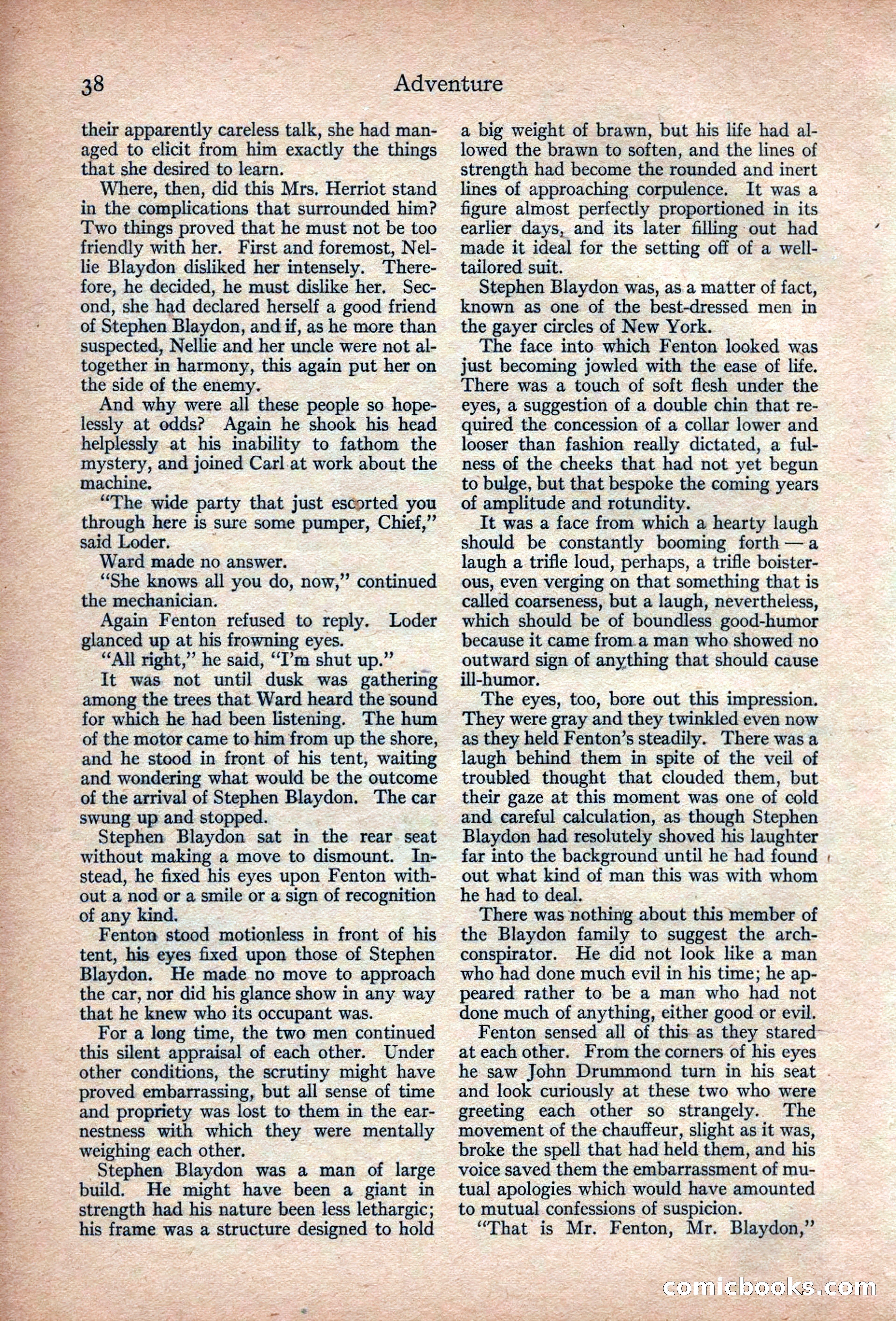
A restored page from Pulp Fiction, 1916. Page through the whole issue in the reader above.
📄 Transcribed text from this page (OCR, searchable)
Machine-transcribed from the original scan — historical spelling and the odd misread are preserved.
ae ! : rey 7 J o* “h .* rs r 4 . ed io I - 38 a Adventure their apparently careless talk, she had man- aged to elicit from him exactly the things that she desired to learn. Where, then, did this Mrs, Herriot stand in the complications that surrounded him? Two things proved that he must not be too friendly with her. First and foremost, Nel- lie Blaydon disliked her intensely. There- fore, he decided, he must dislike her. Sec- ond, she had declared herself a good friend of Stephen Blaydon, and if, as he more than suspected, Nellie and her uncle were not al- together in harmony, this again put her on the side of the enemy. And why were all these people so hope- _ lessly at odds? Again he shook his head helplessly at his inability to fathom the mystery, and joined Carl.at work about the machine. “The wide party that just escorted you through here is sure some pumper, Chief,” said Loder. Ward made no answer. “She knows all you do, now,” continued the mechanician. Again Fenton refused to reply. Loder glanced up at his frowning eyes. “All right,” he said, “I’m shut up.” -It was not until dusk was gathering among the trees that Ward heard the sound for which he had been listening. The hum of the motor came to him from up the shore, and he stood in front of his tent, waiting and wondering what would be the outcome of the arrival of Stephen Blaydon. The car swung up and stopped. Stephen Blaydon sat in the rear. seat without making a move to dismount. In- stead, he fixed his eyes upon Fenton with- out a nod or a smile or a sign of recognition of any kind. Fenton stood motionless in front of his tent, his eyes fixed upon those of Stephen Blaydon. He made no move to approach the car, nor did his glance show in any way that he knew who its occupant was. For a long time, the two men continued this silent appraisal of each other. Under other conditions, the scrutiny might have proved embarrassing, but all sense of time and propriety was lost to them in the ear- nestness with which they were mentally weighing each other. Stephen Blaydon was a man of large build. He might have been a giant in strength had his nature been less lethargic; his frame was a structure designed to hold a big weight of brawn, but his life had al- lowed the brawn to soften, and the lines of strength had become the rounded and inert lines of approaching corpulence. It was a figure almost perfectly proportioned in its earlier days, and its later filling out had made it ideal for the setting off of a well- tailored suit. | Stephen Blaydon was, as a matter of fact, known as one of the best-dressed men in the gayer circles of New York. The face into which Fenton looked was just becoming jowled with the ease of life. There was a touch of soft flesh under the eyes, a suggestion of a double chin that re- quired the concession of a collar lower and looser than fashion really dictated, a ful- ness of the cheeks that had not yet begun to bulge, but that bespoke the coming years of amplitude and rotundity. It was a face from which a hearty laugh should be constantly booming forth —a laugh a trifle loud, perhaps, a trifle boister- ous, even verging on that something that is called coarseness, but a laugh, nevertheless, which should be of boundless good-humor because it came from.a man who showed no outward sign of anything that should cause ill-humor. The eyes, too, bore out this impression. They were gray and they twinkled even now as they held Fenton’s steadily. There was a laugh behind them in spite of the veil of troubled thought that clouded them, but their gaze at this moment was one of cold and careful calculation, as though Stephen Blaydon had resolutely shoved his laughter far into the background until he had found out what kind of man this was with whom he had to deal. There was nothing about this member of the Blaydon family to suggest the arch- conspirator. He did not look like a man who had done much evil in his time; he ap- peared rather to be a man who had not done much of anything, either good or evil. Fenton sensed all of this as they stared at each other. From the corners of his eyes -_ he saw John Drummond turn in his seat . and look curiously at these two who were greeting each other so strangely. The movement of the chauffeur, slight as it was, broke the spell that had held them, and his voice saved them the embarrassment of mu- tual apologies which would have amounted to mutual confessions of suspicion. “That is Mr. Fenton, Mr. Blaydon,” Gomichooks 4 (E(o)}