
Pulp Fiction, 1916 · page 6 of 228
Adventure Magazine, March 1916 — page 6: what you’re looking at
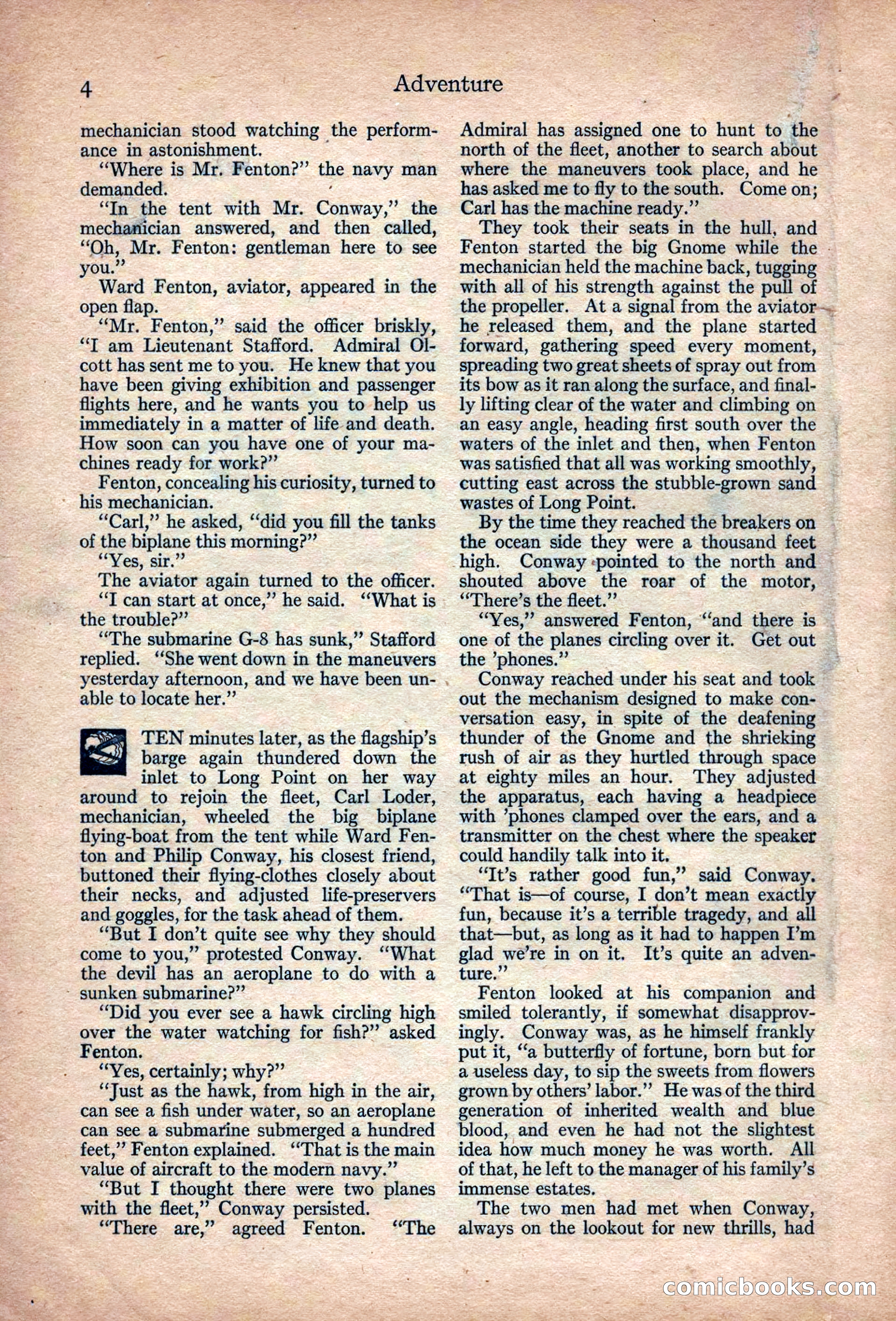
A restored page from Pulp Fiction, 1916. Page through the whole issue in the reader above.
📄 Transcribed text from this page (OCR, searchable)
Machine-transcribed from the original scan — historical spelling and the odd misread are preserved.
4 : | Adventure mechanician stood watching the perform- ance in astonishment. “Where is Mr. Fenton?” the navy man demanded. “In the tent with Mr. Canney the mechamician answered, and then called, “Oh, Mr. Fenton: gentleman here to see you.” Ward Fenton, aviator, appeared in the open flap. “Mr. Fenton,” said the officer briskly, “T am Lieutenant Stafford. Admiral Ol- cott has sent me to you. He knew that you have been giving exhibition and passenger flights here, and he wants you to help us immediately in a matter of life and death. How soon can you have one of your ma- chines ready for work?” Fenton, concealing his curiosity, turned to ’ his mechanician. “Carl,” he asked, ‘‘did you fill the tanks of the biplane this morning?”’ “Yes, sir.” The aviator again turned to the officer. “T can start at once,” he said. “What is the trouble?” “The submarine G-8 has sunk,” Stafford replied. “She went down in the maneuvers yesterday afternoon, and we have been un- , able to locate her.”’ TEN minutes later, as the flagship’s barge again thundered down the inlet to Long Point on her way around to rejoin the fleet, Carl Loder, mechanician, wheeled the big biplane flying-boat from the tent while Ward Fen- ton and Philip Conway, his closest friend, buttoned their flying-clothes closely about their necks, and adjusted life-preservers and goggles, for the task ahead of them. “But I don’t quite see why they should come to you,” protested Conway. “What the devil has an aeroplane to do with a ~ sunken submarine?”’ “Did you ever see a hawk circling high over the water watching for fish?” asked Fenton. “Yes, certainly; why?” ‘Just as the hawk, from high in the air, can see a fish under water, so an aeroplane can see a submarine submerged a hundred _ feet,’ Fenton explained. ‘That is the main value of aircraft to the modern navy.” “But I thought there were two planes with the fleet,’”’ Conway persisted. “There are,” agreed Fenton. ‘The Admiral has assigned one to hunt to the north of the fleet, another to search about where the maneuvers took place, and he has asked me to fly to the south. Come on; Carl has the machine ready.” They took their seats in the hull, and Fenton started the big Gnome while the - mechanician held the machine back, tugging with all of his strength against the pull of the propeller. At a signal from the aviator he released them, and the plane started forward, gathering speed every moment, spreading two great sheets of spray out from its bow as it ran along the surface, and final- ly lifting clear of the water and climbing on an easy angle, heading first south over the waters of the inlet and then, when Fenton was satisfied that all was working smoothly, cutting east across the stubble-grown sand wastes of Long Point. By the time they reached the breakers on the ocean side they were a thousand feet -high. Conway -pointed to the north and shouted above the roar of the motor, ‘*There’s the fleet.”’ | “Yes,’’ answered Fenton, “‘and there is one of the planes circling over it. Get out the ’phones.” Conway reached under his seat and took out the mechanism designed to make con- versation easy, in spite of the deafening thunder of the Gnome and the shrieking rush of air as they hurtled through space at eighty miles an hour. They adjusted the apparatus, each having a headpiece with ’phones clamped over the ears, and a transmitter on the chest where the speaker could handily talk into it. “Tt’s rather good fun,” said Conway, “That is—of course, I don’t mean exactly fun, because it’s a terrible tragedy, and all that—but, as long as it had to happen I’m glad we're in on it. It’s quite an adven- ture.” Fenton looked at his companion and smiled tolerantly, if somewhat disapprov- ingly. Conway was, as he himself frankly put it, “‘a butterfly of fortune, born but for a useless day, to sip the sweets from flowers grown by others’ labor.” He was of the third generation of inherited wealth and blue blood, and even he had not the slightest idea how much money he was worth. All of that, he left to the manager of his family’s immense estates. The two men had met when Conway, always on the lookout for new thrills, had GEomichbooks on _ —_—S. ~~ (El)