
Pulp Fiction, 1916 · page 60 of 228
Adventure Magazine, March 1916 — page 60: what you’re looking at
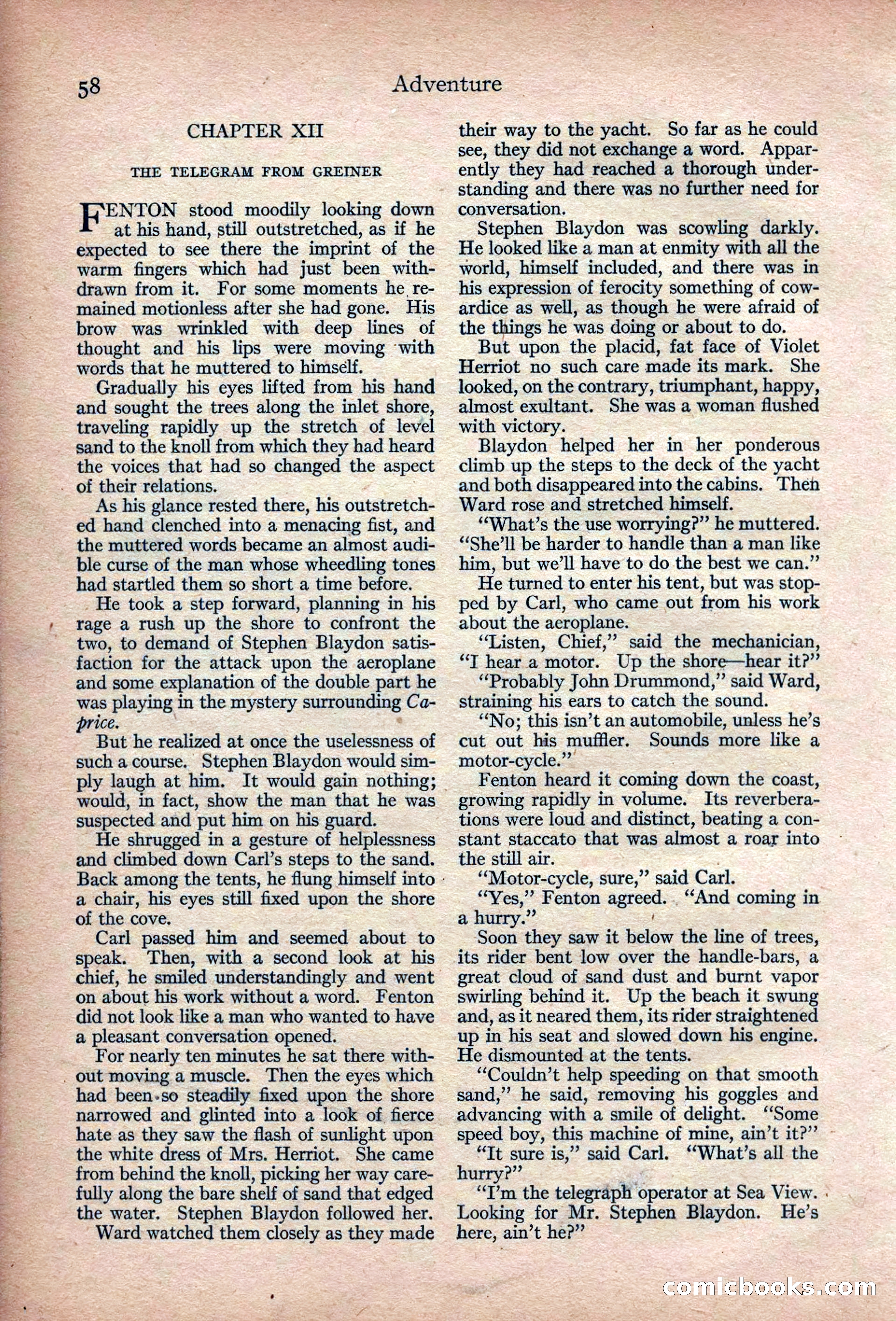
A restored page from Pulp Fiction, 1916. Page through the whole issue in the reader above.
📄 Transcribed text from this page (OCR, searchable)
Machine-transcribed from the original scan — historical spelling and the odd misread are preserved.
374 Gate my oe : 1 7 - % > i: ’ ‘ 7 . ) ea c A 58 CHAPTER XII THE TELEGRAM FROM GREINER | ees stood moodily looking down at his hand, still outstretched, as if he expected to see there the imprint of the warm fingers which had just been with- drawn from it. For some moments he re- mained motionless after she had gone. His brow was wrinkled with deep lines of thought and his lips were moving ‘with words that he muttered to himself. Gradually his eyes lifted from his hand and sought the trees along the inlet shore, traveling rapidly up the stretch of level sand to the knoll from which they had heard the voices that had so changed the aspect . of their relations. As his glance rested there, his outstretch- ed hand clenched into a menacing fist, and the muttered words became an almost audi- ble curse of the man whose wheedling tones had startled them so short a time before. _ He took a step forward, planning in his rage a rush up the shore to confront the two, to demand of Stephen Blaydon satis- faction for the attack upon the aeroplane and some explanation of the double part he was playing i in the mystery surrounding Ca- price. But he realized at once the uselessness of such a course. Stephen Blaydon would sim- ply laugh at him. It would gain nothing; | would, in fact, show the man that he was suspected and put him on his guard. He shrugged in a gesture of helplessness and climbed down Carl’s steps to the sand. Back among the tents, he flung himself into - a chair, his eyes still fixed upon the shore of the cove. Carl passed him and seemed about to speak. Then, with a second look at his chief, he smiled understandingly and went on about his work without a word. Fenton did not look like a man who wanted to have a pleasant conversation opened. For nearly ten minutes he sat there with- _ out moving a muscle. Then the eyes which had been-so steadily fixed upon the shore narrowed and glinted into a look of fierce hate as they saw the flash of sunlight upon the white dress of Mrs. Herriot. She came from behind the knoll, picking her way care- fully along the bare shelf of sand that edged the water. Stephen Blaydon followed her. Ward watched them closely as they made Adventure their way to the yacht. So far as he could see, they did not exchange a word. Appar- ently they had reached a thorough under- standing and there was no further need for conversation. Stephen Blaydon was scowling darkly. He looked like a man at enmity with all the world, himself included, and there was in his expression of ferocity something of cow- ardice as well, as though he were afraid of the things he was doing or about to do. But upon the placid, fat face of Violet Herriot no such care made its mark. She looked, on the contrary, triumphant, happy, almost exultant. She was a woman flushed with victory. Blaydon helped her in her ponderous climb up the steps to the deck of the yacht and both disappeared into the cabins. Theh Ward rose and stretched himself. ‘‘What’s the use worrying?” he muttered. “‘She’ll be harder to handle than a man like him, but we’ll have to do the best we can.” He turned to enter his tent, but was stop- ped by Carl, who came out from his work about the aeroplane. “Listen, Chief,’ said the mechanician, “T hear a motor. Up the shore—hear it?” “Probably John Drummond,” said Ward, straining his ears to catch the sound. “No; this isn’t an automobile, unless he’s cut out his mufiler. Sounds more like a motor-cycle.” Fenton heard it coming down the coast, growing rapidly in volume. Its reverbera- tions were loud and distinct, beating a con- stant staccato that was almost a roar into the still air. ““Motor-cycle, sure,”’ said Carl. ““Ves,’’ Fenton agreed. **And coming in a hurry.” Soon they saw it re the line of trees, its rider bent low over the handle-bars, a great cloud of sand dust and burnt vapor swirling behind it. Up the beach it swung and, as it neared them, its rider straightened up in his seat and slowed down his engine. He dismounted at the tents. ““Couldn’t help speeding on that smooth sand,” he said, removing his goggles and advancing with a smile of delight. ‘Some speed boy, this machine of mine, ain’t it?” — “Tt sure is,” said Carl. ‘What’s all the 99 ‘I’m the telegraph operator at Sea View. . Looking for Mr. Stephen Blaydon. He’s here, ain’t he?” (E©) > Gomichbooks