
Pulp Fiction, 1916 · page 72 of 228
Adventure Magazine, March 1916 — page 72: what you’re looking at
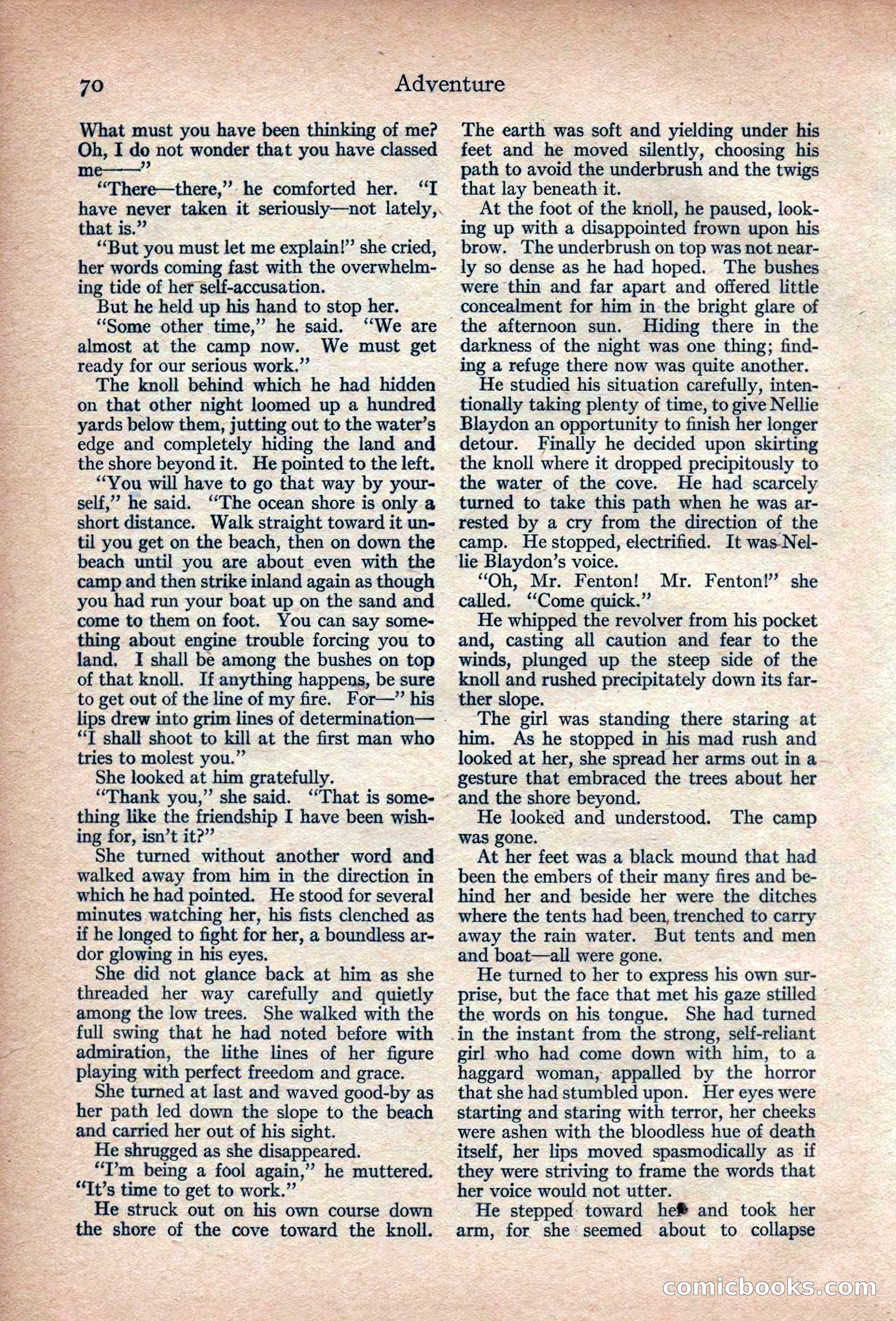
A restored page from Pulp Fiction, 1916. Page through the whole issue in the reader above.
📄 Transcribed text from this page (OCR, searchable)
Machine-transcribed from the original scan — historical spelling and the odd misread are preserved.
eae What must you have been thinking of me? Oh, I do not wonder that you have classed me 99 “There—there,” he comforted her. “T have never taken it seriously—not lately,. that is.” 7 “But you must let me explain!” she cried, her words coming fast with the overwhelm- ing tide of her self-accusation. But he held up his hand to stop her. “Some other time,” he said. ‘We are almost at the camp now. We must get ready for our serious work.” The knoll behind which he had hidden on that other night loomed up a hundred yards below them, jutting out to the water’s edge and completely hiding the land and the shore beyond it. He pointed to the left. “You will have to go that way by your- self,” he said. “The ocean shore is only a short distance. Walk straight toward it un- til you get on the beach, then on down the ch until you are about even with the camp and then strike inland again as though you had run your boat up on the sand and come to them on foot. You can say some- thing about engine trouble forcing you to land, I shall be among the bushes on top of that knoll. If anything happens, be sure to get out of the line of my fire. For—” his lips drew into grim lines of determination— - “T shall shoot to kill at the first man who tries to molest you.” She looked at him gratefully. “Thank you,” she said. ‘“That is some- thing like the friendship I have been wish- ing for, isn’t it?” She turned without another word and walked away from him in the direction in which he had pointed. He stood for several minutes watching her, his fists clenched as if he longed to fight for her, a boundless ar- dor glowing in his eyes. She did not glance back at him as she threaded her way carefully and quietly - among the low trees. She walked with the full swing that he had noted before with admiration, the lithe lines of her figure playing with perfect freedom and grace. She turned at last and waved good-by as her path led down the slope to the beach and carried her out of his sight. He shrugged as she disappeared. “I’m being a fool again,’ he muttered. “Tt’s time to get to work.” He struck out on his own course down the shore of the cove toward the knoll. Adventure The earth was soft and yielding under his feet and he moved silently, choosing his path to avoid the underbrush and the twigs that lay beneath it. At the foot of the knoll, he paused, look- ing up with a disappointed frown upon his brow. The underbrush on top was not near- ly so dense as he had hoped. The bushes were thin and far apart and offered little concealment for him in the bright glare of the afternoon sun. Hiding there in the darkness of the night was one thing; find- ing a refuge there now was quite another. He studied his situation carefully, inten- tionally taking plenty of time, to give Nellie Blaydon an opportunity to finish her longer detour. Finally he decided upon skirting the knoll where it dropped precipitously to the water of the cove. He had scarcely turned to take this path when he was ar- rested by a cry from the direction of the camp. He stopped, electrified. It was-Nel- lie Blaydon’s voice. “Oh, Mr. Fenton! Mr. Fenton!’’ she called. ‘Come quick.” He whipped the revolver from his pocket and, casting all caution and fear to the winds, plunged up the steep side of the knoll and rushed precipitately down its far- ther slope. The girl was standing there staring at him. As he stopped in his mad rush and looked at her, she spread her arms out in a gesture that embraced the trees about her ~ and the shore beyond. He looked and understood. The camp was gone. At her feet was a black mound that had been the embers of their many fires and be- hind her and beside her were the ditches where the tents had been, trenched to carry away the rain water. But tents and men and boat—all were gone. He turned to her to express his own sur- prise, but the face that met his gaze stilled © the words on his tongue. She had turned in the instant from the strong, self-reliant girl who had come down with him, to a haggard woman, appalled by the horror that she had stumbled upon. Her eyes were starting and staring with terror, her cheeks were ashen with the bloodless hue of death itself, her lips moved spasmodically as if they were striving to frame the words that her voice would not utter. He stepped: toward he® and took her arm, for she seemed about to collapse CONNKEL OOS (E@)