
Pulp Fiction, 1916 · page 76 of 228
Adventure Magazine, March 1916 — page 76: what you’re looking at
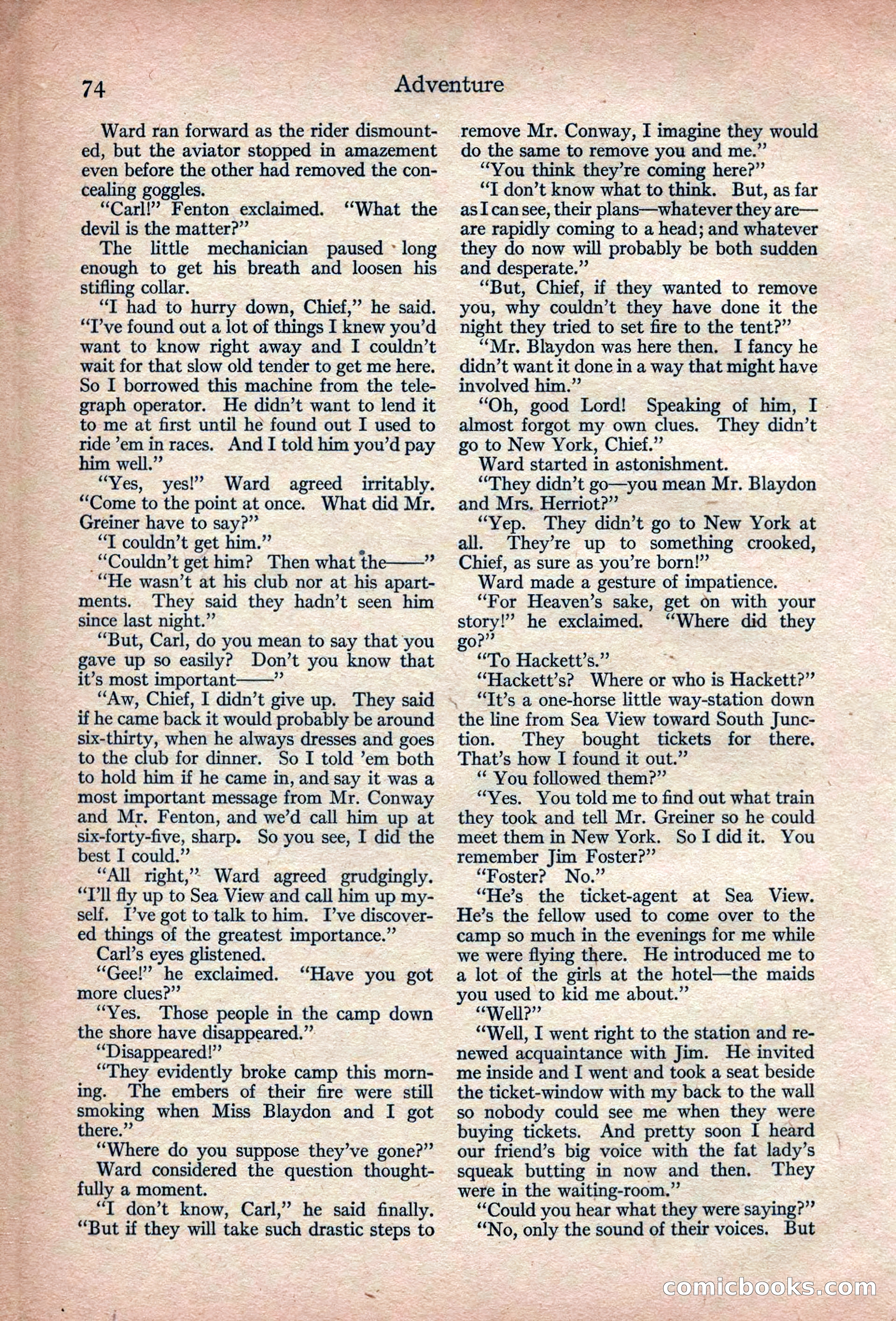
A restored page from Pulp Fiction, 1916. Page through the whole issue in the reader above.
📄 Transcribed text from this page (OCR, searchable)
Machine-transcribed from the original scan — historical spelling and the odd misread are preserved.
ee > oe Adventure Ward ran forward as the rider dismount- ed, but the aviator stopped in amazement even before the other had removed the con- cealing goggles. “Carl!” Fenton exclaimed. “What the devil is the matter?” The little mechanician paused ~ long enough to get his breath and loosen his stifling collar. “T had to hurry down, Chief,” he said. “T’ve found out a lot of things I knew you’d want to know right away and I couldn’t wait for that slow old tender to get me here. So I borrowed this machine from the tele- graph operator. He didn’t want to lend it to me at first until he found out I used to ride ’em in races. And I told him you’d pay him well.” “Yes, yes!” Ward agreed _irritably. “Come to the point at once. What did Mr. Greiner have to say?” “T couldn’t get him.”’ : -“Couldn’t get him? Then what the——” “He wasn’t at his club nor at his apart- ments. They said they hadn’t seen him since last night.” “But, Carl, do you mean to say that you gave up so easily? Don’t you know that it’s most important——’” “Aw, Chief, I didn’t give up. They said if he came back it would probably be around six-thirty, when he always dresses and goes to the club for dinner. So I told ’em both to hold him if he came in, and say it was a most important message from Mr. Conway ‘and Mr. Fenton, and we’d call him up at six-forty-five, sharp. So you see, I did the best I could.” | “All right,’ Ward agreed grudgingly. “Tl fly up to Sea View and call him up my- self. I’ve got to talk to him. I’ve discover- ed things of the greatest importance.” Carl’s eyes glistened. “Gee!” he exclaimed. more clues?” “Yes. Those people in the camp down the shore have disappeared.”’ ““Disappeared!”’ “They evidently broke camp this morn- ing. The embers of their fire were still smoking when Miss Blaydon and I got there.”’ “Where do you suppose they’ve gone?” Ward considered the question thought- fully a moment. : “I don’t know, Carl,” he said finally. “But if they will take such drastic steps to “Have you got remove Mr. Conway, I imagine they would do the same to remove you and me.” “You think they’re coming here?” “T don’t know what to think. But, as far as I can see, their plans—whatever they are— are rapidly coming to a head; and whatever they do now will probably be both sudden and desperate.” “But, Chief, if they wanted to remove you, why couldn’t they have done it the night they tried to set fire to the tent?” “Mr. Blaydon was here then, I fancy he didn’t want it done in a way that might have involved him.” “Oh, good Lord! almost forgot my own clues. They didn’t go to New York, Chief.” Ward started in astonishment. “They didn’t go—you mean Mr. Blaydon and Mrs, Herriot?” - “Vep. They didn’t go to New York at all. They’re up to something crooked, Chief, as sure as you’re born!” Ward made a gesture of impatience. “For Heaven’s sake, get on with your story!” he exclaimed. “Where did they oP” : “To Hackett’s.” 2 “Hackett’s? Where or who is Hackett?” “It’s a one-horse little way-station down the line from Sea View toward South Junc- tion. They bought tickets for there. That’s how I found it out.” You followed them?” Speaking of him, I - “Ves. You told me to find out what train ? they took and tell Mr. Greiner so he could meet them in New York. Sol didit. You remember Jim Foster?” “Foster? No.” “He’s the ticket-agent at Sea View. He’s the fellow used to come over to the camp so much in the evenings for me while we were flying there. He introduced me to a lot of the girls at the hotel—the maids you used to kid me about.” “Well?” “Well, I went right to the station and re- newed acquaintance with Jim. He invited me inside and I went and took a seat beside the ticket-window with my back to the wall so nobody could see me when they were buying tickets. And pretty soon I heard our friend’s big voice with the fat lady’s squeak butting in now and then. They were in the waiting-room,”’ “Could you hear what they were saying?”’ “No, only the sound of their voices. But CONNIE IOOLS (E@)