
Pulp Fiction, 1917 · page 109 of 228
Adventure, February 1917 — page 109: what you’re looking at
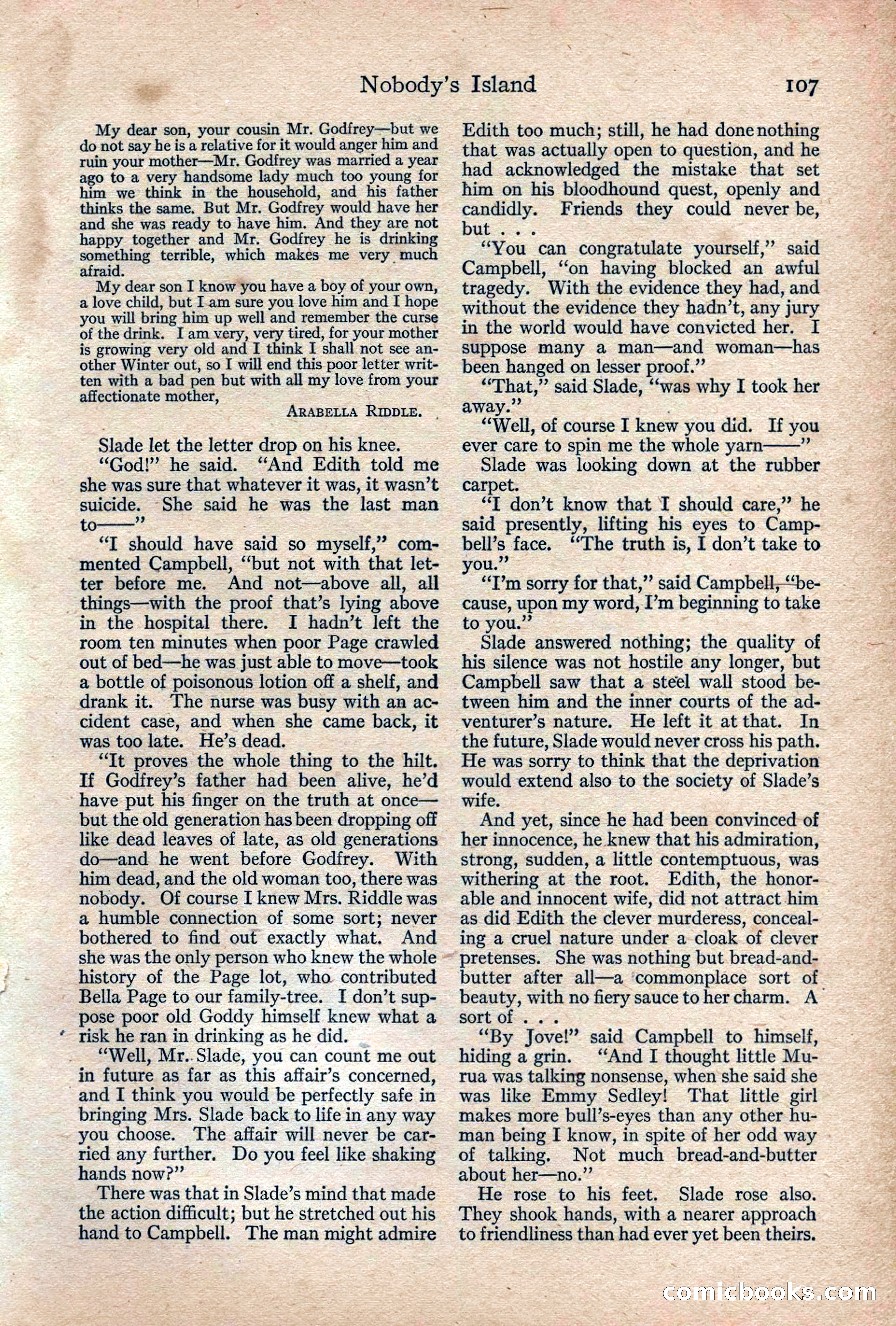
A restored page from Pulp Fiction, 1917. Page through the whole issue in the reader above.
📄 Transcribed text from this page (OCR, searchable)
Machine-transcribed from the original scan — historical spelling and the odd misread are preserved.
My dear son, your cousin Mr. Godfrey—but we do not say he is a relative for it would anger him and ruin your mother—Mr. Godfrey was married a year ago to a very handsome lady much too young for him we think in the household, and his father thinks the same. But Mr. Godfrey would have her and she was ready to have him. And they are not happy together and Mr. Godfrey he is drinking something terrible, which makes me very much afraid. My dear son I know you have a boy of your own, a love child, but I.am sure you love him and I hope you will bring him up well and remember the curse of the drink. I am very, very tired, for your mother is growing very old and I think I shall not see an- other Winter out, so I will end this poor letter writ- ten with a bad pen but with all my love from your affectionate mother, ARABELLA RIDDLE. , Slade let the letter drop on his knee. “God!” he said. “And Edith told me she was sure that whatever it was, it wasn’t suicide. She said he was the last man to——”’ : “T should have said so myself,” com- mented Campbell, “but not with that let- ter before me. And not—above all, all _ things—with the proof that’s lying above in the hospital there. I hadn’t left the room ten minutes when poor Page crawled out of bed—he was just able to move—took a bottle of poisonous lotion off a shelf, and drank it. The nurse was busy with an ac- cident case, and when she came back, it was too late. He’s dead. “Tt proves the whole thing to the hilt. If Godfrey’s father had been alive, he’d have put his finger on the truth at once— but the old generation has been dropping off like dead leaves of late, as old generations do—and he went before Godfrey. With him dead, and the old woman too, there was nobody. Of course I knew Mrs. Riddle was a humble connection of some sort; never bothered to find out exactly what. And she was the only person who knew the whole * history of the Page lot, who contributed Bella Page to our family-tree. I don’t sup- pose poor old Goddy himself knew what a risk he ran in drinking as he did. “Well, Mr..Slade, you can count me out in future as far as this affair’s concerned, _and I think you would be perfectly safe in bringing Mrs. Slade back to life in any way you choose. The affair will never be car- ried any further. Do you feel like shaking hands now?” There was that in Slade’s mind that made the action difficult; but he stretched out his hand to Campbell. The man might admire — Nobody’s Island -venturer’s nature. 107 Edith too much; still, he had done nothing that was actually open to question, and he had acknowledged the mistake that set him on his bloodhound quest, openly and candidly. Friends they could never be, DUE “You can congratulate yourself,” said Campbell, “fon having blocked an awful tragedy. With the evidence they had, and without the evidence they hadn’t, any jury in the world would have convicted her. I suppose many a man—and woman—has been hanged on lesser proof.” “That,” said Slade, “‘was why I took her away.” “‘Well, of course I knew you did. If you ever care to spin me the whole yarn——”’ Slade was looking down at the rubber carpet. “T don’t know that I should care,” he said presently, lifting his eyes to Camp- bell’s face. “The truth is, I don’t take to ou.’ . : “T’m sorry for that,”’ said Campbell,“‘be- cause, upon my word, I’m beginning to take to you.” Slade answered nothing; the quality of his silence was not hostile any longer, but Campbell saw that a steel wall stood be- tween him and the inner courts of the ad- He left it at that. In the future, Slade would never cross his path. He was sorry to think that the deprivation would extend also to the society of Slade’s wife. And yet, since he had been convinced of her innocence, he knew that his admiration, strong, sudden, a little contemptuous, was withering at the root. Edith, the honor- able and innocent wife, did not attract him as did Edith the clever murderess, conceal- ing a cruel nature under a cloak of clever pretenses. She was nothing but bread-and- butter after all—a ‘commonplace sort of beauty, with no fiery sauce tohercharm. A sortof... “By Jove!” said Campbell to himself, hiding a grin. ‘And I thought little Mu- rua was talking nonsense, when she said she was like Emmy Sedley! That little girl makes more bull’s-eyes than any other hu- man being I know, in spite of her odd way - of talking. about her—no.”’ He rose to his feet. Slade rose also. They shook hands, with a nearer approach to friendliness than had ever yet been theirs. Not much bread-and-butter Eomichbooks ae