
Pulp Fiction, 1917 · page 121 of 228
Adventure, February 1917 — page 121: what you’re looking at
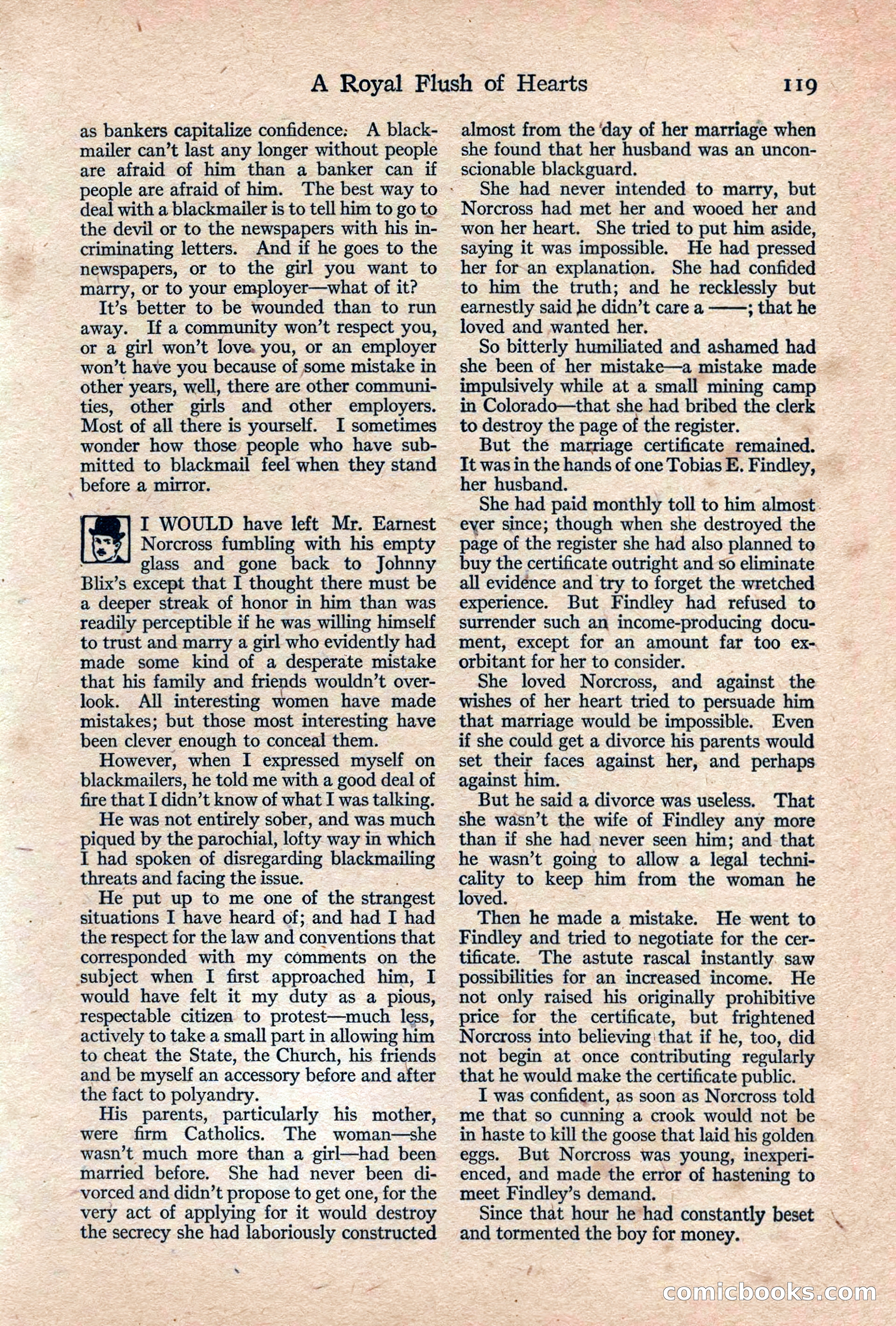
A restored page from Pulp Fiction, 1917. Page through the whole issue in the reader above.
📄 Transcribed text from this page (OCR, searchable)
Machine-transcribed from the original scan — historical spelling and the odd misread are preserved.
as bankers capitalize confidence: A black- mailer can’t last any longer without people are afraid of him than a banker can if people are afraid of him. The best way to - deal with a blackmailer is to tell him to go to the devil or to the newspapers with his in- criminating letters. And if he goes to the newspapers, or to the girl you want to marry, or to your employer—what of it? It’s better to be wounded than to run away. If a community won’t respect you, or a girl won’t love. you, or an employer won’t have you because of some mistake in other years, well, there are other communi- ties, other girls and other employers. Most of all there is yourself. I sometimes wonder how those people who have sub- mitted to blackmail feel when they stand _ before a mirror. Norcross fumbling with his empty : glass and gone back to Johnny Blix’s except that I thought there must be a deeper streak of honor in him than was readily perceptible if he was willing himself to trust and marry a girl who evidently had made some kind of a desperate mistake that his family and friends wouldn’t over- look. All interesting women have made mistakes; but those most interesting have been clever enough to conceal them. However, when I expressed myself on blackmailers, he told me with a good deal of fire that I didn’t know of what I was talking. He was not entirely sober, and was much piqued by the parochial, lofty. way in which I had spoken of disregarding blackmailing threats and facing the issue. He put up to me one of the strangest situations I have heard of; and had I had the respect for the law and conventions that corresponded with my comments on the subject when I first approached him, I would have felt it my duty as a pious, respectable citizen to protest—much less, actively to take a small part in allowing him to cheat the State, the Church, his friends and be myself an accessory before and after the fact to polyandry. His parents, particularly his mother, were firm Catholics. The woman—she wasn’t much more than a girl—had been married before. She had never been di- vorced and didn’t propose to get one, for the very act of applying for it would destroy the secrecy she had laboriously constructed . A Royal Flush of Hearts I WOULD have left Mr. Earnest © 119 almost from the ‘day of her marriage when she found that her husband was an uncon- — scionable blackguard. She had never intended to marry, but Norcross had met her and wooed her and won her heart. She tried to put him aside, _ saying it was impossible. He had pressed her for-an explanation. She had confided - to him the truth; and he recklessly but earnestly said he didn’t care a ——-; that he loved and wanted her. So bitterly humiliated and ashamed had she been of her mistake—a mistake made — impulsively while at a small mining camp in Colorado—that she had bribed the clerk to destroy the page of the register. But the marriage certificate remained. It was in the hands of one Tobias E. Findley, — her husband. She had paid monthly toll to him almost. eyer since; though when she destroyed the page of the register she had also planned to buy the certificate outright and so eliminate all evidence and try to forget the wretched experience. But Findley had refused to surrender such an income-producing docu- ment, except for an amount far too ex- orbitant for her to consider. 3 She loved Norcross, and against the wishes of her heart tried to persuade him that marriage would be impossible. Even if she could get a divorce his parents would set their faces against her, and perhaps against him. But he said a divorce was useless. That she wasn’t the wife of Findley any more than if she had never seen him; and that he wasn’t going to allow a legal techni- cality to keep him from the woman he loved. Then he made a mistake. He went to Findley and tried to negotiate for the cer- tificate. The astute rascal instantly. saw possibilities for an increased income. He not only raised his originally prohibitive price for the certificate, but frightened Norcross into believing that if he, too, did not begin at once contributing ‘regularly that he would make the certificate public. I was confident, as soon as Norcross told me that so cunning a crook would not be in haste to kill the goose that laid his golden. eggs. But Norcross was young, inexperi- enced, and made the error of hastening to meet Findley’ s demand. Since that hour he had constantly beset © and tormented the boy for money. ‘ JOO (E©) AANIG Ss (E@) =)