
Pulp Fiction, 1917 · page 13 of 228
Adventure, February 1917 — page 13: what you’re looking at
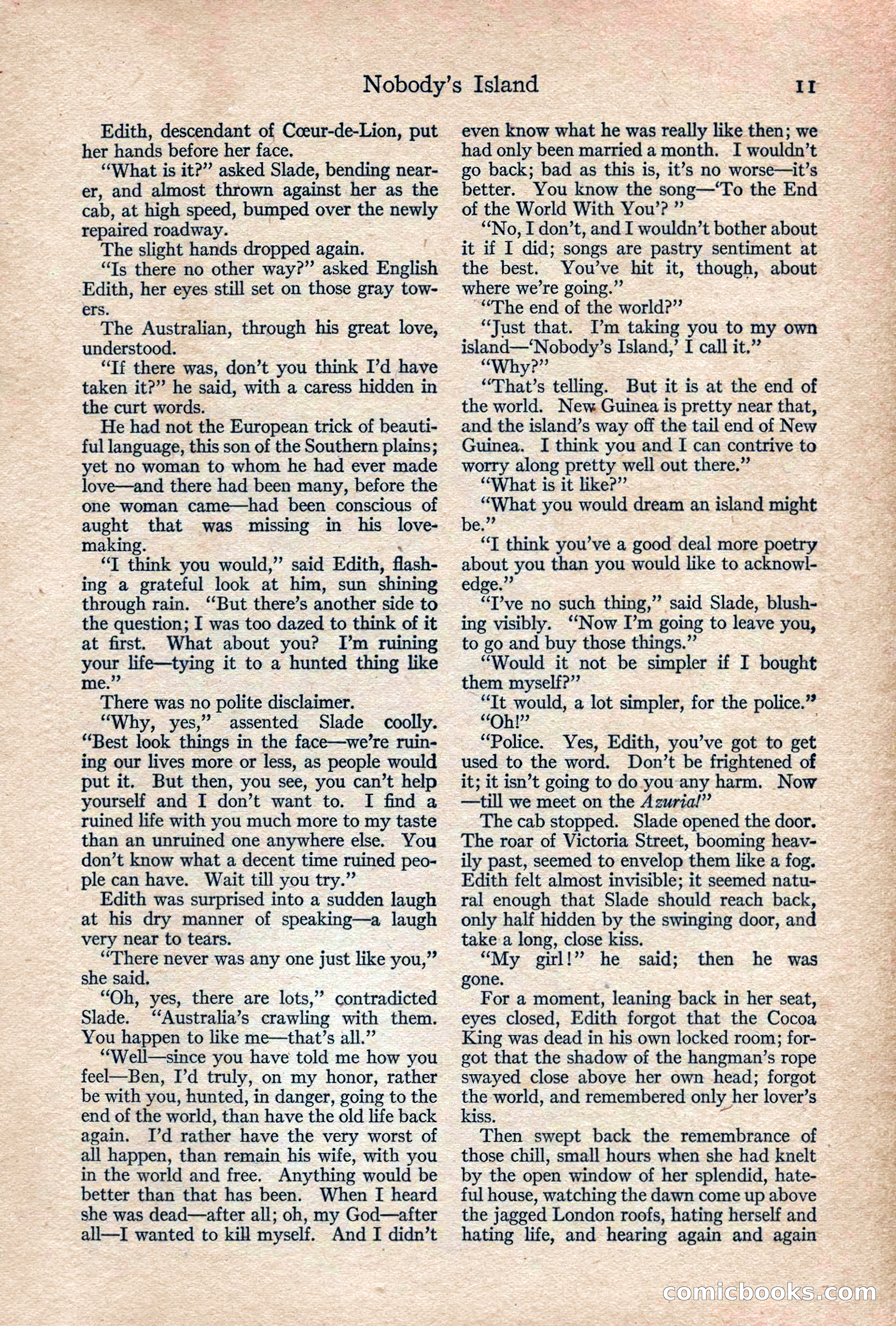
A restored page from Pulp Fiction, 1917. Page through the whole issue in the reader above.
📄 Transcribed text from this page (OCR, searchable)
Machine-transcribed from the original scan — historical spelling and the odd misread are preserved.
Nobody’s Island Edith, descendant of Coeur-de-Lion, put her hands before her face. “What is it?” asked Slade, bending near- er, and almost thrown against her as the cab, at high speed, bumped over the newly repaired roadway. The slight hands dropped again. . “Ts there no other way?” asked English Edith, her eyes still set on those gray tow- ers. The Australian, through his great love, understood. “Tf there was, don’t you think I’d have taken it?” he said, with a caress hidden in the curt words. He had not the European trick of beauti- ful language, this son of the Southern plains; yet no woman to whom he had ever made love—and there had been many, before the one woman came—had been conscious of aught that was missing in his love- making. ae! think you would, ” said Edith, flash- ing a grateful look at him, sun shining through rain. ‘But there’s another side to the question; I was too dazed to think of it at first. What about you? I’m ruining your life—tying it to a hunted thing like me. 39 There was no polite disclaimer. “Why, yes,” assented Slade coolly. “Best look things in the face—we’re ruin- ing our lives more or less, as people would put it. But then, you see, you can’t help yourself and I don’t want to. I find a ruined life with you much more to my taste than an unruined one anywhere else. You don’t know what a decent time ruined peo- _ ple can have. Wait till you try.” Edith was surprised into a sudden laugh at his dry manner of speaking—a laugh very near to tears. “There never was any one just like you,” she said. “Oh, yes, there are lots,” contradicted Slade. “Australia’s crawling with them. You happen to like me—that’s all.” “*“Well—since you have told me how you feel—Ben, I’d truly, on my honor, rather be with you, hunted, in danger, going to the end of the world, than have the old life back again. I’d rather have the very worst of all happen, than remain his wife, with you in the world and free. Anything would be better than that has been. When I heard she was dead—after all; oh, my God—after all—I wanted to kill myself. And I didn’t even know what he was really like then; we had only been married a month. I wouldn’t go back; bad as this is, it’s no worse—it’s better. You know the song—‘To the End of the World With You’? ” “No, I don’t, and I wouldn’t bother about it if I did; songs are pastry sentiment at the best. You’ve hit it, though, about where we’re going.” The end of the world?” “Just that. I’m taking you to my own island—' Nobody’ s Island,’ I call it,” po “That’s telling. But it is at the end of the world. New Guinea is pretty near that, and the island’s way off the tail end of New Guinea. I think you and I can contrive to worry along pretty well out there.” ‘What is it like?” be.” “T think you’ve a good deal more poetry about you than you would like to acknowl- edge.” “I’ve no such thing,” said Slade, blush- ing visibly. ‘‘Now I’m going to leave you, to go and buy those things.” “Would it not be simpler if I bought them myself?” so a lot simpler, for the police.” e¢ }?? “Police. Yes, Edith, you’ve got to get used to the word. Don’t be frightened of i: it isn’t going to do you any harm. Now we meet on the Azuri ~The cab stopped. Slade opened the door. | The roar of Victoria Street, booming heav- ily past, seemed to envelop them like a fog. Edith felt almost invisible; it seemed natu- ral enough that Slade should reach back, only half hidden by the swinging door, and take a long, close kiss. “My girl!” he said; then he was gone. For a moment, leaning back in her seat, eyes closed, Edith forgot that the Cocoa King was dead in his own locked room; for- got that the shadow of the hangman’s rope swayed close above her own head; forgot the world, and remembered only her lover’s S. Then swept back the remembrance of It “What you would dream an island might those chill, small hours when she had knelt — by the open window of her splendid, hate- ful house, watching the dawn come up above the jagged London roofs, hating herself and hating life, and hearing again and again S GEomichoo