
Pulp Fiction, 1917 · page 136 of 228
Adventure, February 1917 — page 136: what you’re looking at
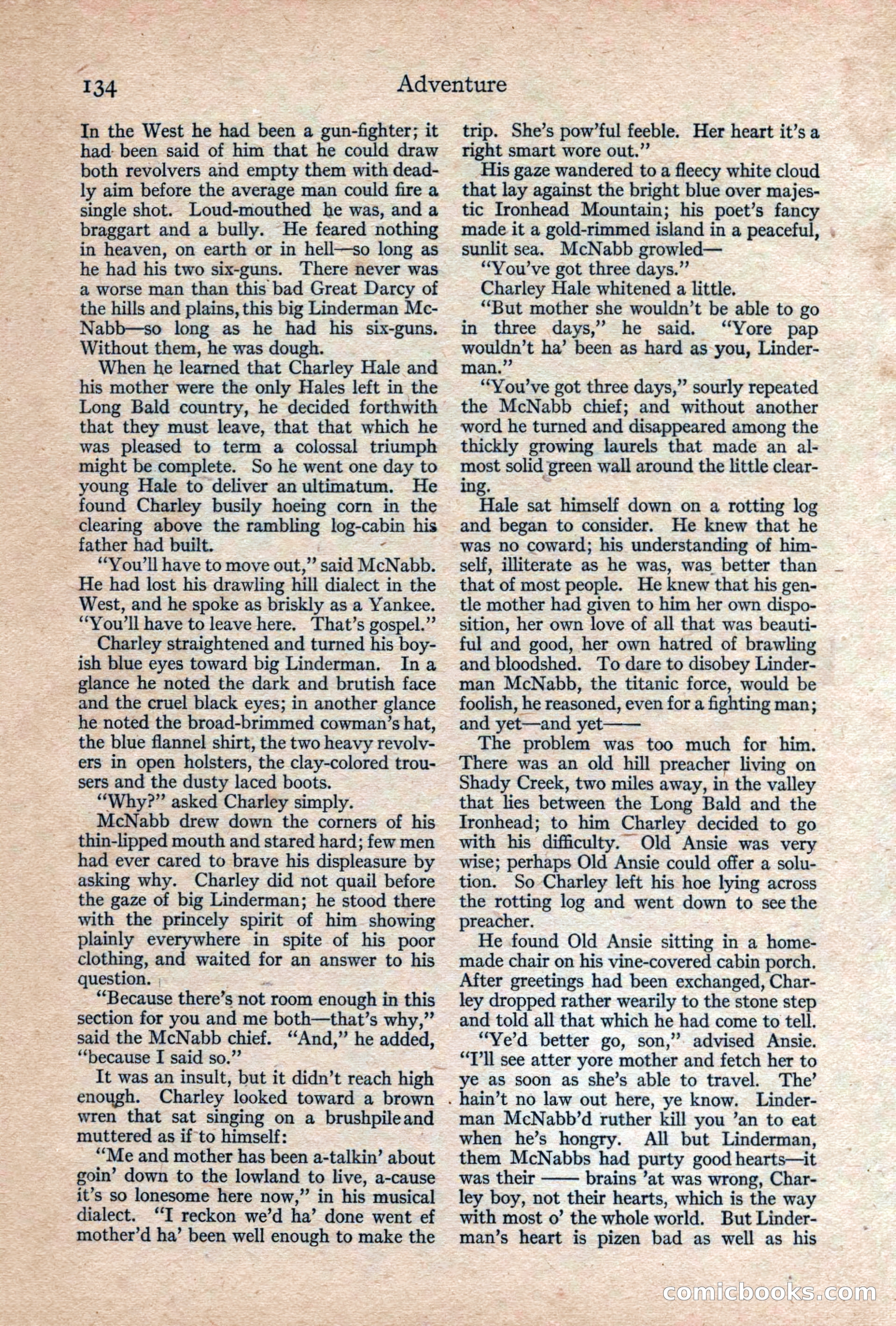
A restored page from Pulp Fiction, 1917. Page through the whole issue in the reader above.
📄 Transcribed text from this page (OCR, searchable)
Machine-transcribed from the original scan — historical spelling and the odd misread are preserved.
134 In the West he had been a gun-fighter; it had: been said of him that he could draw both revolvers and empty them with dead- ly aim before the average man could fire a single shot. Loud-mouthed he was, and a braggart and a bully. He feared nothing in heaven, on earth or in hell—so long as he had his two six-guns. There never was a worse man than this bad Great Darcy of the hills and plains, this big Linderman Mc- Nabb—so long as he had his six-guns. Without them, he was dough. When he learned that Charley Hale and his mother were the only Hales left in the Long Bald country, he decided forthwith that they must leave, that that which he -.. was pleased to term a colossal triumph might be complete. So he went one day to _ young Hale to deliver an ultimatum. He found Charley busily hoeing corn in the clearing above the rambling log-cabin his father had built. : _ “You'll have to move out,” said McNabb. He had lost his drawling hill dialect in the West, and he spoke as briskly as a Yankee. “You'll have to leave here. That’s gospel.” Charley straightened and turned his boy- ish blue eyes toward big Linderman. In a glance he noted the dark and brutish face and the cruel black eyes; in another glance he noted the broad-brimmed cowman’s hat, the blue flannel shirt, the two heavy revolv- ers in open holsters, the clay-colored trou- sers and the dusty laced boots. “Why?” asked Charley simply. McNabb drew down the corners of his thin-lipped mouth and stared hard; few men had ever cared to brave his displeasure by asking why. Charley did not quail before the gaze of big Linderman; he stood there with the princely spirit of him showing plainly everywhere in spite of his poor clothing, and waited for an answer to his - question. | ee “Because there’s not room enough in this section for you and me both—that’s why,” said the McNabb chief. ‘And,” he added, “because I said so.” It was an insult, but it didn’t reach high enough. Charley looked toward a brown wren that sat singing on a brushpileand muttered as if to himself: | “Me and mother has been a-talkin’ about goin’ down to the lowland to live, a-cause it’s so lonesome here now,” in his musical dialect. “TI reckon we’d ha’ done went ef mother’d ha’ been well enough to make the Adventure trip. She’s pow’ful feeble. Her heart it’s a right smart wore out.’’ His gaze wandered to a fleecy white cloud that lay against the bright blue over majes- tic Ironhead Mountain; his poet’s fancy made it a gold-rimmed island in a peaceful, . sunlit sea. McNabb growled— ““You’ve got three days.” Charley Hale whitened a little. “But mother she wouldn’t be able to go in three days,” he said. ‘“Yore pap wouldn’t ha’ been as hard as-you, Linder- man.” ““You’ve got three days,” sourly repeated the McNabb chief; and without another word he turned and disappeared among the thickly growing laurels that made an al- most solid green wall around the little clear- ing. Hale sat himself down on a rotting log and began to consider. He knew that he was no coward; his understanding of him- self, illiterate as he was, was better than that of most people. He knew that his gen- tle mother had given to him her own dispo- sition, her own love of all that was beauti- ful and good, her own hatred of brawling and bloodshed. To dare to disobey Linder- man McNabb, the titanic force, would be foolish, he reasoned, even for a fighting man; and yet—and yet—— 3 The problem was too much for him. There was an old hill preacher living on Shady Creek, two miles away, in the valley that lies between the Long Bald and the Ironhead; to him Charley decided to go with his difficulty. Old Ansie was very wise; perhaps Old Ansie could offer a solu- tion. So Charley left his hoe lying across the rotting log and went down to see the preacher. He found Old Ansie sitting in a home- made chair on his vine-covered cabin porch. After greetings had been exchanged, Char- ley dropped rather wearily to the stone step and told all that which he had come to tell. “Ye’d better go, son,” advised Ansie. “T’ll see atter yore mother and fetch her to ye as soon as she’s able to travel. The’ . hain’t no law out here, ye know. Linder- man McNabb’d ruther kill you ’an to eat when he’s hongry. All but Linderman, them McNabbs had purty good hearts—it was their —— brains ’at was wrong, Char- ley boy, not their hearts, which is the way with most o’ the whole world. But Linder- man’s heart is pizen bad as well as his ke Eomichoo GO