
Pulp Fiction, 1917 · page 147 of 228
Adventure, February 1917 — page 147: what you’re looking at
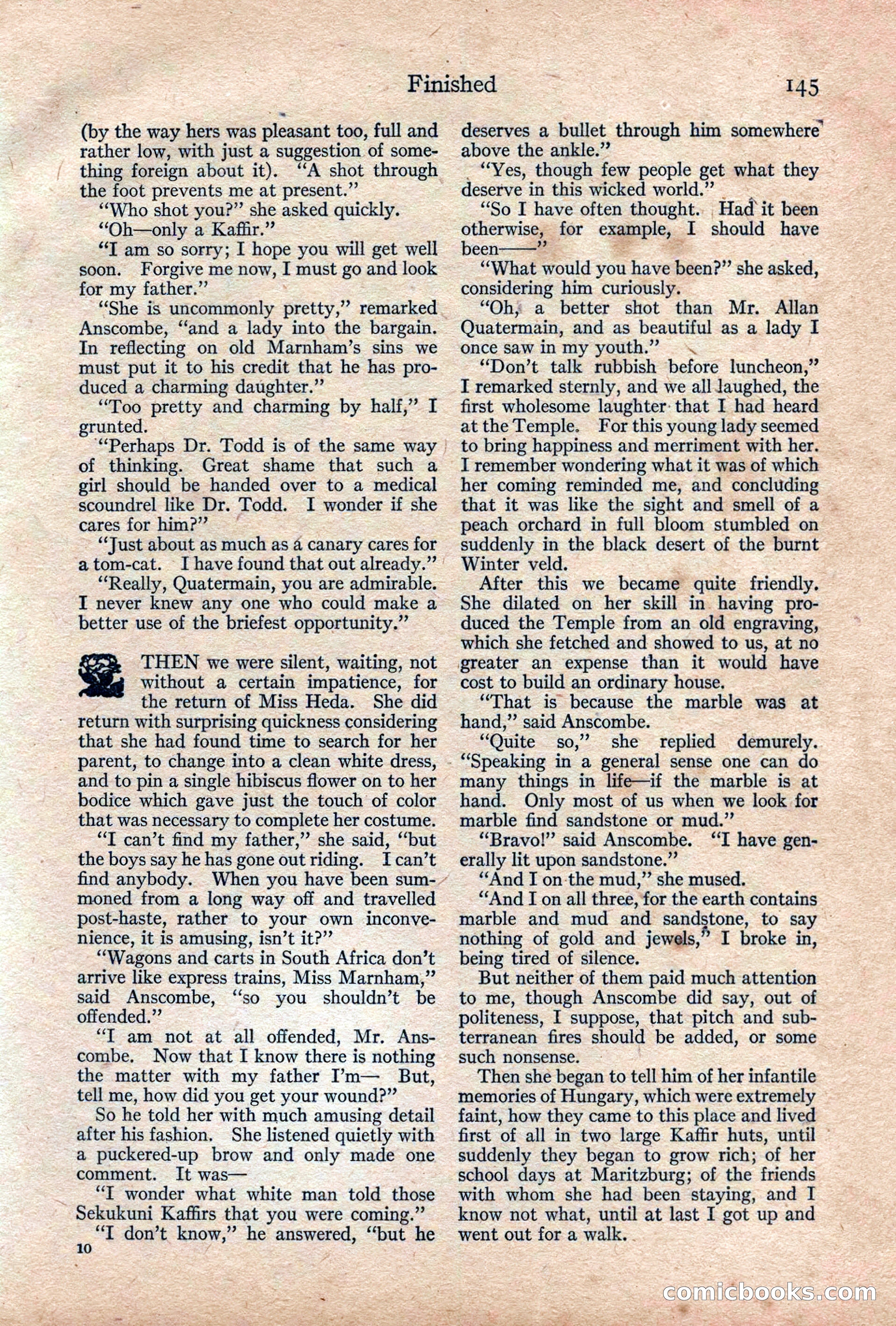
A restored page from Pulp Fiction, 1917. Page through the whole issue in the reader above.
📄 Transcribed text from this page (OCR, searchable)
Machine-transcribed from the original scan — historical spelling and the odd misread are preserved.
Fenicbed (by the way hers was pleasant too, full and rather low, with just a suggestion of some- thing foreign about it). ‘A shot through the foot prevents me at present.” “Who shot your” she asked quickly. “Oh—only a Kaffir.” “I am so sorry; I hope you will get well soon. F orgive me now, f must go and look for my father.”’ “She is uncommonly pretty,” remarked | Anscombe, ‘‘and a lady into the bargain. In reflecting on old Marnham’s sins we must put it to his credit that he has pro- duced a charming daughter.” “Too pretty and charming by half,” I grunted. “Perhaps Dr. Todd is of the same way | of thinking. Great shame that such a girl should be handed over to a medical scoundrel like Dr. Todd. I wonder if she cares for him?” “Just about as much as 4 canary cares for a tom-cat. I have found that out already.” “Really, Quatermain, you are admirable. I never knew any one who could make a better use of the briefest opportunity.” THEN we were silent, waiting, not without a certain impatience, for the return of Miss Heda. She did * return with surprising quickness considering that she had found time to search for her parent, to change into a clean white dress, and to pin a single hibiscus flower on to her bodice which gave just the touch of color that was necessary to complete her costume. “IT can’t find my father,” she said, “but the boys say he has gone out riding. Ican’t find anybody. moned from a long way off and travelled post-haste, rather to your own inconve- nience, it is amusing, isn’t it?” _ “Wagons and carts in South Africa don’t arrive like express trains, Miss Marnham,”’ said Anscombe, ‘“‘so you shouldn’t be offended.” “T am not at all offended, Mr. Ans- combe. Now that I know there is nothing the matter with my father ’m— But, tell me, how did you get your wound?” So he told her with much amusing detail after his fashion. She listened quietly with a puckered-up brow and only made one comment. It was— “YT wonder what white man told fies Sekukuni Kaffirs that you were coming.” 1 don’t know,” he answered, “but he When you have been sum- 145 deserves a bullet through him somewhere’ above the ankle.” _ “Yes, though few people get what they deserve in this wicked world.” “So I have often thought. Had it been otherwise, for cpple I should have been——” “What would you have been?” she asked, considering him curiously. “Oh, a better shot than Mr. Allan Quatermain, and as beautiful as a lady I once saw in my youth.” “Don’t talk rubbish before luncheon,” I remarked sternly, and we all Jaughed, the first wholesome laughter: that I had heard atthe Temple. For this young lady seemed to bring happiness and merriment with her. I remember wondering what it was of which her coming reminded me, and concluding that it was like the sight and smell of a ~ peach orchard in full bloom stumbled on suddenly in the black desert of the burnt Winter veld. After this we became quite friendly. She dilated on her skill in having pro- duced the Temple from an old engraving, which she fetched and showed to us, at no greater an expense than it would have cost to build an ordinary house. ‘That is because the marble was at hand,” said Anscombe. “Quite so,’ she replied demurely. . “Speaking in a general sense one can do many things in life—if the marble is at hand. Only most of us when we look for marble find sandstone or mud.” “Bravo!” said Anscombe. “T have gen- erally lit upon sandstone.” “And I on-the mud,” she mused. ‘And I on all three, for the earth contains marble and mud and sandstone, to say ~ nothing of gold and jewels,” being tired of silence. But neither of them paid much attention to me, though Anscombe did say, out of politeness, I suppose, that pitch and sub- terranean fires should be added, or some such nonsense. Then she began to tell him of her infantile memories of Hungary, which were extremely faint, how they came to this place and lived I broke in, first of all in two large Kaffir huts, until © suddenly they began to grow rich; of her school days at Maritzburg; of the friends with whom she had been staying, and I know not what, until at last I got up and went out for a walk. sbook (E)