
Pulp Fiction, 1917 · page 168 of 228
Adventure, February 1917 — page 168: what you’re looking at
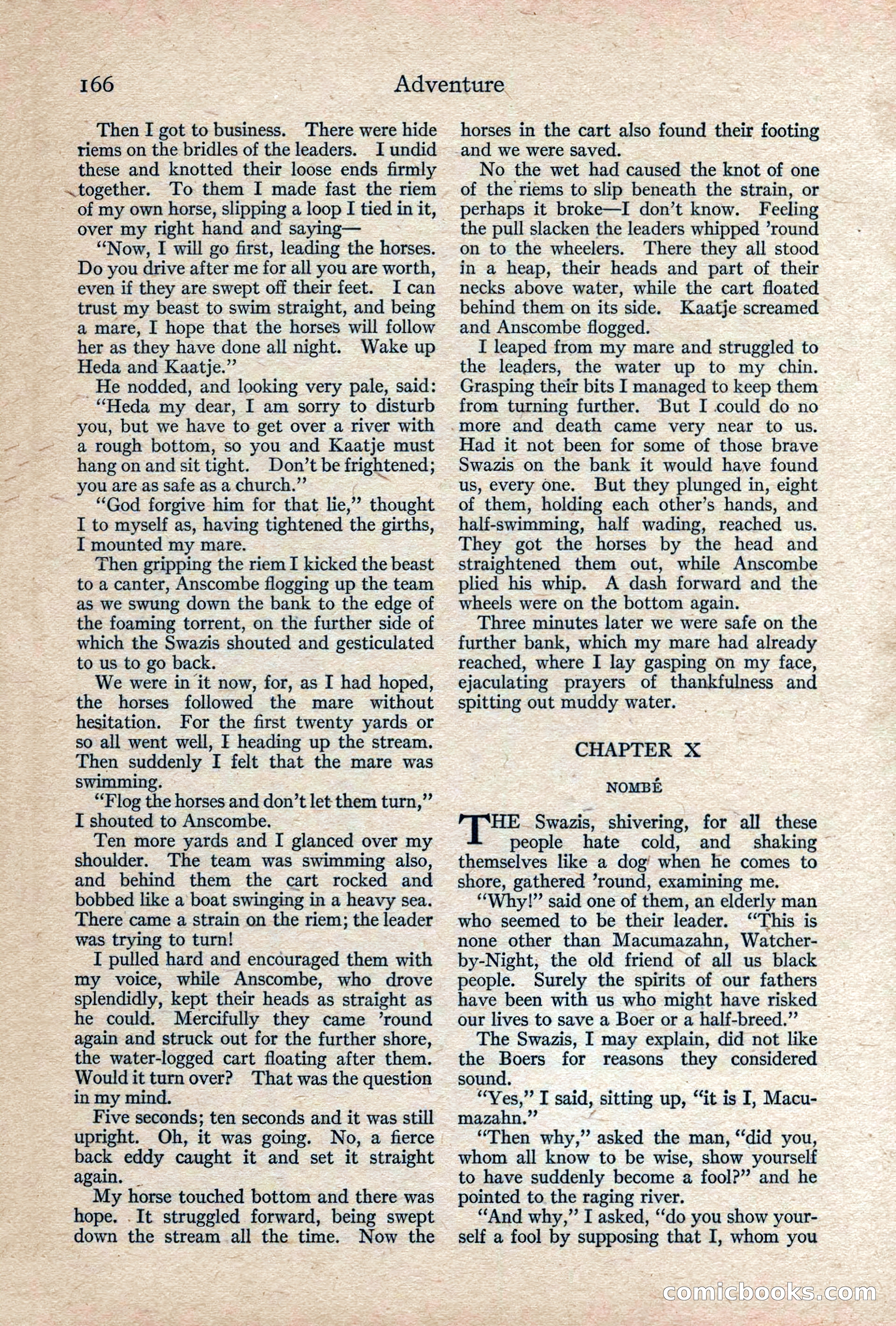
A restored page from Pulp Fiction, 1917. Page through the whole issue in the reader above.
📄 Transcribed text from this page (OCR, searchable)
Machine-transcribed from the original scan — historical spelling and the odd misread are preserved.
- riems on the bridles of the leaders. 166 There were hide I undid these and knotted their loose ends firmly ~ together. To them I made fast the riem of my own horse, slipping a loop I tied in it, over my right hand and saying— “Now, I will go first, leading the horses. Do you drive after me for all you are worth, even if they are swept off their feet. I can trust my beast to swim straight, and being a mare, I hope that the horses will follow her as they have done all night. Wake up Heda and Kaatyje.”’ _ He nodded, and looking very pale, said: “Heda my dear, I am sorry to disturb you, but we have to get over a river with a rough bottom, so you and Kaatje must hang on and sit tight. Don’t be frightened; you are as safe as a church.” “God forgive him for that lie,” thought I to myself as, having tightened the girths, I mounted my mare. Then gripping the riem I kicked the beast to a canter, Anscombe flogging up the team as we swung down the bank to the edge of the foaming torrent, on the further side of which the Swazis shouted and gesticulated to us to go back. We were in it now, for, as I had hoped, _ Then I got to business. - the horses followed the mare without ~ hesitation. For the first twenty yards or so all went well, E heading up the stream. Then suddenly T felt that the mare was swimming “Flog the horses and don’t let them turn, : I shouted to Anscombe. Ten more yards and I glanced over my shoulder. The team was swimming also, and behind them the cart rocked and bobbed like a boat swinging in a heavy sea. There came a strain on the riem; the leader was trying to turn! _ I pulled hard and encouraged them with my voice, while Anscombe, who drove splendidly, kept their heads as straight as he could. Mercifully they came ‘round again and struck out for the further shore, the water-logged cart floating after them. Would it turn over? That was the question in my mind. Five seconds; ten mas and it was still upright. Oh, it was going. No, a fierce back eddy caught it and set it straight again. My horse touched bottom and there was hope. .It struggled forward, being swept down the stream all the time. Now the Adventure horses in the cart also found their footing and we were saved. No the wet had caused the knot of one of the riems to slip beneath the strain, or perhaps it broke—I don’t know. Feeling the pull slacken the leaders whipped ’round on to the wheelers. There they all stood in a heap, their heads and part of their necks above water, while the cart floated behind them on its side. Kaatje screamed and Anscombe flogged. I leaped from my mare and struggled to the leaders, the water up to my chin. Grasping their bits I managed to keep them from turning further. But I could do no -more and death came very near to us. Had it not been for some of those brave Swazis on the bank it would have found us, every One. But they plunged in, eight of them, holding each other’s hands, and half-swimming, half wading, reached us. They got the horses by the head and straightened them out, while Anscombe plied his whip. A dash forward and the wheels were on the bottom again. Three minutes later we were safe on the further bank, which my mare had already reached, where I lay gasping on my face, ejaculating prayers of tha spitting out muddy water. nkfulness and CHAPTER X NOMBE Tue Swazis, shivering, for all these people hate cold, and _ shaking themselves like a dog’ when he comes to shore, gathered ’round, examining me. “Why!” said one of them, an elderly man who seemed to be their leader. “This is none other than Macumazahn, Watcher- by-Night, the old friend of all us black people. Surely the spirits of our fathers have been with us who might have risked our lives to save a Boer or a half-breed.” The Swazis, I may explain, did not like the Boers for reasons they considered sound, “Ves,” I said, , sitting up, “it is I, Macu- mazahn.” “Then why,” asked the man, “did you, whom all know to be wise, show yourself to have suddenly become a fool?” and he pointed to the raging river. “And why,” I asked, “‘do you show your- self a fool by supposing that I, whom you JOOKS (C@) (EOMAUG