
Pulp Fiction, 1917 · page 171 of 228
Adventure, February 1917 — page 171: what you’re looking at
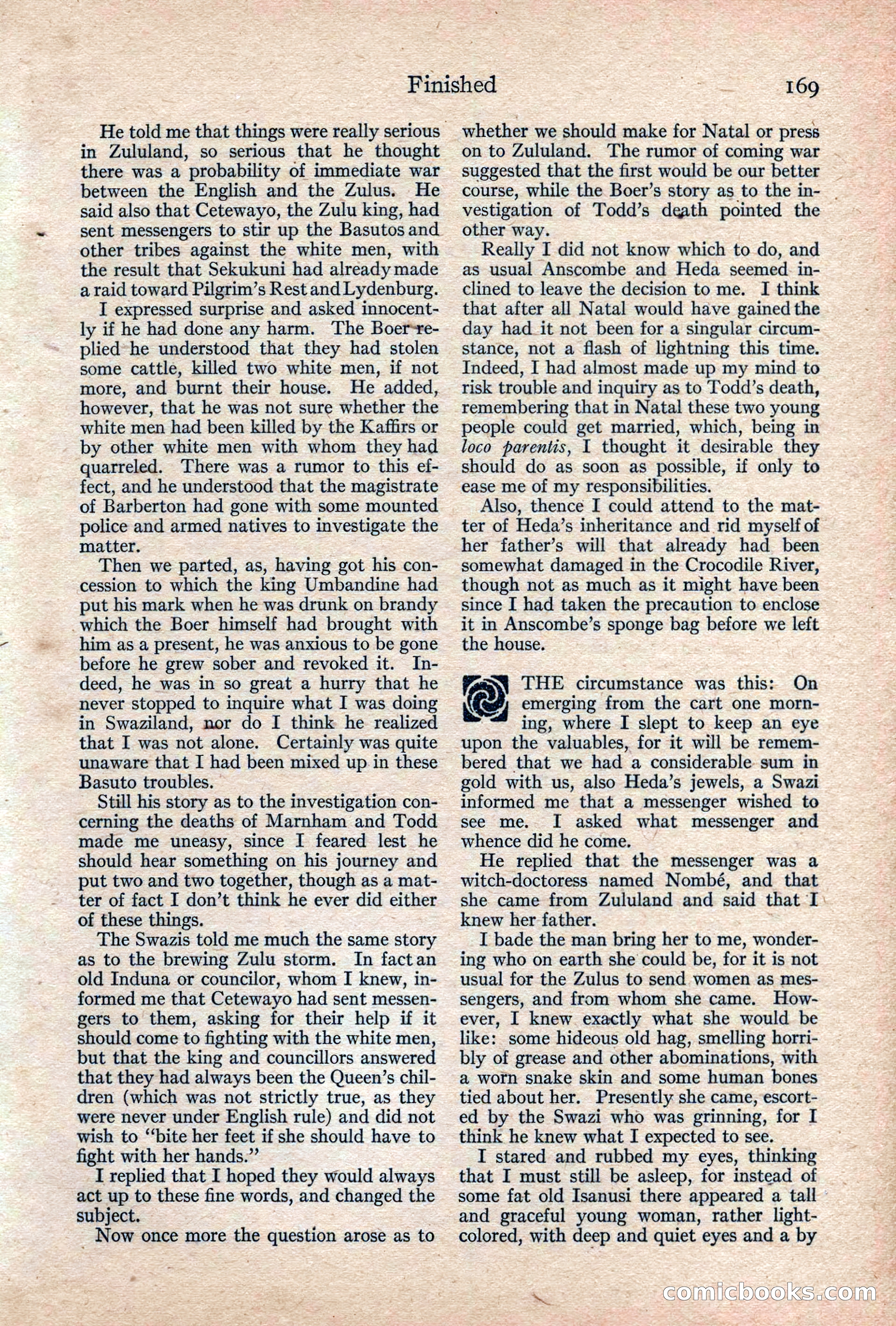
A restored page from Pulp Fiction, 1917. Page through the whole issue in the reader above.
📄 Transcribed text from this page (OCR, searchable)
Machine-transcribed from the original scan — historical spelling and the odd misread are preserved.
Finished He told me that things were really serious in Zululand, so serious that he thought there was a probability of immediate war between the English and the Zulus. He said also that Cetewayo, the Zulu king, had sent messengers to stir up the Basutos and other tribes against the white men, with the result that Sekukuni had already made a raid toward Pilgrim’s Rest and Lydenburg. I expressed surprise and asked innocent- ly if he had done any harm. The Boer-re- plied he understood that they had stolen some cattle, killed two white men, if not more, and burnt their house. He added, however, that he was not sure whether the white men had been killed by the Kaffirs or by other white men with whom they had quarreled. There was a rumor to this ef- fect, and he understood that the magistrate of Barberton had gone with some mounted police and armed natives to investigate the matter. Then we parted, as, having got his con- cession to which the king Umbandine had put his mark when he was drunk on brandy which the Boer himself had brought with him as a present, he was anxious to be gone before he grew sober and revoked it. In- deed, he was in so great a hurry that he never stopped to inquire what I was doing in Swaziland, nor do I think he realized that I was not alone. Certainly was quite unaware that I had been mixed up in these Basuto troubles. Still his story as to the investigation con- cerning the deaths of Marnham and Todd made me uneasy, since I feared lest he should hear something on his journey and put two and two together, though as a mat- ter of fact I don’t think he ever did either of these things. The Swazis told me much the same story as to the brewing Zulu storm. In factan old Induna or councilor, whom I knew, in- formed me that Cetewayo had sent messen- gers to them, asking for their help if it should come to fighting with the white men, but that the king and councillors answered that they had always been the Queen’s chil- dren (which was not strictly true, as they were never under English rule) and did not wish to “‘bite her feet if she should have to fight with her hands.” I replied that I hoped they would always act up to these fine words, and changed the subject. _ Now once more the question arose as to 169 whether we should make for Natal or press on to Zululand. The rumor of coming war . suggested that the first would be our better ~ course, while the Boer’s story as to the in- | vestigation of Todd’s death pointed the other way. Really I did not know which to do, and as usual Anscombe and Heda seemed. in- clined to leave the decision to me. I think that after all Natal would have gained the day had _ it not been for a singular circum- stance, not a flash of lightning this time. Indeed, I had almost made up my mind to risk trouble and inquiry as to Todd’s death, remembering that in Natal these two young people could get married, which, being in loco parentis, I thought it desirable they should do as soon as possible, if only to ease me of my responsibilities. Also, thence I could attend to the mat- ter of Heda’s inheritance and rid myself of her father’s will that already had been somewhat damaged in the Crocodile River, though not as much as it might have been since I had taken the precaution to enclose it in Anscombe’s sponge bag before we left the house. ) emerging from the cart one morn- ing, where I slept to keep an eye upon the valuables, for it will be remem- bered that we had a considerable sum in gold with us, also Heda’s jewels, a Swazi informed me that a messenger wished to see me. [ asked what messenger and whence did he come. He replied that the messenger was a witch-doctoress named Nombé, and that THE circumstance was this: On she came from Zululand and said that As knew her father. I bade the man bring her to me, wonder- ing who on earth she could be, for it is not usual for the Zulus to send women as mes- sengers, and from whom she came. How- ever, I knew exactly what she would be like: some hideous old hag, smelling horri- bly of grease and other abominations, with a worn snake skin and some human bones tied about her. Presently she came, escort- ed by the Swazi who was grinning, for I think he knew what I expected to see. I stared and rubbed my eyes, thinking that I must still be asleep, for instead of some fat old Isanusi there appeared a tall and graceful young woman, rather light- colored, with deep and quiet eyes and a by JOO S COME COL