
Pulp Fiction, 1917 · page 19 of 228
Adventure, February 1917 — page 19: what you’re looking at
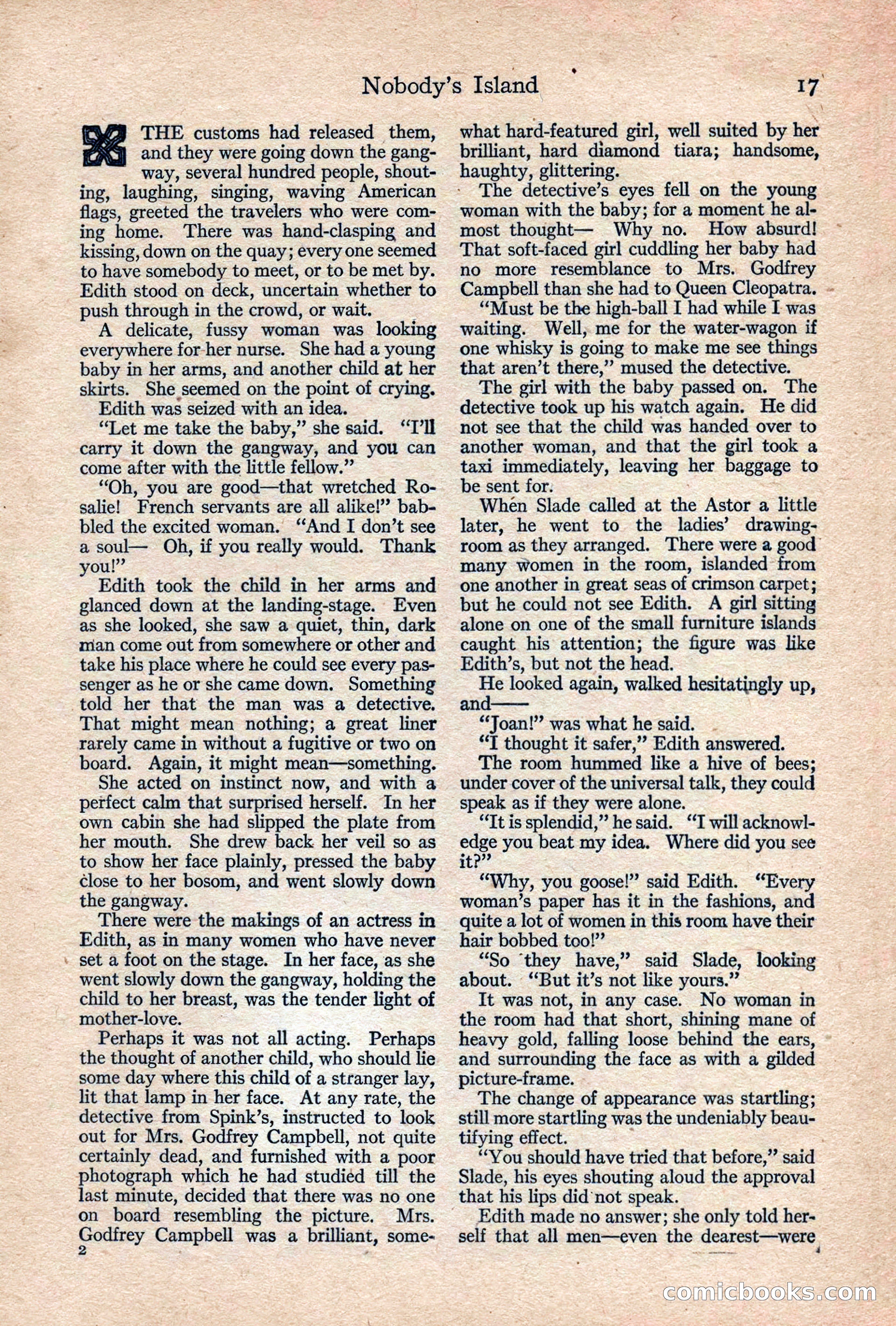
A restored page from Pulp Fiction, 1917. Page through the whole issue in the reader above.
📄 Transcribed text from this page (OCR, searchable)
Machine-transcribed from the original scan — historical spelling and the odd misread are preserved.
- Nobody’s Island THE customs had released them, and they were going down the gang- way, several hundred people, shout- ing, laughing, singing, waving American flags, greeted the travelers who were com- ing home. There was hand-clasping and kissing, down on the quay; every one seemed to have somebody to meet, or to be met by. Edith stood on deck, uncertain whether to push through in the crowd, or wait. A delicate, fussy woman was looking everywhere for-her nurse. She hada young baby in her arms, and another child at her skirts. She seemed on the point of crying. Edith was seized with an idea. “Let me take the baby,” she said. “T’ll carry it down the gangway, and you can come after with the little fellow.” “Oh, you are good—that wretched Ro- salie! French servants are all alike!”? bab- bled the excited woman. ‘And I don’t see a soul— Oh, if you really would. Thank ou!” Edith took the child in her arms and glanced down at the landing-stage. Even as she looked, she saw a quiet, thin, dark man come out from somewhere or other and take his place where he could see every pas- senger as he or she came down. Something told her that the man was a detective. That might mean nothing; a great liner rarely came in without a fugitive or two on board. Again, it might mean—something. She acted on instinct now, and with a perfect calm that surprised herself. In her own cabin she had slipped the plate from her mouth. She drew back her veil so as to show her face plainly, pressed the baby close to her bosom, and went slowly down the gangway. There were the makings of an actress in Edith, as in many women who have never set a foot on the stage. In her face, as she went slowly down the gangway, holding the child to her breast, was the tender light of mother-love. : Perhaps it was not all acting. Perhaps the thought of another child, who should lie some day where this child of a stranger lay, lit that lamp in her face. At any rate, the detective from Spink’s, instructed to look out for Mrs. Godfrey Campbell, not quite certainly dead, and furnished with a poor photograph which he had studied till the last minute, decided that there was no one on board resembling the picture. Mrs. Godfrey Campbell was a brilliant, some- Ef what hard-featured girl, well suited by her brilliant, hard diamond tiara; handsome, haughty, glittering. The detective’s eyes fell on the young woman with the baby; for a moment he al- most thought— Why no. How absurd! That soft-faced girl cuddling her baby had no more resemblance to Mrs. Godfrey ‘ \ Campbell than she had to Queen Cleopatra. ~ “Must be the high-ball I had while I was waiting. Well; me for the water-wagon if one whisky is going to make me see things that aren’t there,’’ mused the detective. The girl with the baby passed on. The detective took up his watch again. He did not see that the child was handed over to another woman, and that the girl took a taxi immediately, leaving her baggage to be sent for. When Slade called at the Astor a little later, he went to the ladies’ drawing- room as they arranged. There were a good many women in the room, islanded from one another in great seas of crimson carpet; but he could not see Edith. A girl sitting alone on one of the small furniture islands caught his attention; the figure was like Edith’s, but not the head. a looked again, walked hesitatingly up, and—— ‘Joan!’ was what he said. “T thought it safer,” Edith answered. The room hummed like a hive of bees; under cover of the universal talk, they could speak as if they were alone. “Tt is splendid,” he said. “TI will acknowl- edge you beat my idea. Where did you see it?’ “Why, you goose!” said Edith. “Every woman’s paper has it in the fashions, and quite a lot of women in this room have their hair bobbed too!’’ “So ‘they have,” said Slade, looking about. ‘But it’s not like yours.” It was not, in any case. No woman in the room had that short, shining mane of heavy gold, falling loose behind the ears, and surrounding the face as with a gilded picture-frame. The change of appearance was startling; still more startling was the undeniably beau- tifying effect. “You should have tried that before,” said | Slade, his eyes shouting aloud the approval that his lips did ‘not speak. Edith made no answer; she only told her- self that all men—even the dearest—were MICLOOOKS (E@) mm (©)