
Pulp Fiction, 1917 · page 210 of 228
Adventure, February 1917 — page 210: what you’re looking at
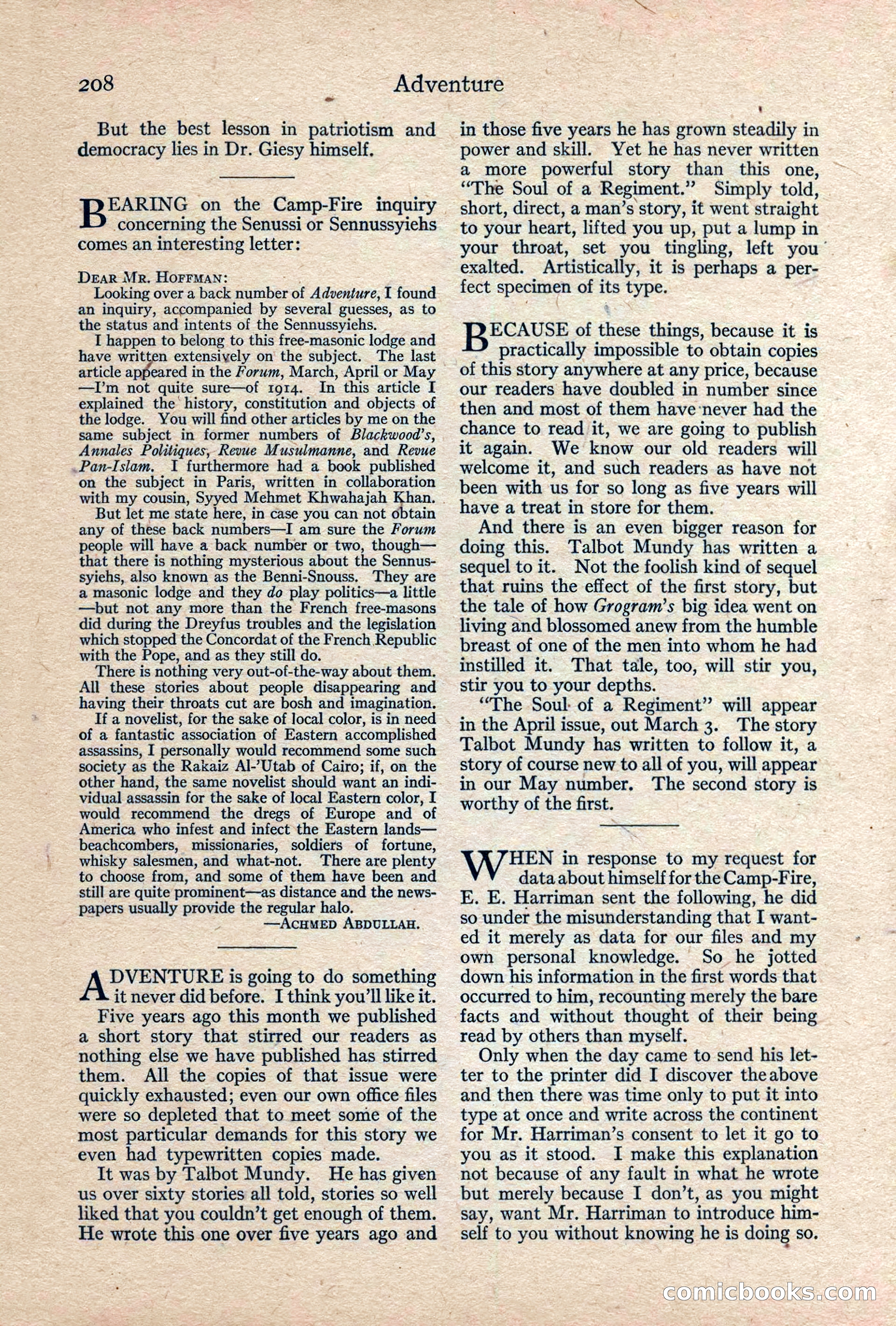
A restored page from Pulp Fiction, 1917. Page through the whole issue in the reader above.
📄 Transcribed text from this page (OCR, searchable)
Machine-transcribed from the original scan — historical spelling and the odd misread are preserved.
208 - But the best lesson in patriotism and democracy lies in Dr. Giesy himself. ge ES ENG on the Camp-Fire inquiry concerning the Senussi or Sennussyiehs comes an interesting letter: Dear Mr. HOFFMAN: Looking over a back garnbar of Adventure, I found an inquiry, accompanied by several guesses, as to the status and intents of the Sennussyiehs. I happen to belong to this free-masonic lodge and have written extensively on the subject. The last article appeared in the Forum, March, April or May —I’m not quite sure—of 1914. In this article I explained the history, constitution and objects of the lodge. You will find other articles by me on the same subject in former numbers of Blackwood’s, Annales Politiques, Revue Musulmanne, and Revue Pan-Islam. 1 furthermore had a book published on the subject in Paris, written in collaboration with my cousin, Syyed Mehmet Khwahajah Khan. | But let me state here, in case you can not obtain any of these back numbers—I am sure the Forum people will have a back number or two, though— that there is nothing mysterious about the Sennus- syiehs, also known as the Benni-Snouss, They are a masonic lodge and they do play politics—a little —but not any more than the French free-masons did during the Dreyfus troubles and the legislation which stopped the Concordat of the French Republic with the Pope, and as they still do. There is nothing very out-of-the-way about them. All these stories about people disappearing and having their throats cut are bosh and imagination. If a novelist, for the sake of local color, is in need of a fantastic association of Eastern accomplished assassins, I personally would recommend some such society as the Rakaiz Al-’Utab of Cairo; if, on the other hand, the same novelist should want an indi- vidual assassin for the sake of local Eastern color, I would recommend the dregs of Europe and of America who infest and infect the Eastern lands— beachcombers, missionaries, soldiers of fortune, whisky salesmen, and what-not. There are plenty to choose from, and some of them have been and still are quite prominent—as distance and the news- papers usually gee ee the regular hal —ACHMED Sits. pe Aecrales URE is going to do something it never did before. I think you'll like it. Five years ago this month we published a short story that stirred our readers as nothing else we have published has stirred them. All the copies of that issue were quickly exhausted; even our own office files were so depleted that to meet some of the most particular demands for this story we even had typewritten copies made. It was by Talbot Mundy. He has given us Over sixty stories all told, stories so well liked that you couldn’t get enough of them. He wrote this one over five years ago and Adventure in those five years he has grown steadily in power and skill. Yet he has never written a more powerful story than this one, “The Soul of a Regiment. % Simply told, short, direct, a man’s story, if went straight to your heart, lifted you up, put a lump in your throat, set you tingling, left you exalted. Artistically, it is perhaps a per- fect specimen of its type. Bits. of se things, because it is practically impossible to obtain copies of this story anywhere at any price, because our readers have doubled in number since then and most of them have-never had the chance to read it, we are going to publish it again. We know our old readers will welcome it, and such readers as have not been with us for so long as five years will have a treat in store for them. And there is an even bigger reason for doing this. Talbot Mundy has written a sequel to it. Not the foolish kind of sequel that ruins the effect of the first story, but the tale of how Grogram’s big idea went on living and blossomed anew from the humble breast of one of the men into whom he had instilled it. That tale, too, will stir you, stir you to your depths. “The Soul of a Regiment” will appear in the April issue, out March 3. The story Talbot Mundy has written to follow it, a story of course new to all of you, will appear in our May number. The second story is worthy of the first. V7 BEN in response to my request for data about himself for the Camp-Fire, E. E. Harriman sent the following, he did so under the misunderstanding that I want- ed it merely as data for our files and my own personal knowledge. So he jotted down his information in the first words that occurred to him, recounting merely the bare facts and without thought of their being read by others than myself. Only when the day came to send his let- ter to the printer did I discover theabove and then there was time only to put it into type at once and write across the continent for Mr. Harriman’s consent to let it go to you as it stood. I make this explanation not because of any fault in what he wrote but merely because I don’t, as you might say, want Mr. Harriman to introduce him- self to you without knowing he is doing so. MMIC LKOOKS (S@)