
Pulp Fiction, 1917 · page 215 of 228
Adventure, February 1917 — page 215: what you’re looking at
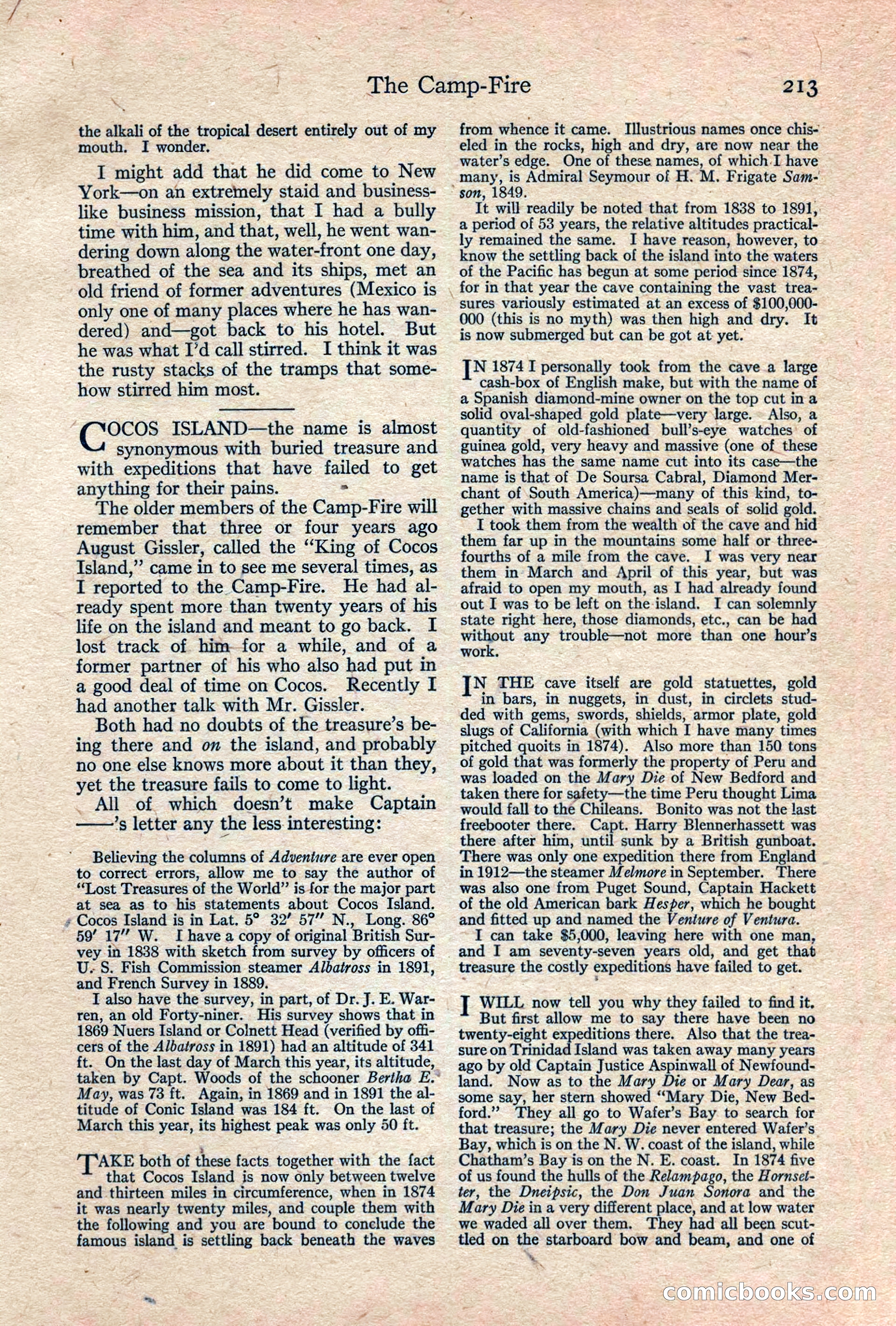
A restored page from Pulp Fiction, 1917. Page through the whole issue in the reader above.
📄 Transcribed text from this page (OCR, searchable)
Machine-transcribed from the original scan — historical spelling and the odd misread are preserved.
a good deal of time on Cocos. Ray The Camp-Fire . the alkali of the tropical desert entirely out of my mouth. I wonder. I might add that he did come to New York—on an extremely staid and business- like business mission, that I had a bully time with him, and that, well, he went wan- dering down along the water-front one day, - breathed of the sea and its ships, met an old friend of former adventures (Mexico is only one of many places where he has wan- dered) and—got back to his hotel. But he was what I’d call stirred. I think it was the rusty stacks of the tramps that some- how stirred him most. OCOS ISLAND—the name is almost synonymous with buried treasure and with expeditions that have failed to get anything for their pains. - The older members of the Camp-Fire will remember that three or four years ago August Gissler, called the “King of Cocos Island,”’ came in to see me several times, as I reported to the Camp-Fire. He had al- ready spent more than twenty years of his life on the island and meant to go back. I lost track of him for a while, and of a former partner of his who also had put in Recently I had another talk with Mr. Gissler. Both had no doubts of the treasure’s be- ing there and om the island, and probably no one else knows more about it than they, yet the treasure fails to come to light. - All of which doesn’t make Captain ——’s letter any the less interesting: Believing the columns of Adveniure are ever open to correct errors, allow me to say the author of “Lost Treasures of the World” is for the major part at sea as to his statements about Cocos Island. Cocos Island is in Lat. 5° 32’ 57” N., Long. 86° _ 69 17” W. I have a copy of original British Sur- vey in 1838 with sketch from survey by officers of | U.S. Fish Commission steamer Albatross in 1891, and French Survey in 1889. . I also have the survey, in part, of Dr. J. E. War- ren, an old Forty-niner. His survey shows that in 1869 Nuers Island or Colnett Head (verified by off- cers of the Albatross in 1891) had an altitude of 341 ft. On the last day of March this year, its altitude, taken by Capt. Woods of the schooner Bertha E.~ May, was 73 ft. Again, in 1869 and in 1891 the al- titude of Conic Island was 184 ft. On the last of March this year, its highest peak was only 50 ft. ‘TAKE both of these facts together with the fact that Cocos Island is now only between twelve and thirteen miles in circumference, when in 1874 it was nearly twenty miles, and couple them with the following and you are bound to conclude the famous island is settling back beneath the waves 213 from whence it came. Illustrious names once chis-— eled in the rocks, high and dry, are now near the water’s edge. One of these names, of which. I have _many, is Admiral Seymour of H. M. Frigate Sam- son, 1849. . It will readily be noted that from 1838 to 1891, a period of 53 years, the relative altitudes practical- ly remained the same. I have reason, however, to know the settling back of the island into the waters of the Pacific has begun at some period since 1874, _ for in that year the cave containing the vast trea- sures variously estimated at an excess of $100,000- 000 (this is no myth) was then high and dry. It is now submerged but can be got at yet. IN 1874 I personally took from the cave a large cash-box of English make, but with the name of a Spanish diamond-mine owner on the top cut ina solid oval-shaped gold plate—very large. Also, a quantity of old-fashioned bull’s-eye watches’ of guinea gold, very heavy and massive (one of these watches has the same name cut into its case—the - name is that of De Soursa Cabral, Diamond Mer- chant of South America)—many of this kind, to- gether with massive chains and seals of solid gold. I took them from the wealth of the cave and hid them far up in the mountains some half or three- fourths of a mile from the cave. I was very near them in March and April of this year, but was afraid to open my mouth, as I had already found out I was to be left on the island. I can solemnly state right here, those diamonds, etc., can be had Lise ate any trouble—not more than one hour’s work. N THE cave itself are gold statuettes, gold in bars, in nuggets, in dust, in circlets stud- ded with gems, swords, shields, armor plate, gold slugs of California (with which I have many times pitched quoits in 1874). Also more than 150 tons of gold that was formerly the property of Peru and was loaded on the Mary Die of New Bedford and taken there for safety—the time Peru thought Lima would fall to the Chileans. Bonito was not the last freebooter there. Capt. Harry Blennerhassett was there after him, until sunk by a British gunboat. There was only one expedition there from England in 1912—the steamer Melmore in September. There was also one from Puget Sound, Captain Hackett of the old American bark Hesper, which he bought and fitted up and named the Venture of Ventura. I can take $5,000, leaving here with one man, and I am seventy-seven years old, and get that treasure the costly expeditions have failed to get. i WILL. now tell you why they failed to find it, But first allow me to say there have been no twenty-eight expeditions there. Also that the trea- sure on Trinidad Island was taken away many years ago by old Captain Justice Aspinwall of Newfound- land. Now as to the Mary Die or Mary Dear, as some say, her stern showed ‘‘Mary Die, New Bed- ford.” They all go to Wafer’s Bay to search for that treasure; the Mary Die never entered Wafer’s Bay, which is on the N. W. coast of the island, while Chatham’s Bay is on the N. E. coast. In 1874 five of us found the hulls of the Relampago, the Hornsei- ter, the Dneipsic, the Don Juan Sonora and the Mary Die in a very different place, and at low water we waded all over them. They had all been scut- tled on the starboard bow and beam, and one of * MUICLOOOKS (©)