
Pulp Fiction, 1917 · page 22 of 228
Adventure, February 1917 — page 22: what you’re looking at
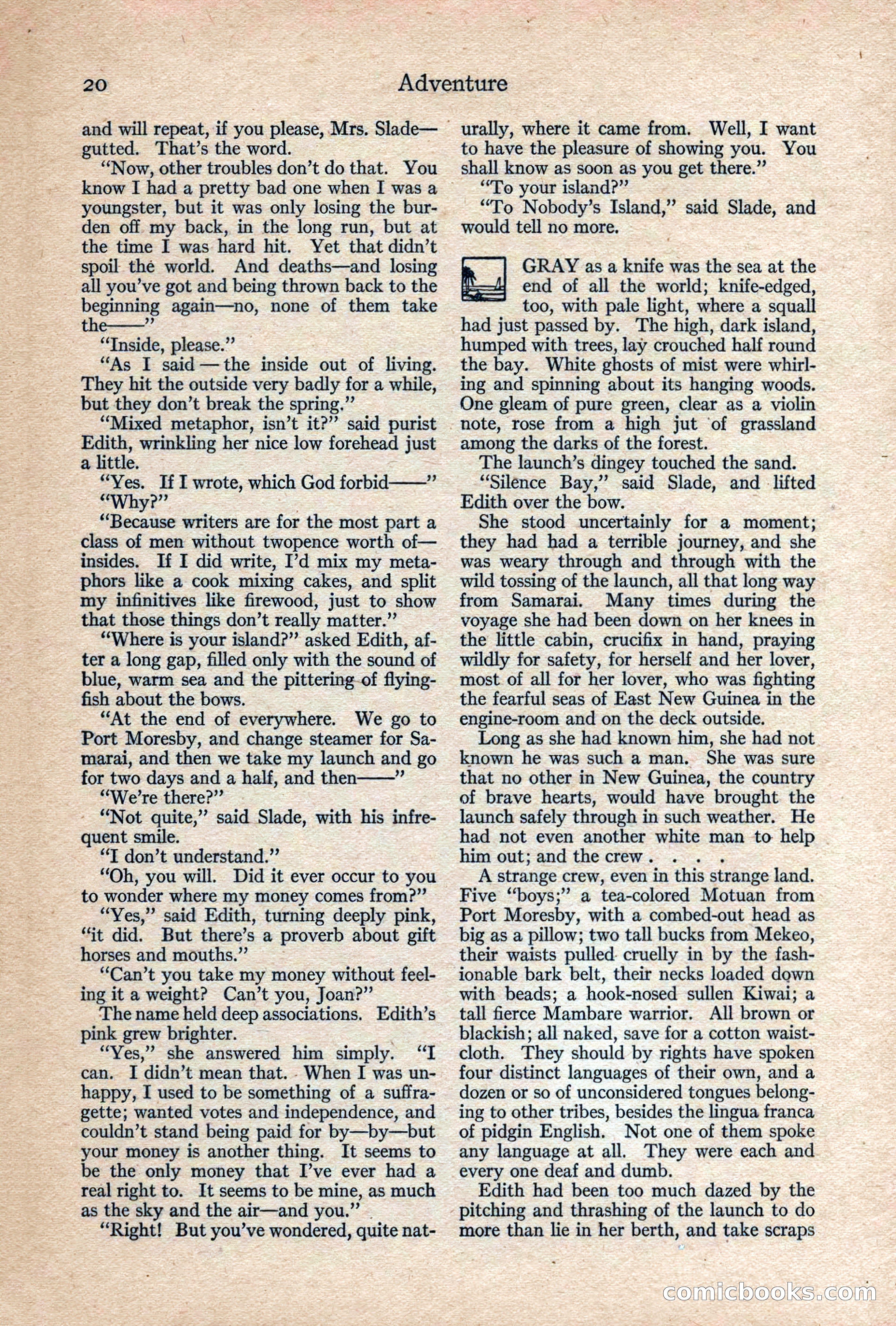
A restored page from Pulp Fiction, 1917. Page through the whole issue in the reader above.
📄 Transcribed text from this page (OCR, searchable)
Machine-transcribed from the original scan — historical spelling and the odd misread are preserved.
20 and will repeat, if you please, Mrs. Slade— © gutted. That’s the word. — “Now, other troubles don’t do that. You know I had a pretty bad one when I was a © youngster, but it was only losing the bur- den off my back, in the long run, but at the time I was hard hit. Yet that didn’t spoil the world. And deaths—and losing _ all you’ve got and being thrown back to the beginning again—no, none of them take the-——”’ “Inside, please.” — “As I said —the inside out of living. They hit the outside very badly for a while, but they don’t break the spring.” “Mixed metaphor, isn’t it?” said purist Edith, wrinkling her nice low forehead just alittle. — “Ves. If I wrote, which God forbid——” “Why?” “Because writers are for the most part a class of men without twopence worth of— insides. If I did write, I’d mix my meta- phors like a cook mixing cakes, and split my infinitives like firewood, just to show that those things don’t really matter.” “Where is your island?” asked Edith, af- ter a long gap, filled only with the sound of blue, warm sea and the pittering-of flying- fish about the bows. “At the end of everywhere. We go to Port Moresby, and change steamer for Sa- marai, and then we take my launch and go for two days and a half, and then——” “‘We’re there?” ~ “Not quite,’”’ said Slade, with his infre- quent : “T don’t understand.” “Oh, you will. Did it ever occur to you to wonder where my money comes from?” “Yes,” said Edith, turning deeply pink, ‘it did. But there’s a proverb about gift horses and mouths.” “Can’t you take my money without feel- ing it a weight? Can’t you, Joan?” The name held deep associations. Edith’s pink grew brighter. “Yes,” she answered him simply. “I can. I didn’t mean that. When I was un- happy, I used to be something of a suffra- gette; wanted votes and independence, and - couldn’t stand being paid for by—by—but your money is another thing. It seems to be the only money that I’ve ever had a real right to. It seems to be mine, as much as the sky and the air—and you.” - “Right! But you’ve wondered, quite nat- Adventure urally, where it came from. Well, I want to have the pleasure of showing you. You shall know as soon as you get there.” “To your island?” “To Nobody’s Island,” said Slade, and would tell no more. GRAY as a knife was the sea at the end of all the world; knife-edged, too, with pale light, where a squall had just passed by. The high, dark island, humped with trees, lay crouched half round the bay. White ghosts of mist were whirl- ing and spinning about its hanging woods. One gleam of pure green, clear as a violin -note, rose from a high jut of grassland among the darks of the forest. The launch’s dingey touched the sand. “Silence Bay,’ said Slade, and lifted Edith over the bow. She stood uncertainly for a moment; they had had a terrible journey, and she was weary through and through with the wild tossing of the launch, all that long way from Samarai. Many times during the voyage she had been down on her knees in the little cabin, crucifix in hand, praying wildly for safety, for herself and her lover, most of all for her lover, who was fighting the fearful seas of East New Guinea in the engine-room and on the deck outside. Long as she had known him, she had not known he was such a man. She was sure that no other in New Guinea, the country of brave hearts, would have brought the launch safely through in such weather. He had not even another white man to help him out; and the crew . A strange crew, even in this strange land. Five “boys;” a tea-colored Motuan from Port Moresby, with a combed-out head as big as a pillow; two tall bucks from Mekeo, their waists pulled: cruelly in by the fash- ionable bark belt, their necks loaded down with beads; a hook-nosed sullen Kiwai; a tall fierce Mambare warrior. All brown or blackish; all naked, save for a cotton waist- cloth. They should by rights have spoken four distinct languages of their own, and a dozen or so of unconsidered tongues belong- ing to other tribes, besides the lingua franca of pidgin English. Not one of them spoke any language at all. They were each and every one deaf and dumb. Edith had been too much dazed by the pitching and thrashing of the launch to do more than lie in her berth, and take scraps COPICLOOOKS (E©)