
Pulp Fiction, 1917 · page 34 of 228
Adventure, February 1917 — page 34: what you’re looking at
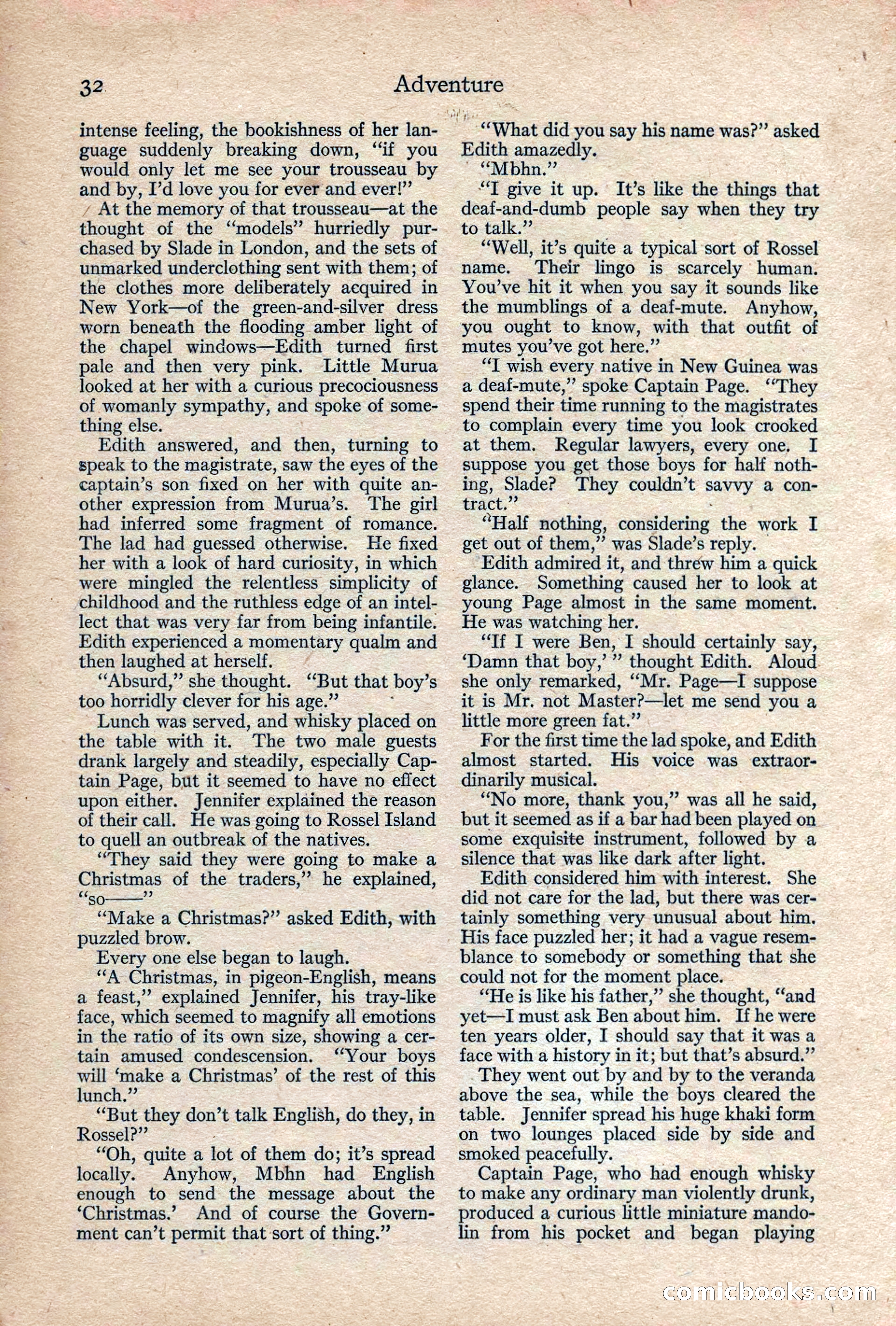
A restored page from Pulp Fiction, 1917. Page through the whole issue in the reader above.
📄 Transcribed text from this page (OCR, searchable)
Machine-transcribed from the original scan — historical spelling and the odd misread are preserved.
35 intense feeling, the bookishness of her lan- | guage suddenly breaking down, “if you would only let me see your trousseau by and by, I’d love you for ever and ever!”’ / At the memory of that trousseau—at the thought of the “models” hurriedly pur- chased by Slade in London, and the sets of unmarked underclothing sent with them; of the clothes more deliberately acquired in New York—of the green-and-silver dress worn beneath the flooding amber light of the chapel windows—Edith turned first pale and then very pink. Little Murua looked at her with a curious precociousness of womanly sympathy, and spoke of some- thing else. Edith answered, and then, turning to speak to the magistrate, saw the eyes of the captain’s son fixed on her with quite an- other expression from Murua’s. The girl had inferred some fragment of romance. The lad had guessed otherwise. He fixed her with a look of hard curiosity, in which | were mingled the relentless simplicity of childhood and the ruthless edge of an intel- lect that was very far from being infantile. Edith experienced a momentary qualm and then laughed at herself. “Absurd,” she thought. “But that boy’ S too horridly clever for his age.” Lunch was served, and whisky placed on the table with it. The two male guests drank largely and steadily, especially Cap- tain Page, but it seemed to have no effect upon either. Jennifer explained the reason of their call. He was going to Rossel Island to quell an outbreak of the natives. “They said they were going to make a Christmas of the traders,’ he explained, bs 6 Ge? “Make a Christmas?” asked Edith, with puzzled brow. Every one else began to laugh. “A Christmas, in pigeon-English, means a feast,” explained Jennifer, his tray-like face, which seemed to magnify all emotions in the ratio of its own size, showing a cer- tain amused condescension. ‘Your boys will ‘make a Christmas’ of the rest of this lunch.” “But they don’t talk English, do they, in Rossel?” “Oh, quite a lot of them do; it’s spread locally. Anyhow, Mbhn had English enough to send the message about the ‘Christmas.’ And of course the Govern- ment can’t permit that sort of thing.” Adventure “What did you say his name was?” asked Edith amazedly. Oe *‘M bhn.”’ “T give it up. It’s like the things that ig Sn oat people say when they try to talk.” “Well, it’s quite a typical sort of Rossel name. Their lingo is scarcely human: You’ve hit it when you say it sounds like the mumblings of a deaf-mute. Anyhow, you ought to know, with that outfit of mutes you’ve got here.” “T wish every native in New Guinea was a deafi-mute,’’ spoke Captain Page. ‘“They spend their time running to the magistrates to complain every time you look crooked at them. Regular lawyers, every one. I suppose you get those boys for half noth- ing, Slade? They couldn’t Savvy a con- tract.” “Half nothing, epueidering the work I get out of them,” was Slade’s reply. Edith admired it, and threw him a quick glance. Something caused her to look at young Page almost in the same moment. He was watching her. “Tf I were Ben, I should certainly say, ‘Damn that boy,’ ” thought Edith. Aloud. she only remarked, ‘““Mr. Page—I suppose it is Mr. not Master?-—let me send you a little more green fat.” For the first time the lad spoke, and Edith almost started. His voice was extraor- dinarily musical. “‘No more, thank you,” was all he said, but it seemed as if a bar had been played on some exquisite instrument, followed by a silence that was like dark after light. Edith considered him with interest. She did not care for the lad, but there was cer- tainly something very unusual about him. His face puzzled her; it had a vague resem- blance to somebody or something that she could not for the moment place. “He is like his father,” she thought, “ard yet—I must ask Ben about him. If he were ten years older, I should say that it was a face with a history in it; but that’s absurd.” They went out by and by to the veranda above the sea, while the boys cleared the table. Jennifer spread his huge khaki form on two lounges placed side by side and smoked peacefully. : Captain Page, who had enough whisky to make any ordinary man violently drunk, produced a curious little miniature mando- lin from his pocket and began playing CEORMMICIOO“KS (C (©)