
Pulp Fiction, 1917 · page 36 of 228
Adventure, February 1917 — page 36: what you’re looking at
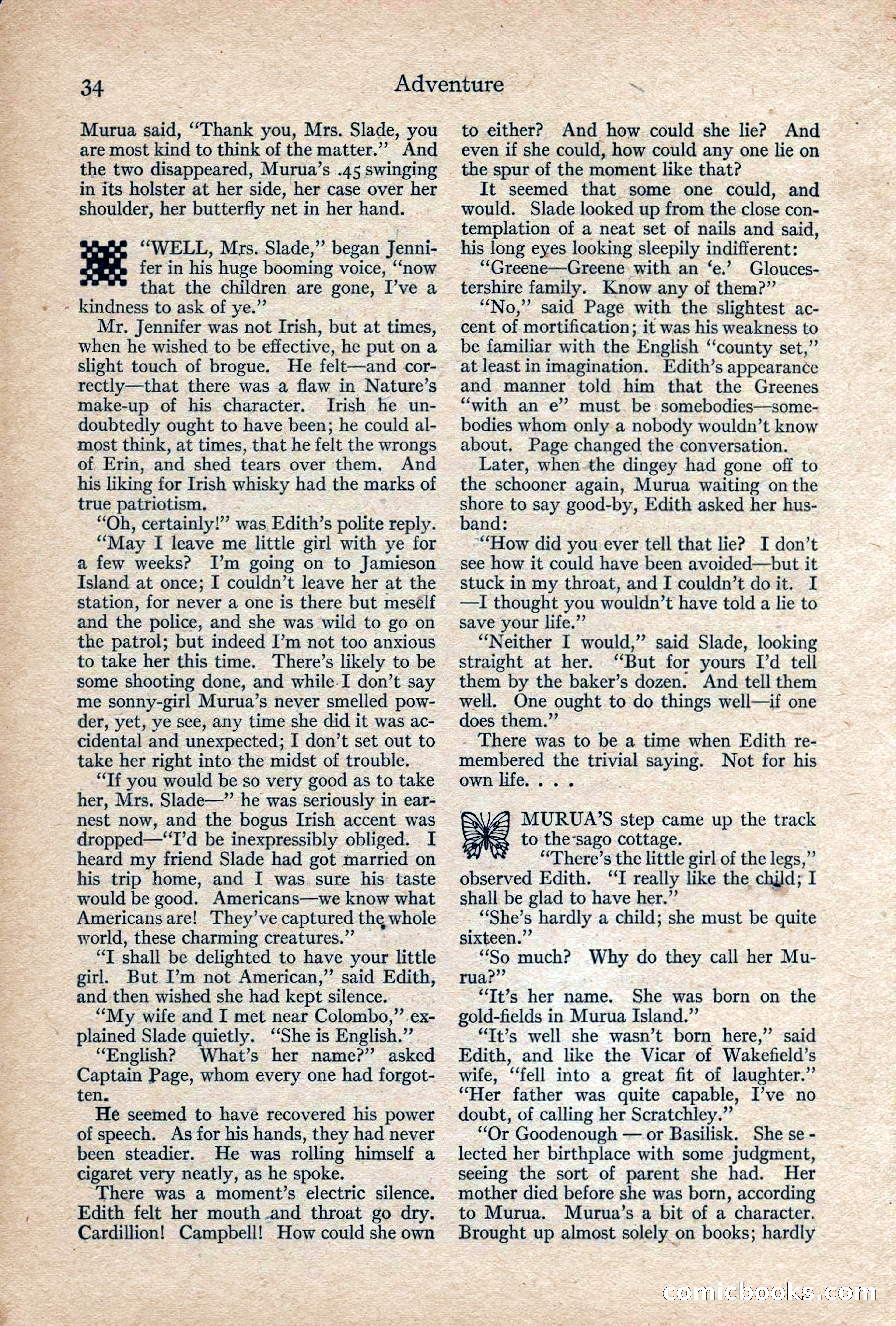
A restored page from Pulp Fiction, 1917. Page through the whole issue in the reader above.
📄 Transcribed text from this page (OCR, searchable)
Machine-transcribed from the original scan — historical spelling and the odd misread are preserved.
34 Murua said, “Thank you, Mrs. Slade, you are most kind to think of the matter.”” And the two disappeared, Murua’s .45 swinging in its holster at her side, her case over her shoulder, her butterfly net in her hand. ae “WELL, Mrs. Slade,” began Jenni- fer in his huge booming voice, “‘now - kindness to ask of ye.” Mr. Jennifer was not Irish, but at times, when he wished to be effective, he put on a slight touch of brogue. He felt—and cor- rectly—that there was a flaw in Nature’s make-up of his character. Irish he un- doubtedly ought to have been; he could al- most think, at times, that he felt the wrongs of Erin, and shed tears over them. And his liking for Irish whisky had the marks of true patriotism. “Oh, certainly!’ was Edith’s polite reply. “May I leave me little girl with ye for a few weeks? I’m going on to Jamieson Island at once; I couldn’t leave her at the station, for never a one is there but mesélf and the police, and she was wild to go on the patrol; but indeed I’m not too anxious to take her this time. There’s likely to be some shooting done, and while-I don’t say me sonny-girl Murua’s never smelled pow- der, yet, ye see, any time she did it was ac- cidental and unexpected; I don’t set out to take her right into the midst of trouble. “Tf you would be so very good as to take her, Mrs. Slade—” he was seriously in ear- nest now, and the bogus Irish accent was dropped—“‘I’d be inexpressibly obliged. I heard my friend Slade had got married on his trip home, and I was sure his taste - would be good. Americans—we know what Americans are! They’ve captured the whole world, these charming creatures.” “T shall be delighted to have your little girl, But I’m not American,” said Edith, and then wished she had kept silence. “My wife and I met near Colombo,” ex- plained Slade quietly. “She is English.” “English? What’s her name?” asked Captain Page, whom every one had forgot- ten. He seemed to have recovered his power of speech. As for his hands, they had never been steadier. He was rolling himself a cigaret very neatly, as he spoke. There was a moment’s electric silence. Edith felt her mouth and throat go dry. Cardillion! Campbell! How could she own that the children are gone, I’ve a _ _ Adventure — to either? And how could she lie? And even if she could, how could any one lie on the spur of the moment like that? It seemed that some one could, and would. Slade looked up from the close con- templation of a neat set of nails and said, his long eyes looking sleepily indifferent: ““Greene—Greene with an ‘e.’? Glouces- tershire family. Know any of them?” “No,” said Page with the slightest ac- cent of mortification; it was his weakness to be familiar with the ‘English “county set,” at least in imagination. Edith’s appearance and manner told him that the Greenes “with an e” must. be: somebodies—some- bodies whom only a nobody wouldn’t know about, Page changed the conversation. Later, when the dingey had gone off to the schooner again, Murua waiting on the shore to say peas Edith asked her hus- band: “How did you ever tell that lie? I don’t see how it could have been avoided—but it stuck in my throat, and I couldn’t doit. I —I thought you wouldn’t have told a lie to save your life.”’ “Neither I would,” said Slade, looking straight at her. “But for yours I'd tell them by the baker’s dozen. And tell them well. One ought to do things well—if one does them.” - There was to be a time when Edith re- membered the trivial saying. Not for his own life... . 3 MURUA’S step came up the track to the-sago cottage. “*There’s the little girl of the legs,” observed Edith. “TI really like the child; I shall be glad to have her.” “one° s hardly a child; she must be quite sixteen.” “So much? Why do they call her Mu- rua?” “Tt’s her name. She was born on the gold-fields in Murua Island.” “Tt’s well she wasn’t born here,” said Edith, and like the Vicar of Wakefield’s wife, ‘‘fell into a great fit of laughter.” “Her father was quite capable, I’ve no doubt, of calling her Scratchley.”’ “Or Goodenough — or Basilisk. She se - lected her birthplace with some judgment, seeing the sort of parent she had. Her mother died before she was born, according to Murua. Murua’s a bit of a character. Brought up almost solely on books; hardly GEomicbooks (€@)